

, OH
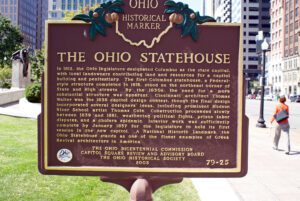
In 1812, the Ohio legislature designated Columbus as the state capital, with local landowners contributing land and resources for a capitol building and penitentiary. The first Columbus statehouse, a Federal-style structure completed in 1816, stood on the northeast corner of State and High streets. By the 1830s, the need for a more substantial structure was apparent. Cincinnati architect Thomas Walter won the 1838 capitol design contest, though the final design incorporated several designers’ ideas, including prominent Hudson River School artist Thomas Cole. Construction proceeded slowly between 1839 and 1861, weathering political fights, prison labor disputes, and a cholera epidemic. Interior work was sufficiently complete by January 1857 for the legislature to hold its first session in the new capitol. A National Historic Landmark, the Ohio Statehouse stands as one of the finest examples of Greek Revival architecture in America.
, OH
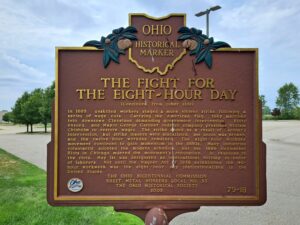
Organized efforts to establish an eight-hour workday existed as early as 1866 in the United States. The Cleveland Rolling Mills Strikes of 1882 and 1885, as part of this almost-70-year struggle, contributed to the establishment of the eight-hour workday. Both strikes challenged the two-shift, twelve-hour workday in addition to seeking recognition of the Amalgamated Association of Iron, Steel, and Tin Workers. The first strike – by English, Welsh, and Irish skilled workers – was at the Newburgh Rolling Mills, a major producer of steel rails for the rapidly expanding railroad industry that once stood near this site. It was quickly broken when unskilled Polish and Czech immigrants, unaware of the ongoing labor dispute, were hired. The strike ended when these new workers did not support the union. (continued on other side)
, OH
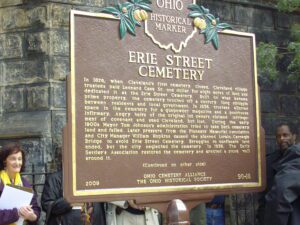
In 1826, when Cleveland’s first cemetery closed, Cleveland village trustees paid Leonard Case Sr. one dollar for eight acres of land and dedicated it as the Erie Street Cemetery. Built on what became prime property, the cemetery touched off a century long struggle between residents and local government. In 1836, trustees allotted space in the cemetery for a gunpowder magazine and a poorhouse infirmary. Angry heirs of the original lot owners claimed infringement of covenant and sued Cleveland, but lost. During the early 1900s Mayor Tom Johnson’s administration tried to take back cemetery land and failed. Later pressure from the Pioneers’ Memorial Association and City Manager William Hopkins caused the planned Lorain Carnegie Bridge to avoid Erie Street Cemetery. Struggles to confiscate land ended, but the city neglected the cemetery. In 1939, The Early Settler’s Association restored the cemetery and erected a stone wall around it. (continued on other side)
, OH
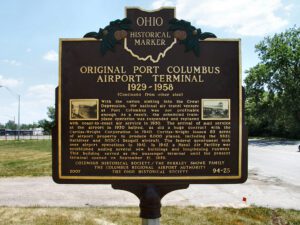
The original Port Columbus Airport terminal was founded by the people of Columbus and was one of the first airport facilities in the United States. Dedicated on July 8, 1929, Port Columbus was the first transfer point in the westbound transcontinental passenger service, which was operated by the Pennsylvania Railroad, Transcontinental Air Transport (TAT), and the Santa Fe Railway. Its first passengers departed by rail from New York City on July 7, 1929, and boarded TAT Ford Tri-Motor aircraft at Port Columbus to fly to Waynoka, Oklahoma, the following day. They then traveled by rail to Clovis, New Mexico, and completed their journey with a TAT flight to Los Angeles. The scheduled 48-hour trip was celebrated in Columbus, marking the beginning milestone of national airport travel. (continued on other side)
, OH
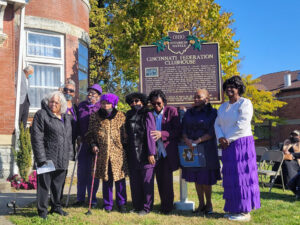
“Lifting As We Climb”: The Cincinnati Federation of Colored Women’s Clubs (CFCWC) was organized May 6, 1904, during a meeting called by Mary Fletcher Ross at the Allen Temple A.M.E. Church. Gathering together eight existing African-American women’s clubs, the CFCWC sought to unite in their work promoting “the betterment of the community.” At a time when both government and private philanthropies overlooked the needs of Black Americans, CFCWC members helped to organize the city’s first kindergartens for Black children, taught in Cincinnati African-American public schools –including the Walnut Hills Douglass and Stowe schools—and raised money for the Home of Aged Colored Women. Since 1904, the Cincinnati Federation of Colored Women’s Clubs has ensured the civic and constitutional rights of all African Americans while meeting the needs of their city.
, OH
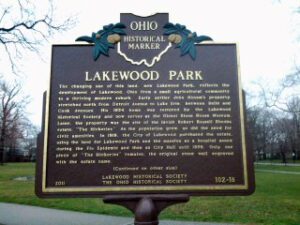
The changing use of this land, now Lakewood Park, reflects the development of Lakewood, Ohio from a small agricultural community to a thriving modern suburb. Early settler John Honam’s property stretched north from Detroit Avenue to Lake Erie, between Belle and Cook Avenues. His 1834 home was restored by the Lakewood Historical Society and now serves as the Oldest Stone House Museum. Later, the property was the site of the lavish Robert Russell Rhodes estate, “The Hickories.” As the population grew, so did the need for civic amenities. In 1919, the City of Lakewood purchased the estate, using the land for Lakewood Park and the mansion as a hospital annex during the Flu Epidemic and then as City Hall until 1959. Only one piece of “The Hickories” remains; the original stone wall engraved with the estate name.
, OH
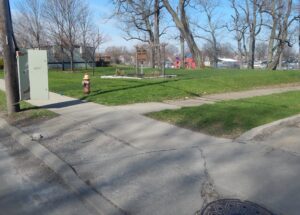
By 1922, the Ambler Realty Company of Cleveland owned this site along with 68 acres of land between Euclid Avenue and the Nickel Plate rail line. Upon learning of the company’s plans for industrial development, the Euclid Village Council enacted a zoning code based on New York City’ building restrictions. Represented by Newton D. Baker, former Cleveland mayor and U.S. Secretary of War under Woodrow Wilson, Ambler sued the village claiming a loss of property value. In 1926, the U.S. Supreme Court ruled in favor of Euclid and upheld the constitutionality of zoning and land-use regulations by local governments. The federal government eventually acquired the Ambler site during World War II to build a factory to make aircraft engines and landing gear. From 1948 to 1992, the site was used as a production facility by the Fisher Body Division of General Motors.
, OH
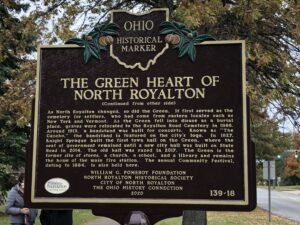
Bounded by Ridge, Royalton, and Bennett Roads, the Green has been the heart of North Royalton even before it was incorporated. Once part of Brecksville Township, Royalton became its own township in 1818. Local lore says that settlers David and Knight Sprague paid a gallon of whiskey to name the community after their hometown of Royalton, Vermont. In 1825, John Watkins sold five acres to create this Green, so that the township could have a cemetery, a public square, and a place for public buildings. In 1885, “North” was added to “Royalton” to distinguish it from another Royalton in Ohio. Formerly a small agricultural community known for milk and cheese production, as well as nurseries, North Royalton became a Cleveland suburb following World War II. North Royalton incorporated as a village in 1927 and became city in 1961. (Continued on other side)