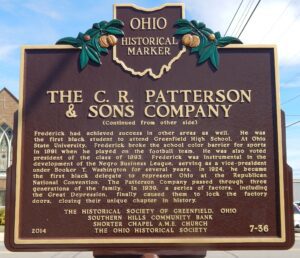
The factory of the C. R. Patterson & Sons Company once stood near here at 138 N. Washington Street. Established in the mid-nineteenth century by the black businessman Charles Richard (C. R.) Patterson and his white partner, J. P. Lowe, the business, originally known as J. P. Lowe & Company, became a successful carriage firm. Patterson became the sole owner in 1893 and changed the name to C. R. Patterson & Sons. After succeeding his father as owner, C. R.’s son, Frederick, became the first known African-American automobile manufacturer. Under his leadership, the company transitioned from building carriages to automobiles, then to trucks and buses to keep up with the changing demands of the transportation industry. (Continued on other side)
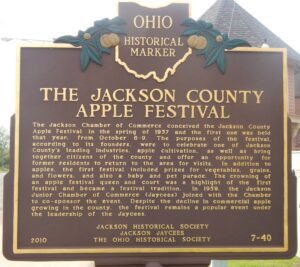
The Jackson Chamber of Commerce conceived the Jackson County Apple Festival in the spring of 1937 and the first one was held that year, from October 6-9. The purposes of the festival, according to its founders, were to celebrate one of Jackson County’s leading industries, apple cultivation, as well as bring together citizens of the county and offer an opportunity for former residents to return to the area for visits. In addition to apples, the first festival included prizes for vegetables, grains, and flowers, and also a baby and pet parade. The crowning of an apple festival queen and court was a highlight of the first festival and became a festival tradition. In 1959, the Jackson Junior Chamber of Commerce (Jaycees) joined with the Chamber to co-sponsor the event. Despite the decline in commercial apple growing in the county, the festival remains a popular event under the leadership of the Jaycees.
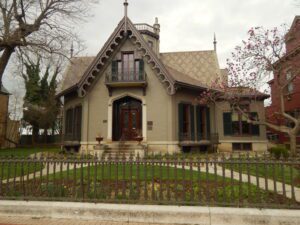
James Elrick, a local carpenter, built the Lane-Hooven House in 1863 for Clark Lane (1823-1907), a Hamilton industrialist and philanthropist. Lane, who first came to the area at age twenty-one as a blacksmith, resided in the house for more than eleven years. In 1866, Lane built the library, also originally an octagon, across the street. In 1868, he conveyed the library to the city. The C. Earl Hooven family resided in the house from 1895 to 1942. In 1943, Bertrand Kahn purchased the residence and presented it to the community for civic and charitable uses. It was donated as a memorial to his father, Lazard Kahn, a Hamilton industrialist and civic leader. The Lane-Hooven House was added to the National Register of Historic Places in 1973. (Continued on other side)
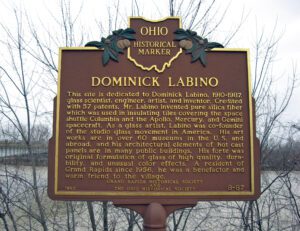
This site is dedicated to Dominick Labino, 1910-1987, glass scientist, engineer, artist, and inventor. Credited with 57 patents, Mr. Labino invented pure silica fiber which was used in insulating tiles covering the space shuttle Columbia and the Apollo, Mercury, and Gemini spacecraft. As a glass artist, Labino was co-founder of the studio glass movement in America. His art works are in over 60 museums in the U.S. and abroad, and his architectural elements of hot cast panels are in many public buildings. His forte was original formulation of glass of high quality, durability, and unusual color effects. A resident of Grand Rapids since 1956, he was a benefactor and warm friend to the village.
745 Davids Drive (is across the street from Greenway sign and pull-in)
Wilmington
, OH
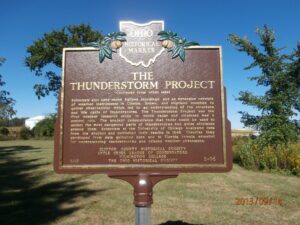
Before and during World War II, the aviation industry was vulnerable to adverse weather conditions, particularly thunderstorms. In 1945, Congress mandated the nation’s first large-scale, scientific study of thunderstorms. The Thunderstorm Project was a cooperative undertaking of the U.S. Weather Bureau, Army Air Force, Navy, and the National Advisory Committee for Aeronautics (predecessor of NASA). The first phase of the project was conducted in Florida in 1946 and the second phase in Clinton County in 1947, partly because weather fronts frequently pass through this area. Pilots from the Clinton County Army Air Force Base made many flights through storms of varying intensities and all stages of development. (Continued on other side)
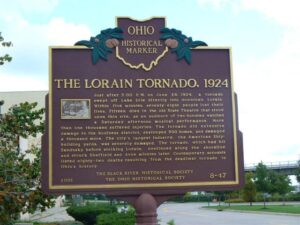
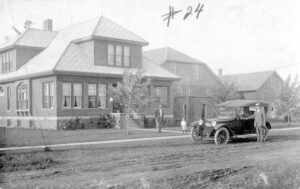
Just after 5:00 P.M on June 28, 1924, a tornado swept off Lake Erie directly into downtown Lorain. Within five minutes, seventy-eight people lost their lives. Fifteen died in the old State Theatre that stood upon this site, as an audience of two hundred watched a Saturday afternoon musical performance. More than one thousand suffered injuries. The tornado did extensive damage to the business district, destroyed 500 homes, and damaged a thousand more. The city’s largest industry, the American Shipbuilding yards, was severely damaged. The tornado, which had hit Sandusky before striking Lorain, continued along the shoreline and struck Sheffield and Avon minutes later. Contemporary accounts listed eighty-two deaths resulting from the deadliest tornado in Ohio’s history.
Nicknamed “Dutchtown” for the many German families that settled in this area, New Washington was platted in 1833 by George Washington Meyers, who arrived in Cranberry Township in 1826. Prominent Austrian romantic poet Nicholas Lenau (1802-1850), author of “Faust” and “Don Juan,” owned property here in the 1830s. The village incorporated in 1874, shortly following the arrival of the Mansfield, Coldwater & Lake Erie Railroad. New Washington is a pioneer in the commercial poultry hatchery industry and initiated the shipment of baby chicks by rail in 1900.
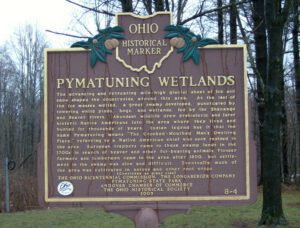
The advancing and retreating mile-high glacial sheet of ice and snow shaped the countryside around this area. As the last of the ice masses melted, a great swamp developed, punctuated by towering white pines, bogs, and wetlands, fed by the Shenango and Beaver rivers. Abundant wildlife drew prehistoric and later historic Native Americans into the area where they lived and hunted for thousands of years. Indian legend has it that the name Pymatuning means “The Crooked-Mouthed Man’s Dwelling Place,” referring to a Native American chief who once resided in the area. European trappers came to these swamp lands in the 1700s in search of beaver and other fur-bearing animals. Pioneer farmers and lumbermen came to the area after 1800, but settlement in the swamp was slow and difficult. Eventually much of the area was cultivated in onions and other root crops. (continued on other side)