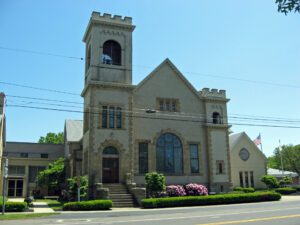
On this site, the Canfield Congregational Church, the first church in Canfield village, was built in 1822. The congregation was organized in 1804 by Joseph Badger and Thomas Robbins, both missionaries from the Connecticut Missionary Society. This was the fifth Congregational Church organized west of the Allegheny Mountains and the fourth organized on the Western Reserve. In 1853, there was a division in the church and a faction split off to form the Canfield Presbyterian Society. In 1837, an antislavery speech was given by Reverend Miller from the Poland Methodist Church. A rowdy group of outsiders protested his words and threw eggs onto the pulpit. They waited for him outside with tar and feathers, but the ladies of the church hastily escorted him out the back door to his horse and buggy, and he made a hasty and safe departure. The Bible with egg on it is displayed in the church.
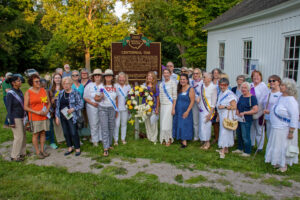
The Newbury Woman Suffrage Political Club, headquartered at Union Chapel, planted the Centennial Oak on July 4, 1876. The White Oak (Quercus alba) was chosen for its endurance, longevity, and beauty. The picnic and planting celebration included speeches, songs, fireworks, and a poem dedicated to the Oak written by local suffragist Anna Green. As the club gained national recognition, it attracted such notable suffragists as Susan B. Anthony and Harriet Taylor Upton as visitors and speakers. A Newbury gathering on August 23, 1919, held to celebrate Ohio’s recent ratification of the 19th Amendment, included suffragists Upton and Frances Jennings Casement. The last living founding member of Newbury’s Woman Suffrage Club, Dr. Julia Porter Green, led a parade from the chapel to Centennial Oak. There she placed a wreath of evergreen and goldenglow upon the tree.
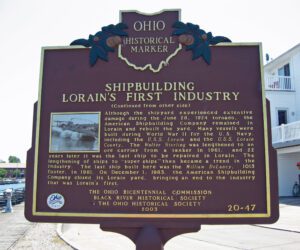
Lorain’s shipbuilding industry began when Augustus Jones and William Murdock began constructing wooden sailing vessels on the west side near the mouth of the Black River. The sloop General Huntington was the first boat launched from Lorain in 1819. In 1897, the shipbuilding industry moved to the east side of the river with the establishment of the Lorain yard of the Cleveland Shipbuilding Company, the precursor of the American Shipbuilding Company. In 1898, they were the largest dry dock on the Great Lakes. On April 13, 1898, the first steel ship, the Superior City, was launched. At the time, it was the largest vessel on fresh water. During the early years well-known passenger ships, railroad car ferries, tankers, self-unloaders, tugs, and barges were built here.
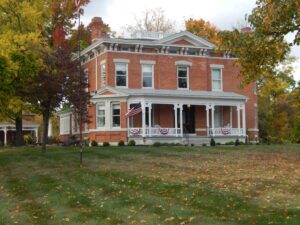
Built of bricks of clay from the Little Miami River, the King Mansion has stood majestically overlooking the town of Kings Mills since 1885. The home of industrialist Ahimaaz King and the first house in Kings Mills, this 12-room, three-story Italianate-style house is crowned with a widow’s walk and features stained-glass windows, distinctive fireplaces, and a tack room. The carriage house included a milking operation for cows on the lower level, stables on the main level, and carriage storage on the upper level. A cast iron fountain in the yard gave the name “Fountain Square” to the area. Occupied by three generations of Kings until 1988, the mansion was added to the National Register of Historic Places in 2008 and is a reminder of Ahimaaz King’s importance to the history of Kings Mills.
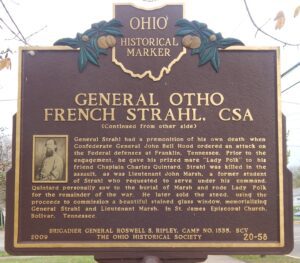
Born in 1832, Otho French Strahl grew up in Malta Township, Morgan County, Ohio. After attending Ohio Wesleyan University and teaching in a schoolhouse that stood on this site, he moved to Tennessee, becoming a successful attorney and landowner. Following the attack on Fort Sumter and President Abraham Lincoln’s call to arms, Strahl chose to stay and fight with his adopted state. Despite his northern roots, he was elected Captain of the Dyers Guards, his local volunteer unit in Tennessee. Two years later, he attained the rank of brigadier general in the Confederate army and served with distinction in some of the bloodiest battles of the Civil War. At the age of 32, Strahl was one of six Confederate generals killed or mortally wounded at the Battle of Franklin. He is buried in Old City Cemetery in Dyersburg, Tennessee. (continued on other side)
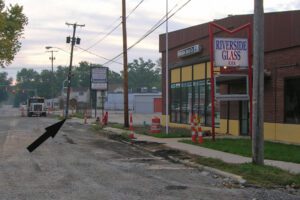
In 1884, the first natural gas well was successfully drilled in Findlay, and when The Great Karg Well, then the largest in the world, was drilled in 1886, the boom was on. Many industries, especially glass, were attracted to Findlay, lured by free or cheap gas for fuel. They included eight window, two bottle, two chimney lamp, one light bulb, one novelty, and five tableware glass factories. Famed manufacturing pioneer and inventor Mike Owens (later associated with Owens Illinois) managed the Richardson Glass Works, located at this site in 1891-1892. Tableware glass companies included Bellaire Goblet (1888-1892), Columbia Glass (1886-1892), Dalzell, Gilmore & Leighton (1888-1901), Findlay Flint Glass (1889-1991), and Model Flint Glass (1888-1893). Tableware companies employed women as decorators and packers. Hundreds of skilled glassworkers came from the eastern states of America, as well as Europe, especially Belgium, France, and Germany. Bottle glassworkers were among the first workers to unionize and to use collective bargaining.
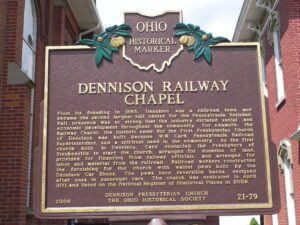
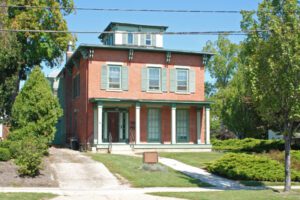
From its founding in 1865, Dennison was a railroad town and became the second largest rail center for the Pennsylvania Railroad. Rail presence was so strong that the industry dictated social and economic development throughout the community. For example, the Railway Chapel, the historic name for the First Presbyterian Church of Dennison was built because W.W. Card, Pennsylvania Railroad Superintendent, saw a spiritual need in the community. As the first church built in Dennison, Card contacted the Presbytery of Steubenville to start the church, arranged for donation of land, provided for financing from railway officials, and arranged for labor and material from the railroad. Railroad workers constructed the furnishing for the church with walnut pews built by the Dennison Car Shops. The pews have reversible backs, designed after ones in passenger cars. The church was dedicated in April 1871 and listed on the National Register of Historical Places in 2009.
Aluminum pioneer Charles Martin Hall was born in 1863 in Thompson, Ohio (Geauga County), and moved with his family to Oberlin in 1873. Hall graduated from Oberlin College in 1885, studying chemistry under Professor Frank Fanning Jewett (1844-1926). Jewett, who lived in this house from 1884 to 1923, encouraged Hall’s interest in chemistry and aluminum, then a semi-precious metal. Hall discovered an electrochemical reduction process for producing metallic aluminum from aluminum oxide dissolved in molten cryolite in his woodshed laboratory at his family’s home at 64 East College Street on February 23, 1886. This process, the culmination of research with Jewett, became the basis for the aluminum industry in America. In 1888 Hall co-founded the Pittsburgh Reduction Company, later the Aluminum Company of America (ALCOA). Upon his death in 1914, Hall left one-third of his estate to Oberlin College.