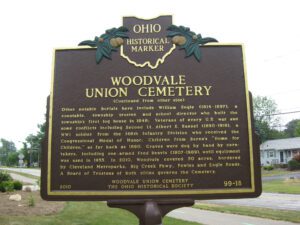
Woodvale Cemetery was established in the mid-1800s, in Middleburgh Township, Ohio. The oldest marked grave holds Fred G. Klink (1835-1858), whose family donated a half acre of land for burials. In 1876, Frank M. Stearns (1832-1911) suggested the unnamed cemetery be called Woodvale, after the wooded vale beside it. In 1908, a fire destroyed the caretaker’s house and many cemetery records. Woodvale became a non-profit, union cemetery in 1931, owned by Berea and the Village of Middleburg Hts. and covering 35 acres at 7535 Engle Road. Pioneer families buried here: Fowles, Kraft, Lovejoy, Sprague, and Stearns. Also buried here: John Baldwin (1799-1884) founder of Baldwin University and James Wallace (1878-1953) founder of German Wallace College (merged in 1913 to become Baldwin Wallace College) (Continued other side)
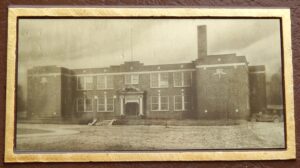
A bond issue passed by the voters of Parma and Parma Heights Township in 1919 funded the construction of Parma’s first high school. It was located at this site on Ridge Road, south of Ridgewood Drive (then Bean Road) and was dedicated in October 1921. Charles W. Bates designed the school as a single story building, but two years later a second story was added. The first graduating class in 1922 consisted of six students, two boys and four girls. In 1928, the land behind the school became the football field. The Parma High School building became a junior high in 1937 and then in the 1950s, Ridge Road Elementary. From 1962 to 2006 the old high school was the Parma City Schools’ Board of Education. The building was demolished in October 2010.
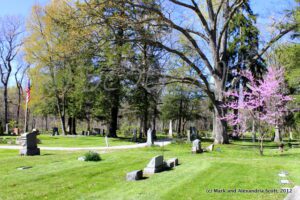
The northward course of the west branch of Rocky River forms a boundary for this cemetery, which lies above the river valley. Old trees convey stateliness and solemnity to these seven acres, often called “Turkey Foot” because turkeys roosted in the trees. Settlers from New England are buried here and include descendants of William Bradford, second governor of the Plymouth Colony. Julie Carter Northrop, granddaughter of one of Cleveland’s early settlers, Lorenzo Carter, is buried here. Veterans of six wars are honored here. The Daughters of the American Revolution recorded the cemetery’s tombstone engravings and cenotaphs in 1961. (Continued on other side)
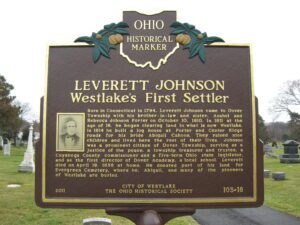
Born in Connecticut in 1794, Leverett Johnson came to Dover Township with his brother-in-law and sister, Asahel and Rebecca Johnson Porter on October 10, 1810. In 1811 at the age of 16, he began clearing land in what is now Westlake. In 1814 he built a log house at Porter and Center Ridge roads for his bride Abigail Cahoon. They raised nine children and lived here the rest of their lives. Johnson was a prominent citizen of Dover Township, serving as a justice of the peace, a township treasurer and trustee, a Cuyahoga County commissioner and a five-term Ohio state legislator, and as the first director of Dover Academy, a local school. Leverett died on April 19, 1856 at home. He donated part of his land for Evergreen Cemetery, where he, Abigail, and many of the pioneers of Westlake are buried.
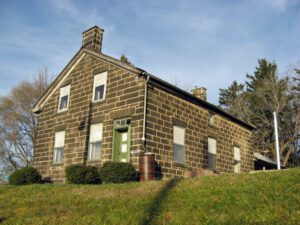
The Henninger Homestead was founded in an era when local quarries provided raw materials for the construction of the Ohio and Erie Canal. Bavarian immigrants Philip and Sophia Henninger came to Parma Township in 1840. Although Philip was a skilled tinsmith, he soon established a quarry on his property to supply sandstone for the breakwall of Cleveland’s harbor in Lake Erie, canal locks, and other building projects. In 1849, the Henningers replaced their log home with this Greek Revival house using stone from their quarry. Blocks at its base measure 30″ thick while upper walls are 14″ thick. Abandoned in 1988, the site was saved from demolition in 2003. The house and nearby carriage barn stand as the oldest buildings in the City of Parma.
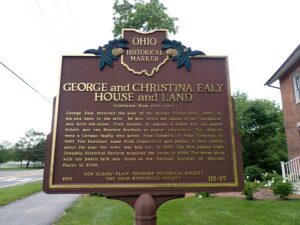
The George and Christina Ealy House is a testament to the prosperity of one of this area’s early residents and the skills of mid-nineteenth-century craftsmen. In 1830, members of the Ealy family moved from Pennsylvania to a 73-acre parcel where the house and six-acre Resch Park surrounding it are located. The Ealys were representative of a second wave of pioneers who settled Plain Township after 1812. The Ealys cleared land for farming and operated a sawmill on Rose Run. George prospered and in 1860 built this fine brick house. Architecturally, the house exhibits the transition between Greek Revival and Italianate styles. Its layout reflects the former; its proportions and decorative detail, the latter. (Continued on other side)
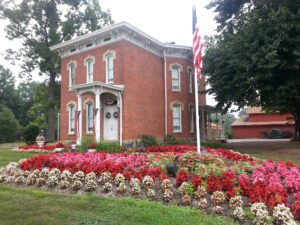
The Clague House and barn serve the community as a museum, history library, and a community theater. It is also a reminder of the area’s agrarian past and is a memorial to the philanthropic generosity of the Clagues. Robert Clague first came to Dover Township from the Isle of Man in 1829. Clague briefly returned to his native land; in 1837 he arrived back in Dover with his wife and infant. The couple raised nine children on the 78 acre farm. The Italianate structure, built in 1876, is the third home constructed on the Clague property. In 1926, surviving children Walter and Sophronia donated the farm to Dover Township for the creation of Clague Memorial Park.
The Clague House and barn serve the community as a museum, history library, and a community theater. It is also a reminder of the area’s agrarian past and is a memorial to the philanthropic generosity of the Clagues. Robert Clague first came to Dover Township from the Isle of Man in 1829. Clague briefly returned to his native land; in 1837 he arrived back in Dover with his wife and infant. The couple raised nine children on the 78 acre farm. The Italianate structure, built in 1876, is the third home constructed on the Clague property. In 1926, surviving children Walter and Sophronia donated the farm to Dover Township for the creation of Clague Memorial Park.