Poland Township Historical Society, 4515 Center Road
Lowellville
, OH
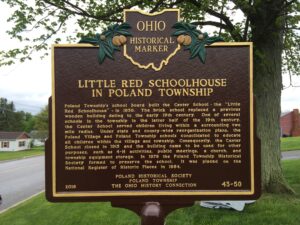
Poland Township’s school board built the Center School- the “Little Red Schoolhouse”- in 1858. The brick school replaced a previous wooden building dating to the early 19th century. One of several schools in the township in the latter half of the 19th century, the Center School served children living within a surrounding two mile radius. Under state and county-wide reorganization plans, the Poland Village and Poland Township schools consolidated to educate all children within the village and township. Consequently, the Center School closed in 1915 and the building came to be used for other purposes, such as 4-H activities, public meetings, a church, and township equipment storage. In 1979 the Poland Township Historical Society formed to preserve the school. It was placed on the National Register of Historic Places in 1984.
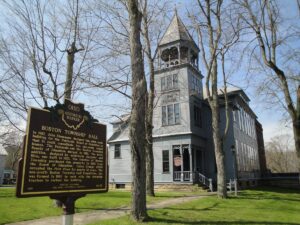
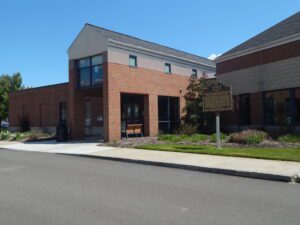
In 1887, John Eisenmann designed this stick-style building for the Peninsula Board of Education so that it could consolidate two one-room school houses. The Peninsula and the Boston Township Boards of Education merged in 1919. The brick addition, designed by architects Harpster and Bliss, was built in 1920. The trustees of Boston Township purchased this property in 1939 from the Board of Education. Union Grange #2380 occupied the first floor for nearly 50 years. The non-profit Boston Township Hall Committee, Inc. was formed in 1990 to work with the township trustees to restore the building.
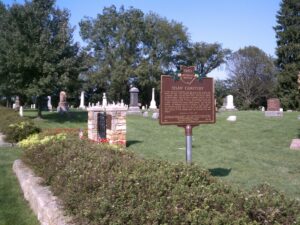
In 1829, Samuel and Charlotte Hale Shaw came to Bath Township from Bristol, New York. They purchased 145 acres of land where Samuel, a carpenter, built a two-story frame house. They had six children; two died in infancy. Their two year old daughter, Charlotte, was the first to be buried in Shaw Cemetery. They conveyed one half acre of land to the township for a “burying ground” in 1836. Samuel died in 1836; Charlotte then married Lyman Doolittle. They had five children; two daughters survived to adulthood. In 1892, Virgil E and Genevieve Doolittle Shaw sold one acre to Bath Township to expand Shaw Cemetery. Samuel’s parents, Constant and Mercy Pitts Shaw, migrated to Bath Township along with his brothers and their families.
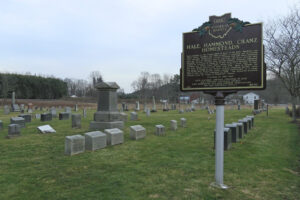
This cemetery is the resting place of many of the Hale, Hammond, and Cranz family members who were integral in founding and developing Bath Township. Connecticut natives Jonathan Hale and Jason Hammond were the first to purchase land in the area that would become Bath Township. In 1810, Jonathan Hale and his nephew, Theodore Hammond, arrived at Township 3, Range 12 of the Connecticut Western Reserve. Jonathan and Mercy Piper Hale’s family built a brick home in 1827. The Hale family lived in this home until 1956, when it became the Hale Farm & Village of the Western Reserve Historical Society. Jason and Rachel Hale Hammond’s family started construction on a frame home in 1818 that was completed in 1836. The Hammond property extended from the valley to Hammond’s Corners. (Continued on other side)
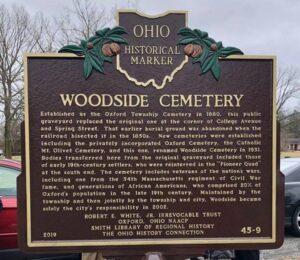
Established as the Oxford Township Cemetery in 1880, this public graveyard replaced the original one at the corner of College Avenue and Spring Street. That earlier burial ground was abandoned when the railroad bisected it in the 1850s. New cemeteries were established including the privately incorporated Oxford Cemetery, the Catholic Mt. Olivet Cemetery, and this one, renamed Woodside Cemetery in 1931. Bodies transferred here from the original graveyard included those of early 19th-century settlers, who were reinterred in the “Pioneer Quad” at the south end. The cemetery includes veterans of the nation’s wars, including one from the 54th Massachusetts regiment of Civil War fame, and generations of African Americans, who comprised 20% of Oxford’s population in the late 19th century. Maintained by the township and then jointly by the township and city, Woodside became solely the city’s responsibility in 2002.
John Richards Buchtel was born in Green Township, Ohio. A successful businessman and philanthropist, Buchtel was a leading spirit in the Akron Library Association. He donated to establish the Akron Public Library and served as the First Chairman of the Board. He also donated $31,000 in 1870 to found Buchtel College, which became The University of Akron in 1913, where he often paid the tuition of underprivileged students. He served as the college’s President of the Board of Trustees and served for the board of A & M University, which is now The Ohio State University.
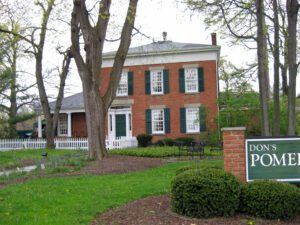
The Pomeroy House, built from 1847 to 1848, was the home of Alanson Pomeroy and his wife, Kezia. They continued the tradition, known as “Pomeroy Hospitality,” that began when Alanson’s parents established a tavern in Strongsville. Prominent in the community, Alanson served as township trustee and Justice of the Peace in Strongsville Township, and was a leader in the Congregational Church. Oral tradition holds that the Pomeroy House served as a stop on the Underground Railroad. Runaway slaves were brought from Oberlin, often concealed under bales of hay in wagons, and hidden in the cellar of the house until they could be safely taken to Rocky River. From there, the fugitives boarded ships headed to Canada. The Pomeroy House, listed on the National Register of Historic Places, was restored in 1979 and opened as Don’s Pomeroy House restaurant in 1980.
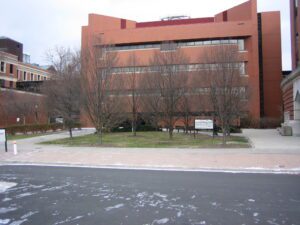
Roy J. Plunkett was born in New Carlisle, Ohio, and graduated from Newton Township High School in Pleasant Hill. He received his B.A. degree from Manchester College before enrolling as a graduate student in chemistry at The Ohio State University, receiving his Ph.D. in 1936 under the direction of William Lloyd Evans in the McPherson Chemical Laboratory. On April 6, 1938, while employed by the Du Pont Company to develop a nontoxic refrigerant, Plunkett discovered Teflon®, one of the most important polymers of the 20th century. On that day, Dr. Plunkett opened a tank of gaseous tetrafluoroethylene only to find that the gas was gone–its molecules had combined with another (“polymerized”) to form a solid material. Teflon has been used on cookware, the outer skin of space suits, nose cones of space vehicles, bone replacement, and much more.