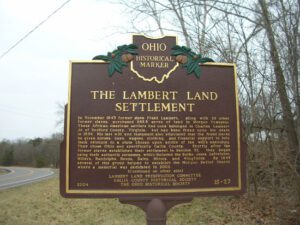
In November 1843 former slave Frank Lambert, along with 29 other former slaves, purchased 265.5 acres of land in Morgan Township. These African American settlers had once belonged to Charles Lambert Jr. of Bedford County, Virginia, but had been freed upon his death in 1839. His last will and testament also stipulated that the freed slaves be given horses, oxen, wagons, clothing, and financial support to help them relocate to a state chosen upon advise of the will’s executors. They chose Ohio and specifically Gallia County. Shortly after the former slaves established their settlement in Section 32, they began using their authentic surnames, which included the Burks, Jones, Leftwiches, Millers, Randolphs, Reeds, Sales, Minnis, and Wingfields. By 1845 several of this group helped to establish the Morgan Bethel Church where a memorial was dedicated in 2002. (continued on other side)
6750 Outville Road SW (take entrance road past the offices to township complex (more below)
Pataskala
, OH
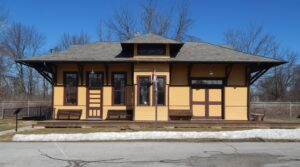
Arriving in 1853, the Central Ohio Railroad called this place “Kirkersville Station,” and it was later changed by stationmaster James Outcalt, who renamed the town Outville after himself. As rail traffic increased in Ohio, a successor company, the Baltimore and Ohio Railroad, built numerous rural depots, this one in 1899. After 1940, the depot was closed and then sold and moved from town in 1963. The Harrison Township Trustees arranged for the return of the depot to Outville in 1993. Today, it stands as the only one of its type remaining on this line, and one of only a handful of original railroad buildings extant between Columbus and Pittsburgh. It serves as a reminder of local railroad and transportation history. The Queen Anne, Stick/Eastlake architectural style depot was listed on the National Register of Historic Places in 1995.
James Abram Garfield, 20th President of the United States, was born here in 1831. His father died when he was two, but the family remained on the farm where James helped when he was not attending school. He continued to live here through his years as a driver and bowsman on the canal and as a student at Geauga Seminary and Hiram Eclectic Institute (later Hiram College). He left here in 1859 when he was elected to the Ohio Senate.
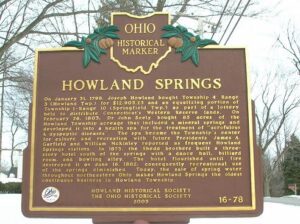
On January 31, 1798, Joseph Howland bought Township 4-Range 3 (Howland Twp.) for $12, 903.23 and an equalizing portion of Township 1-Range 10 (Springfield Twp.) as part of a lottery held to distribute Connecticut’s Western Reserve lands. On February 26, 1803, Dr. John Seely bought 85 acres of the Howland Township acreage that included a mineral springs and developed it into a health spa for the treatment of “scrofulous & dyspeptic diseases”. The spa became the Township’s center for culture and recreation with future Presidents James A. Garfield and William McKinley reported as frequent Howland Springs visitors. In 1873, the Shedd brothers built a three-story hotel south of the springs with a dance hall, billiard room, and bowling alley. The hotel flourished until fire destroyed it on June 16, 1882; consequently recreational use of the springs diminished. Today, the sale of spring water throughout northeastern Ohio makes Howland Springs the oldest continuous business in Howland Township.
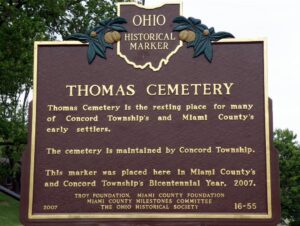
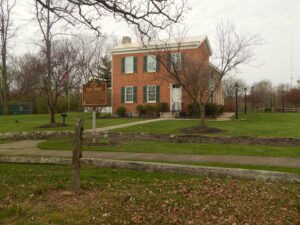
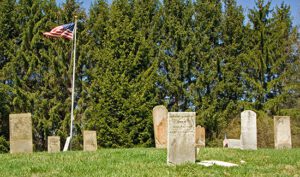
Thomas Cemetery is the resting place for many of Concord Township’s and Miami County’s early settlers. The cemetery is maintained by Concord Township. This marker was placed here in Miami County’s and Concord Township’s Bicentennial Year, 2007.
Elisha Morgan purchased 48.6 acres in Fairfield Township, part of the Symmes Purchase, in 1817. The Farm Mansion was built shortly after he settled the land. The house incorporates two prevalent architectural styles in southwest Ohio in the nineteenth century. The original front portion is an example of Federal style architecture while the 1858 rear addition represents the Greek Revival style. Built earlier than most farmsteads in the township, the Mansion is a rare example of an early farmhouse that has survived despite suburban development. The Mansion is listed on the National Register of Historic Places.
Smith’s Burying Ground was established in 1814 when John Smith (born 1742), Revolutionary War Veteran, died and was buried here. John Smith and four of his sons and their families made the six week, six-hundred-mile journey from New Jersey with ox teams the previous year. John Clouse (1758-1822), Dutch immigrant and Revolutionary War veteran, is also buried here. (Continued on other side)
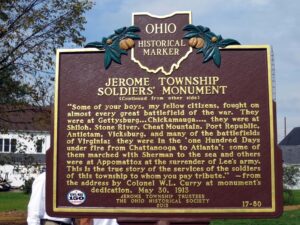
This monument was dedicated on Memorial Day of 1913 to honor the Union soldiers of the Civil War from Jerome Township. Many citizens, school children, and Civil War veterans attended the dedication as Col. W.L. Curry, who fought at Chickamauga, spoke to the crowd. The zinc monument contains the names of 400 soldiers of the township. The shaft is just over 21 feet high. Placed inside was a time capsule containing a number of historical documents including 60 photographs of Civil War veterans. Donations from a grateful community and a bequest from R.L. Woodburn, a Civil War veteran and Ohio legislator funded the monument.