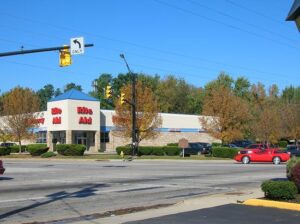
Thomas Johnson first came to Norton Township in 1814, and within three years he had established the township’s first sawmill along the fast-moving waters of Wolf Creek. The enterprising Johnson also erected a tavern, store, and post office, all on the northeast corner of this town square. In 1830 a grist mill was added to the community. Predating the founding of Barberton by seventy-seven years, Johnson’s Corner existed from 1817 until 1929, when it was annexed into Barberton.
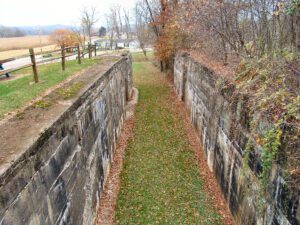
The Upper Trenton Lock (Lock 15 South) of the Ohio & Erie Canal was built between 1828 and 1829. Originally built of cut sandstone blocks, the lock was named for the Village of Trenton, now Tuscarawas. Lock 16, or Lower Trenton Lock, lies only 800 feet southwest of Lock 15. The lock tender, who lived in a house on this site, served both locks. Repeated flood damage prompted reconstruction of Lock 15 in 1907. The deteriorated stonemasonry was completely replaced with concrete at a cost of $6,815. The old stone was used to shore up the towpath. Use of the state-owned canal had declined significantly by this point, and the great flood of 1913 brought the canal era to an end in Ohio.
Butternut Ridge Road in front of the North Olmsted Library
North Olmsted
, OH
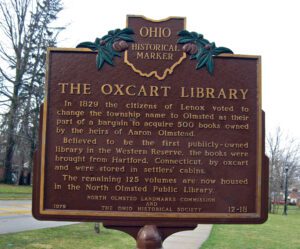
In 1829 the citizens of Lenox voted to change the township name to Olmsted as their part of a bargain to acquire 500 books owned by the heirs of Aaron Olmsted. Believed to be the first public library in the Western Reserve, the books were brought from Hartford, Connecticut, by oxcart and were stored in settlers’ cabins. The remaining 125 volumes are now housed in the North Olmsted Public Library.
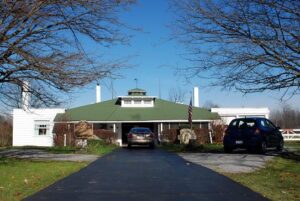
Southern Park Stables, at 126 Washington Boulevard in Boardman, was the private training stable of Attorney David Arrel and was built circa 1912 to house his standardbred horses racing at Southern Park Trotting Track one block south. The Stables is the last remaining structure of a large complex known as Southern Park, which included not only the racetrack and accompanying stables, grandstand, and outbuildings, but a dance hall, picnic pavilions, and baseball diamonds. The park was a favorite destination for Youngstown city residents wishing to relax in the country, and many company picnics were held here. Janie S. Jenkins has lived at Southern Park Stables since 1946 and deeded it and 8.33 acres to the Boardman Township Park District in 1993 with restrictions that it be forever preserved. The wrought iron gates at the driveway entrance were originally the main entrance gates for the racetrack.
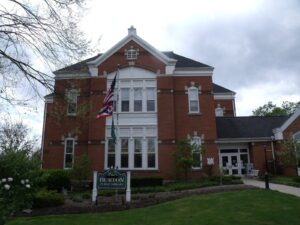
This Queen Anne style building with segmental-arched windows and steep hipped roof was Burton’s second high school. Completed in 1885 at a cost of $12,500, it is wood framed with a brick and stone exterior, modeled after an academy in River Falls, Wisconsin. Its basement and two upper floors contained 12,720 square feet of space, enough for all twelve grades. There were two separate entrances; girls entered on the left and boys on the right. Electricity was installed in 1921 by the superintendent and students. Classes met here until 1936. During its history, the building housed various organizations, including the Red Cross, Opportunity School of Geauga County (later Metzenbaum), Geauga County Historical Society, American Legion, and County Extension Office. In 1937, it became the home of the Burton Public Library and in 1983 was expanded with a north wing designed to be architecturally consistent with the original 1885 structure.
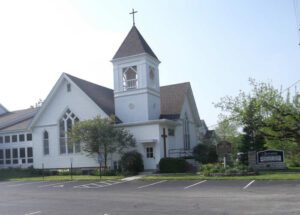
The First Presbyterian Church of West Union, built in 1810, is known as the “Church of the Governors.” Although the date is uncertain, the congregation was organized circa 1800 on Thomas Kirker’s land on Eagle Creek, about three miles from West Union. Kirker, Ohio’s second governor, was influential in organizing the congregation and raising funds for the construction of the building. Stonemason, Thomas Metcalfe, Kentucky governor from 1828-1832, was awarded the contract to build the walls for $250.00; the total construction cost was $500.00. The first three regular ministers – William Williamson, Dyer Burgess, and John P. Van Dyke – all held strong anti-slavery sentiment that was felt throughout the congregation. During the Civil War, soldiers of the 70th Ohio Volunteer Infantry, a regiment of recruits from Adams County and eastern Brown County, were said to have been temporarily quartered in the church before leaving West Union in 1861.
Company E of the 30th Ohio Volunteer Infantry was the only full infantry company formed in Jerome Township. Capt. Elijah Warner organized the unit in the village of Jerome and it was mustered into the Union Army at Camp Chase in Columbus on August 29, 1861. A total of 102 men from the township fought in the regiment throughout the war, while approximately 25% of the total population of the Jerome Township served. Company E performed outstanding service, participating in the Antietam, Vicksburg, and Atlanta Campaigns, Sherman’s March to the Sea and the March through the Carolinas, and the in the Grand Review in Washington, D.C. Of the 102 Jerome Township men in Company E, 32 perished during the war. The regiment was mustered out of service August 13, 1865.
Alexander Sutherland (1767-1845) and his wife Sarah (1768-1836) were the first settlers in Newton Township, Trumbull County, Ohio. Coming from Westmoreland County, Pennsylvania, the Sutherlands acquired 205 acres of land along Duck Creek southward from this site. Alexander was an influential person in the area after the settlement was made at Duck Creek. He was the second Recorder and the first elected Surveyor for Trumbull County. He was an early Mason with Old Erie Lodge, Warren schoolteacher, postmaster at Newton, Newton Township Trustee and Clerk, and Justice of the Peace. Sutherland, along with Ezekiel Hover, marked the first path from this Duck Creek settlement to Youngstown to reach the nearest mill.