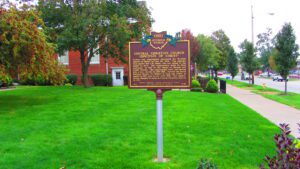
Harvey Howard, a local druggist, built the house at 407 North Market Street around 1860. After many owners, Captain James B. Taylor bought the home in 1893. Taylor commanded Company H of the 120th Ohio Volunteer Infantry during the Civil War. He studied law after the war and moved his practice to Wooster in 1882. Taylor’s wife Emelie died in 1905 and in 1906 Taylor sold the property to become Wooster’s first city hospital. Many of the town’s noted physicians practiced here and the facility was eventually enlarged to accommodate 30 beds. The house was a hospital until 1943, when Central Christian Church purchased it. The church used the building for education programs and restored much of its decor, including four fireplaces, inlaid floors, and bronze door hardware.
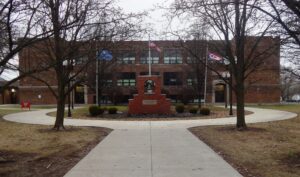
In 1893, Ohio and Indiana constructed the first Union School on the state line separating Ohio and Indiana. For 111 years, students from both states have been educated in what is the only schoolhouse located in Ohio and Indiana. In 1925, a new Union School was designed to replace the old schoolhouse. The dedication of this new school building took place on December 21, 1926. A new addition was added in 2004. The Union School Building has special architectural features such as a center stone placed on the Ohio and Indiana state line and Ohio and Indiana arched doorways. The bell from the 1893 Union School is displayed to the south side of the current school.
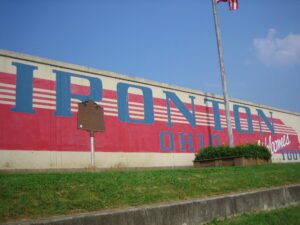
In 1849, the city of Ironton was founded by local ironmasters, railroaders, and financiers associated with the Ohio Iron and Coal Company. They saw the city as a manufacturing and shipping point for their products. As a young industrial city, Ironton prospered when river transportation facilitated the development and export of Lawrence County’s natural resources and manufactured items. The Iron Railroad Company was also established to transport pig iron and manufactured goods from nearby towns to Ironton, to awaiting steamboats on the Ohio River. Steamboats, in the form of towboats, packet boats, and showboats, traveled the river providing the city with goods, services, and entertainment. The Ironton wharf and boat landing once served the community as a gathering place to greet incoming passengers, receive mail, and hear the latest news.
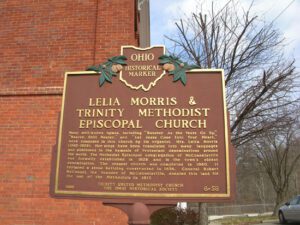
Many well-known hymns, including “Sweeter As the Years Go By,” “Nearer, Still Nearer,” and “Let Jesus Come Into Your Heart,” were composed in this church by its organist, Mrs. Lelia Morris (1862-1929). Her songs have been translated into many languages and published in the hymnals of Protestant denominations around the world. The Methodist Episcopal congregation of McConnelsville was formally established in 1826 and is the town’s oldest denomination. The present church was completed in 1860. It replaced a stone building constructed in 1836. General Robert McConnel, the founder of McConnelsville, donated this land for the use of the Methodists in 1817.
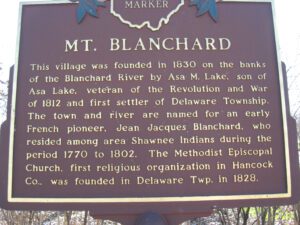
This village was founded in 1830 on the banks of the Blanchard River by Asa M. Lake, son of Asa Lake, veteran of the Revolution and War of 1812 and first settler of Delaware Township. The town and river are named for an early French pioneer, Jean Jacques Blanchard, who resided among area Shawnee Indians during the period 1770 to 1802. The Methodist Episcopal Church, first religious organization in Hancock Co., was founded in Delaware Twp. in 1828.
In 1809 the citizens of Zanesville erected a building on this site which served as the capitol of Ohio from October 1, 1810, until May 1, 1812. The 9th and 10th sessions of the Ohio General Assembly met here before returning to Chillicothe in May 1812. The building was then used as the Muskingum County Courthouse until the present courthouse was built in 1874. The 1809 date stone from the old building was incorporated into the new building and may be seen over the front steps.
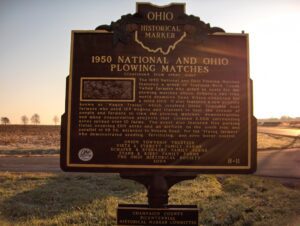
Benson Road and the North Urbana Lisbon Road (SR 54) in Champaign County was the site of the 1950 National and Ohio Plowing Matches and the National Association of Soil Conservation Districts Field Days. The three-day event drew a crowd of nearly 75,000 and was headquartered in the woods of the Edwin (Ned) Kirby farm located a quarter mile north on Benson Road. The National Association of Soil Conservation Districts sponsored the National and Ohio Plowing Matches. The first national matches were held in Mitchellville, Iowa in 1939 and continued until halted by the start of World War II. They resumed in 1945. Ohio’s 1950 Champaign County-Union Township National Plowing Matches was the first “National” to be held outside Iowa. (continued on other side)
Intersection of State Route 554 and Depot Road, Springfield Township
Bidwell
, OH
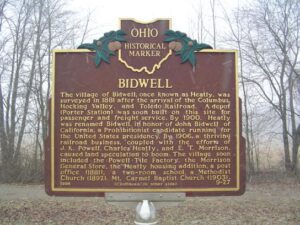
The village of Bidwell, once known as Heatly, was surveyed in 1881 after the arrival of the Columbus, Hocking Valley, and Toledo Railroad. A depot (Porter Station) was soon built on this site for passenger and freight service. By 1900, Heatly was renamed Bidwell, in honor of John Bidwell of California, a Prohibitionist candidate running for the United States presidency. By 1906, a thriving railroad business, coupled with the efforts of J.K. Powell, Charles Heatly, and E.T. Morrison, caused land speculation to boom. The village soon included the Powell Tile Factory, the Morrison General Store, the Heatly housing addition, a post office (1881), a two-room school, a Methodist Church (1892), Mt. Carmel Baptist Church (1903), (Continued)