

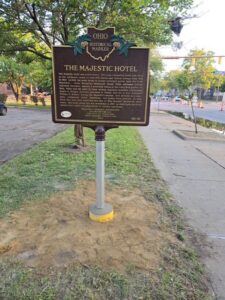
, OH
The Majestic Hotel was a five-story, 250-room residential hotel that stood on the northeast corner of East 55th Street and Central Avenue from 1902 to 1967. In 1924 the hotel began to accept overnight guests. Amid the Great Migration, owner Hungarian immigrant Joseph Weiss welcomed African American travelers, earning a perennial listing in the Green Book guides. In 1944, Weiss sold the hotel to three African American investors: businessman Alonzo G. Wright, attorney Lawrence O. Payne, and Call & Post publisher William O. Walker. During the Majestic’s heydey, such services as a pharmacy, restaurant, tailor, beautician, and barber were offered. Its Rose Room jazz club drew musicians and fans to “Blue Monday” parties for many years. The hotel closed and was demolished in 1967, as civil rights advances opened more public accommodations to African Americans.
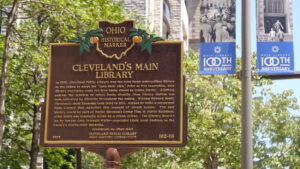
, OH
In 1890, Cleveland Public Library was the first large metropolitan library in the nation to adopt the “open shelf plan.” Prior to this innovation, only library employees could retrieve books stored in closed stacks. Allowing patrons the freedom to select books directly from library shelves was soon embraced by libraries throughout the nation. William Howard Brett, Cleveland’s chief librarian from 1884 to 1918, worked to build a permanent Main Library that embodied this concept of direct access. The new library would be part of Daniel Burnham’s Group Plan of Public Buildings. After Brett was tragically killed by a drunk driver, the Library Board — led by lawyer John Griswold White — appointed Linda Anne Eastman as the library’s fourth chief librarian. (Continued on other side)
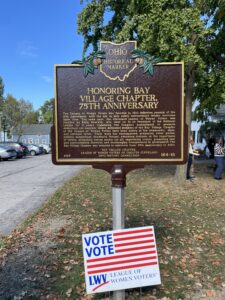
, OH
The Bay Village Chapter of the League of Women Voters was established in Spring 1948, with Dorothy M. Austin as president. The goal of the chapter was to ensure all citizens of Bay Village had the information they needed to cast an educated vote. They first met in the Cahoon family homestead, which then served as the city library and later as Rose Hill Museum. Gladys H. Luecke led the group on its first study, a city charter form of government for the village. Voters approved the charter on April 12, 1949, and the Village of Bay officially became the “City of Bay Village” in 1951. Since its founding, the Bay Village Chapter has made an educated voter its first priority by supporting citizen participation in government and influencing public policy through education and advocacy.

, OH
The Central Avenue Public Bath House was designed by Frederic Betz, the City of Cleveland’s first appointed architect. Opened in February 1920, it served the Black population in the congested Central neighborhood. The brick building featured symmetrical windows and entrances at either end that led into men’s and women’s waiting rooms and individual shower rooms. Larger group showers for children were in the basement. The second floor featured club rooms as well as a physician’s room and a nurse’s room. In 1926, a swimming pool and gymnasium were added. In 1940, as the need for public bathing facilities waned, Central Avenue Public Bath House was converted into a recreation center. One of Cleveland’s five remaining Bath Houses, Central Avenue stands as a manifestation of the city’s commitment to the health and welfare of its citizens.
, OH
Prominent architect William S. Lougee designed the Woodland Public Bath House that opened in 1915 at a cost of approximately $90,000. The first floor of the facility included separate shower baths for men and women, an office, waiting rooms, and a gymnasium with a 53-yard running track. The second story was divided into four rooms: a club room, a small city library branch, a baby dispensary, and clinic. The basement featured an indoor swimming pool popular among adults and children. Like other public bath houses in Cleveland, the Woodland Bath House was an invaluable social space for its diverse community of largely Hungarian, but also Slovak, Bohemian, Italian, Lithuanian, and Jewish residents. In 1918, the City estimated that 254,508 residents had used Woodland Bath House facilities, enjoying classes, camps, baths, and clinics.