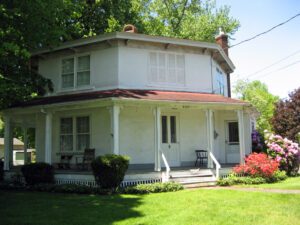
This eight-sided house reflects a widespread pre-Civil War architectural fad. Promoted by phrenologist Orson S. Fowler in his 1848 book A Home for All as a way to “bring comfortable homes within the reach of the poorer classes,” the octagon made efficient use of interior space and natural ventilation. More than thirty octagonal houses are known to have been built in Ohio, and at least twenty-five survive. This example was built circa 1854 and purchased by cabinetmaker Amirus Darrow in 1864. The exterior walls are constructed of chestnut beams between layers of concrete. It was added to the National Register of Historic Places in 1971.
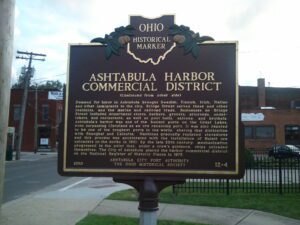
When the Pittsburgh, Youngstown and Ashtabula Railroad was finished in 1873, Ashtabula’s harbor became a direct route to ship iron ore to the booming steel mills of Youngstown and Pittsburgh. On the west side of the Ashtabula River, a brush-filled gulley became Bridge Street. New buildings and bridges attest to the harbor’s importance as a commercial and shipping hub from the late 19th through mid 20th centuries. Fires destroyed wood-frame buildings on the block closest to the river. A fire in 1886 nearly cleared the north side of Bridge Street. Another fire swept over the south side in 1900. Fire resistant brick buildings replaced frame structures and over the course of rebuilding, the level of the street rose approximately eight feet. In 1889, a swing-span bridge replaced the original pontoon bridge over the river. A bascule lift (draw) bridge replaced the swing bridge in 1925.
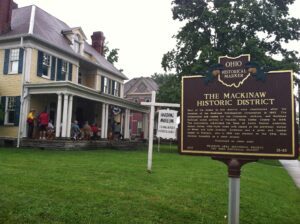
Most of the homes in this district were constructed after the creation of the Mackinaw Development Corporation in 1887. The corporation was named for the Cincinnati, Jackson, and Mackinaw Railroad which arrived in Franklin from Darke County in 1886. The corporation subdivided the farm of Lewis Gaston Anderson, whose Italian Villa-style home still stands at the northwest corner of Miami and Lake Avenues. Anderson was a grain and lumber dealer in Franklin, who in 1881 was elected to the 65th Ohio General Assembly as a state senator. (Continued on other side)
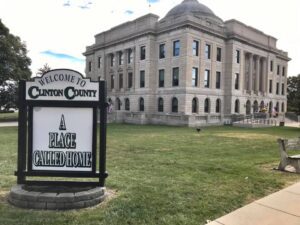
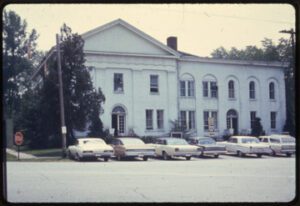
The Clinton County Courthouse was dedicated October 22, 1919. The Cincinnati firm of Weber, Werner and Adkins designed the edifice and it is a local masterpiece that fuses the Beaux-Arts and Neo-Classical architectural styles. A grand marble staircase rises from the basement to the second floor. At the center of the cruciform plan is a dome 32 feet in diameter with a stained-glass window. The murals of four women beneath the dome represent Agriculture, Education, Medicine, and Industry, and are known as the Guardians of the Courthouse. The county built courthouse and former jail for a combined cost of nearly $370,000.
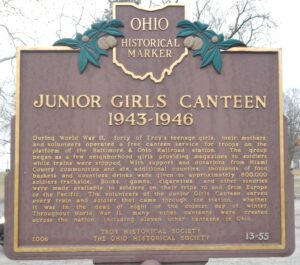
During World War II, forty of Troy’s teenage girls, their mothers, and volunteers operated a free canteen service for troops on the platform of the Baltimore & Ohio Railroad station. The group began as a few neighborhood girls providing magazines to soldiers while trains were stopped. With support and donations from Miami County communities and six additional counties, thousands of food baskets and countless drinks were given to approximately 600,000 soldiers trackside. Books, games, cigarettes, and other sundries were made available to soldiers on their trips to and from Europe or the Pacific. The volunteers of the Junior Girls Canteen served every train and soldier that came through the station, whether it was in the dead of night or the coldest day of winter. Throughout World War II, many other canteens were created across the nation, including eleven other canteens in Ohio.
Mahoning County was created in 1846 by combining townships from southern Trumbull and northern Columbiana counties. Canfield engaged in competition with several surrounding communities for the new county seat, and its success was attributed to its central location along with the state and local political influence of Judge Eben Newton and Elisha Whittlesey, Esq., Comptroller of the United States Treasury from 1849-1857. To become the county seat, the State of Ohio required “a suitable lot and $5,000 toward public buildings” Judge Newton donated the land and spearheaded the subscription of the state required bond. Once attained, construction progressed rapidly on the Classical Revival style courthouse, completed in June 1848. The Italianate style West wing was added in 1862, but its government status was challenged when in the early 1870s, Youngstown, by now a city, resumed its earlier challenge for the county seat. (continued on other side)
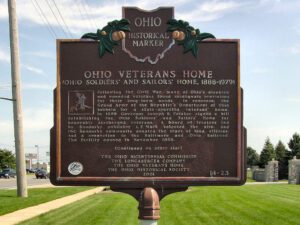
Following the Civil War, many of Ohio’s disabled and wounded veterans found inadequate provisions for their long-term needs. In response, the Grand Army of the Republic’s Department of Ohio lobbied for a state-operated veterans’ home. In 1886 Governor Joseph B. Foraker signed a bill establishing the Ohio Soldiers’ and Sailors’ Home for honorably discharged veterans. A board of trustees led by Sandusky publisher I.F. Mack selected the site, and the Sandusky community donated the tract of land, utilities, and a connection to the Baltimore and Ohio Railroad. The facility opened in November 1888. (continued on other side)
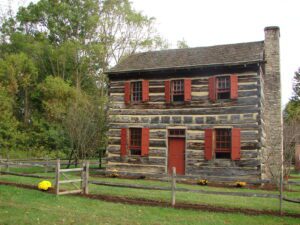
Zachariah Price DeWitt was born of a Dutch family in New Jersey in 1768. With brothers Jacob and Peter, he migrated to Kentucky where, in 1790, he married Elizabeth Teets, who was born in Pennsylvania in 1774. By 1805 all three brothers had settled in Ohio near Four Mile (Talawanda) Creek. Here Zachariah and Elizabeth raised corn, hogs, and eventually, nine children. Zachariah became a prominent community leader, operating a sawmill, building houses in Oxford, serving as Masonic Lodge secretary, and commanding a rifle company during the War of 1812. Tradition has it that Elizabeth wore a black sunbonnet to cover a scar from having been scalped as a child in Kentucky. Elizabeth died in 1843, followed by Zachariah in 1851. Both are buried in Darrtown Cemetery.