The SW corner of N Market Street and W Emmitt Street/US 23
Waverly
, OH
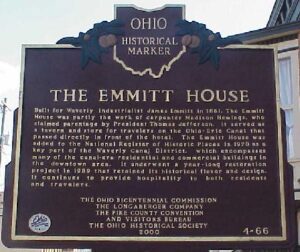
Built for Waverly industrialist James Emmitt in 1861, The Emmitt House was partly the work of carpenter Madison Hemings, who claimed parentage by President Thomas Jefferson. It served as a tavern and store for travelers on the Ohio-Erie Canal that passed directly in front of the hotel. The Emmitt House was added to the National Register of Historic Places in 1978 as a key part of the Waverly Canal District, which encompasses many of the canal-era residential and commercial buildings in the downtown area. It underwent a year-long restoration project in 1989 that retained its historical flavor and design. It continues to provide hospitality to both residents and travelers.
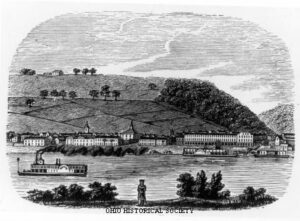
Ripley was incorporated as the village of Staunton in 1812. Its name was changed in 1816 to honor General Eleazer Wheelock Ripley, a hero of the War of 1812. In the years before railroads, Ripley was a principal Ohio River shipping center. Also important were its extensive boat-building, tobacco, pork, and timber industries. Ripley too was the home of saw and planing mills, iron foundries, and a piano factory. Such varied commerce enabled Ripley to remain vibrant throughout the nineteenth century. Although noted as a port, Ripley is best remembered as an abolitionist stronghold. Many of its citizens, including Rev. John Rankin and John P. Parker, served as conductors on the famed “Underground Railroad.” The notoriety of Ripley’s anti-slavery network perhaps eclipsed that of nearby Cincinnati, earning the town a reputation as the “Black Hole of Abolitionism.” (Continued on side two)
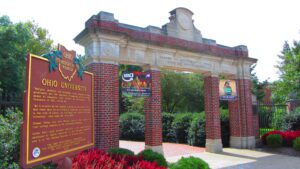
Manasseh Cutler, Rufus Putnam, Winthrop Sargeant, and Benjamin Tupper of the Ohio Company conceived Ohio University, which was encouraged by the Ordinance of 1787 and the Northwest Territorial Legislature in 1799, incorporated as the American Western University in 1802, and chartered by the Ohio State Legislature on February 18, 1804. The university is the first institution of higher learning in the Northwest Territory, second west of the Allegheny Mountains, and the first in the United States to be endowed with land by the government with proceeds used to pay for its operations-revenue from two townships was set aside to support the university. Opened on June 1, 1809, as an academy with three students, Ohio University awarded its first undergraduate degrees in 1815.
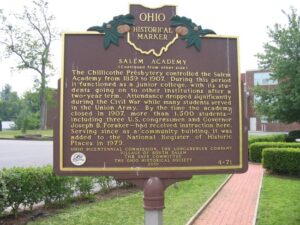
Presbyterian minister Hugh Stewart Fullerton asked his congregation in 1841: “Shall we endeavor to form an academy to provide better educational advantages to the young citizens of this remote community?” Predating the founding of the town of South Salem, the Salem Academy was built and opened in 1842, its stone coming from a quarry south of Greenfield. Its primary purpose was to prepare ministers and teachers for the West. Professor J.A. Lowes served as principal during the “golden age” of the academy from 1848 to 1858. (continued on other side)
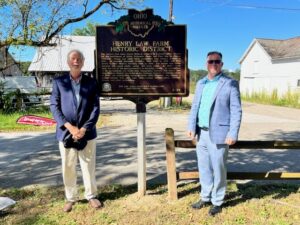
The historic Law Farm (circa 1846) is situated in a broad valley formed by the confluence of Little Stillwater Creek and Plum Run in Monroe Township. Henry Law (1812-1869) immigrated from Ireland to Ohio in 1830. He married Elizabeth McMillan (1818-1892) in 1839, and they moved to their Monroe Township farm by 1846. The couple had eleven children and raised cattle, sheep, and other crops. By 1860, their farm was one of the most productive in Harrison County. In recognition of its agricultural and Scots-Irish immigration history, the Henry Law Farm Historic District was listed on the National Register of Historic Places in 2002. Its contributing buildings (1846-1920) included: two houses; a summer kitchen; tool, milk, coal, smoke houses; multiple barns; carriage houses; and other outbuildings.
This historic village was a hub for early Ohio industry and travel. The natural geography of the area provided ideal conditions for the establishment of a variety of mills. Col. Robert Patterson, an ancestor of the founder of National Cash Register in Dayton, John Patterson, chose Clifton for the site of a woolen mill, which furnished material for the American army during the War of 1812. Davis Mill, established in 1802 and in operation today as Clifton Mill, produced meal and flour for Civil War troops. A major stop on the stagecoach trail, “The Accommodation Line,” which ran from Springfield to Cincinnati from 1827 to 1840, the village bustled with the commotion of travelers. The once flourishing industry of Clifton faded as railroad traffic bypassed the village and manufacturers left the area.
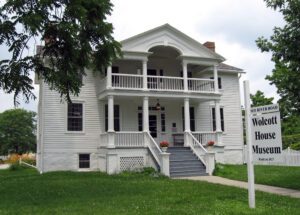
This federal style house was built in 1827 by James A. Wolcott who migrated to Ohio in 1818 from Connecticut. Of distinguished parentage, Wolcott was a leading merchant, shipbuilder, judge and politician. Here he and his wife, Mary Wells, daughter of scout William Wells and Sweet Breeze, Indian Chief Little Turtle’s daughter, made their home a center of frontier activity. This house stands as a tangible symbol of this Maumee pioneer, a Registered National Historic Place.
Myron T. Herrick, Governor of Ohio from 1904 to 1906, was born in Huntington Township in 1854 and lived here until age 12. A respected Cleveland attorney and businessman, Herrick was a friend and confidant to Senator Mark Hanna and Presidents McKinley, Taft, and Harding. His public service career culminated in two appointments as ambassador to France, from 1912 through the outbreak of World War I in 1914, and again from 1921 until his death in 1929. Enormously popular with the French people, Herrick escorted Charles Lindbergh in Paris after his historic 1927 transatlantic flight.