

, OH
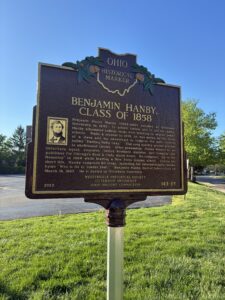
Benjamin Russel Hanby (1833-1867) enrolled at Otterbein University in 1849. To afford tuition and to aid his family, Hanby alternated college terms with teaching in nearby public schools. While a student in 1856, he was moved by the story of a slave and his sweetheart to compose the anti-slavery ballad “Darling Nelly Gray.” The song quickly proved popular in abolitionist circles. After graduation, Hanby worked as an Otterbein agent, educator, United Brethren minister, and compiler and publisher for Chicago’s Root & Cady music house. He composed “Up on the Housetop” in 1864 while leading a New Paris singing school. During his short life, Hanby composed 80 songs, including the internationally-known hymn “Who is He in Yonder Stall.” Benjamin Hanby died of tuberculosis on March 16, 1867. He is buried in Otterbein Cemetery.
, OH
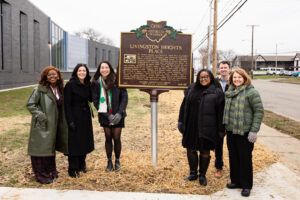
Dr. Harley Manuel and Charles E. Jones were frustrated by the restrictive covenants and redlining that kept Black residents from purchasing homes in desirable Columbus neighborhoods. Deciding to create their own neighborhood, the two men purchased 10.5 acres of farmland in March 1945. They divided it into 42 lots that became Livingston Heights Place. The first lots were sold to pharmacist Waldo W. and Harriet Tyler in 1946. Other early residents included Edward J. Cox, William and Esther Toler, David D. White, Dr. William K. Allen, and Dr. Harry Jefferson. Later residents were Dr. John H. Rosemond, Llewellyn (Jack) A. Coles, Captain Amos A. Carter Jr., Sammy Hopkins, William “Bill” Willis, and Dr. Richard Ruffin. Twenty homes were built between 1948 and 1967 within the subdivision’s boundaries of Johnson Park, Livingston, Byron, and Waverly.
, OH
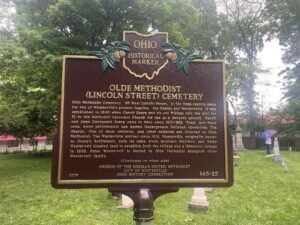
Olde Methodist Cemetery, 66 West Lincoln Street, is the final resting place for two of Westerville’s pioneer families, the Sharps and Westervelts. It was established in 1849 when Garrit Sharp and his son William sold the plot for $1 to the Methodist Episcopal Church for use as a burying ground. Garrit and Anna Goodspeed Sharp came to Ohio circa 1810-1812. They, and their sons, were abolitionists and known Underground Railroad operatives. The Sharps, five of their children, and other relatives are interred in Olde Methodist. The Westervelts arrived circa 1818. Westerville, originally known as Sharp’s Settlement, took its name when brothers Matthew and Peter Westervelt donated land to establish both the village and a Methodist college in 1839. Peter Westervelt is buried in Olde Methodist alongside other Westervelt family. (Continued on other side)
, OH
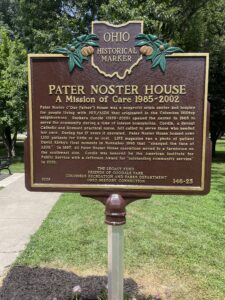
Pater Noster (“Our Father”) House was a nonprofit crisis center and hospice for people living with HIV/AIDS that originated in the Columbus Hilltop neighborhood. Barbara Cordle (1939-2020) opened the center in 1985 to serve the community during a time of intense homophobia. Cordle, a devout Catholic and licensed practical nurse, felt called to serve those who needed her care. During the 17 years it operated, Pater Noster housed over 1,100 patients for little or no cost. LIFE magazine ran a photo of patient David Kirby’s final moments in November 1990 that “changed the face of AIDS.” In 1997, all Pater Noster House operations moved to a farmhouse on the southwest side. Cordle was honored by the American Institute for Public Service with a Jefferson Award for “outstanding community service” in 2002.
, OH
William Henry Fouse was born in Westerville to former slaves Squire Fouse and “Sallie” Syler. The first Black student to graduate from Westerville High School (1884), he worked as a bootblack and waiter to earn college tuition. Fouse graduated cum laude from Otterbein (1893), and as the college’s first Black graduate, delivered “A Plea for the Afro-American” at commencement. For forty-five years Fouse worked as a teacher and administrator in Corydon (Indiana), Gallipolis (Ohio), Covington (Kentucky), and Lexington (Kentucky). He served as principal at Lexington’s Paul Lawrence Dunbar High School from its opening in 1923 until his retirement in 1938. During that time, Fouse developed the Bluegrass Oratorical Association, served as president of the Kentucky Negro Education Association, and earned his MA in Education. In 1937, Otterbein conferred a Doctor of Pedagogy upon the distinguished educator.