2210 Summit Street once housed one of Ohio’s longest-running lesbian bars. In 1970, a lesbian bartender at Jack’s A Go Go recognized that while Columbus had bars for gay men, it needed one geared toward lesbian clientele. Patrons knew the bar as “Jack’s,” Logan’s Off Broadway, and Summit Station. Staff welcomed women from small towns, women working in trades, women of color, butch/femme lesbians, and transgender people. Regulars recall that stepping through the door felt like finally entering a place of true belonging. Women could dance, “get together,” break up, sing karaoke, party with friends, and celebrate birthdays and holidays. Summit Station remained a safe public space, despite ongoing police harassment of its gender non-conforming regulars. A sign posted outside declared: “Ladies Night, Every Night. Men $5.” (Continued on other side)
Bethel A.M.E. Church was the first African American church in Worthington. Black residents joined Worthington’s established churches as early as 1847 or worshipped together in their homes. Peter Banks with D.H. Taborn, Charles Kiner, J.T. Horton, and James Birkhead organized the A.M.E. congregation in 1896. Rapid growth moved their meetings to the Worthington Town Hall by 1897. A lot was purchased from Millie Alston on September 24, 1897, and a house relocated to serve as Bethel Chapel. Local carpenter Chester Hard constructed a new building that was dedicated as St. John A.M.E. in 1914. The church has served as the religious and social hub of Worthington’s Black community for more than a century. While St. John A.M.E. Church retains their original location, worship services moved to 7700 Crosswoods Drive in 2004.
Hugh Grant Sr. (1769-1806) owned a gristmill and land in Pittsburgh, Pennsylvania, during the 1790s. He married Catharine Barr Grant (unknown-1836) and they had 6 children: Alexander, Jacob, Isabella, Nancy, Mary, and Hugh Grant Jr. (born posthumously). In 1804 Grant purchased 450 acres of federal land at the Chillicothe land office. In 1805 he and his family moved to Jackson Township, Ohio. Uncertain of the location of his tracts, he settled his family in a log structure along the Scioto River. During the winter of 1806-1807, Grant died in a freak accident climbing a honeybee tree. Catharine Barr Grant realized they were on the wrong land and moved her family to the right property holdings where the Grant Homestead remains. She died August 17, 1836, and is buried in Union Methodist Cemetery.
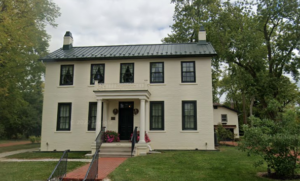
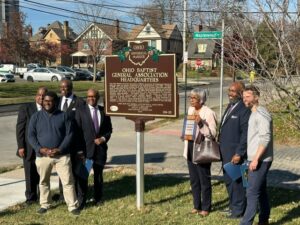
The Ohio Baptist General Association (OBGA) acquired 48 Parkwood Avenue in 1954 and used the former residence as its headquarters until 1996. Formed in 1896, the Association includes more than forty African American churches, many formed prior to the Civil War. Baptist general associations nationwide became an important voice during the 1960s Civil Rights Movement as they addressed the wrongs of racial violence and discrimination in business, housing, and education. The OGBA fought for the ideals of justice and freedom with its strongly-held Baptist beliefs. “America with her wealth as a great nation,“ OGBA President Wilber A. Page declared in 1957, “is well able to face integration and give a democracy to all her citizens.” The former Association Headquarters was listed in the National Register of Historic Places on December 3, 2020.
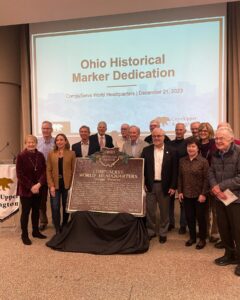
The world headquarters of CompuServe was located on the six-acre site at 5000 Arlington Centre Boulevard from 1973 to 2009. Incorporated in 1969, Compu-Serve Corporation (later CompuServe Inc.) was the first major online information services provider. Its subscribers were the first to have access to email, online newspapers and magazines, the ability to share and download files, and a variety of popular chat forums. One especially successful CompuServe innovation was the GIF graphics format. Increasing competition and a succession of corporate owners pressed CompuServe into the fate of many tech start-ups and it ran its course. It did, however, introduce millions of people to online connectivity, social networking, and laid the foundation for the widespread use of the internet.
Pleasant Litchford was born into slavery in Virginia in 1789. He purchased his freedom and moved his family to Ohio by 1831. A master blacksmith, Litchford bought a small farm four miles north of Columbus in 1833. By the time of his death in 1879, he was the fourth largest landowner in Perry Township. Described as “a man of iron constitution,” Litchford served as a lay-preacher, founding member, and deacon at Second Baptist Church. The church and James Poindexter, its pastor in 1847, provided an important voice during the anti-slavery movement. In 1869, Litchford sold, for $1, a parcel of land to establish a school for African American children. He was married three times and was survived by seven living children, twenty-five grandchildren, and three great-grandchildren. Pleasant Litchford was buried in the Litchford Family Cemetery.
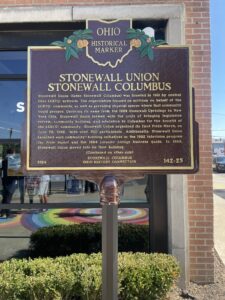
Stonewall Union (later Stonewall Columbus) was founded in 1981 by central Ohio LGBTQ+ activists. The organization focused on activism on behalf of the LGBTQ+ community, as well as providing physical spaces where that community could prosper. Deriving its name from the 1969 Stonewall Uprisings in New York City, Stonewall Union formed with the goals of bringing legislative reform, community building, and education to Columbus for the benefit of the LGBTQ+ community. Stonewall Union organized its first Pride March, on June 26, 1982, with over 500 participants. Additionally, Stonewall Union launched such community-building initiatives as the 1982 television program Gay Pride Report and the 1984 Lavender Listings business guide. In 1985, Stonewall Union moved into its first building. (Continued on other side)