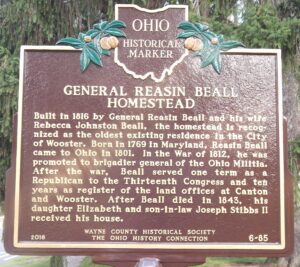
Built in 1816 by General Reasin Beall and his wife Rebecca Johnston Beall, the homestead is recognized as the oldest existing residence in the City of Wooster. Born in 1769 in Maryland, Reasin Beall came to Ohio in 1801. In the War of 1812, he was promoted to brigadier general of the Ohio militia. After the war, Beall served one term as a Republican to the Thirteenth Congress and ten years as a register of the land offices at Canton and Wooster. After Beall died in 1843, his daughter Elizabeth and son-in-law Joseph Stibbs II received his house.
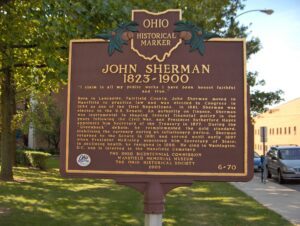
Born in Lancaster, Fairfield County, John Sherman moved to Mansfield to practice law and was elected to Congress in 1854 as one of the first Republicans. In 1861, Sherman was elected to the U.S. Senate. An authority on finance, Sherman was instrumental in shaping federal financial policy in the years following the Civil War, and President Rutherford Hayes appointed him Secretary of the Treasury in 1877. During the “Greenback” debate, he re-implemented the gold standard, stabilizing the currency during an inflationary period. Sherman returned to the Senate in 1881 and served until early 1897 when President McKinley appointed him Secretary of State; in declining health, he resigned in 1898. He died in Washington, D.C. and is interred in the Mansfield Cemetery.
In the mid-1700s, France found its influence waning among midwestern tribes as it contested for Native American trade and military alliances with Great Britain. Shortly after Miami chief Memeskia (also known as Old Britain or La Demoiselle) moved his village to Pickawillany, British traders were given permission to establish a small post in the village, which was deep in the territory claimed by France. When French demands to evacuate the post failed, Charles Langlade led a party of 250 Ottawa and Ojibwe warriors and French Canadians in a surprise attack on the Miami village on June 21, 1752. The trading post was destroyed, British traders were taken to Detroit as prisoners, and Memeskia was executed. Pickawillany was completely abandoned soon after. As a prelude to the French and Indian War, the Battle of Pickawillany fueled land claim and trading right conflicts between France and Britain.
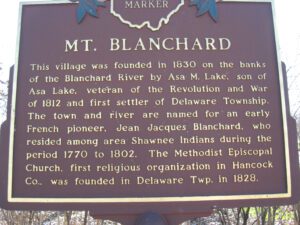
This village was founded in 1830 on the banks of the Blanchard River by Asa M. Lake, son of Asa Lake, veteran of the Revolution and War of 1812 and first settler of Delaware Township. The town and river are named for an early French pioneer, Jean Jacques Blanchard, who resided among area Shawnee Indians during the period 1770 to 1802. The Methodist Episcopal Church, first religious organization in Hancock Co., was founded in Delaware Twp. in 1828.
Prior to the Civil War, New Richmond citizens participated actively in the abolitionist movement and the Underground Railroad. In 1836, James G. Birney published The Philanthropist, an abolitionist newspaper, in New Richmond before moving publication to Cincinnati. Local tradition tells of Jim, a slave living in Kentucky who was given permission from his master to visit his parents in New Richmond. He aided his friend Joe, a fugitive slave, by packing him in a box and placing him on a riverboat headed to New Richmond. Famed Cincinnati abolitionist Levi Coffin recorded, “A few abolitionist – white men – who lived near were called into see the fugitive and to advise in regard to his safety.” Joe was taken from Jim’s parents’ home to Cincinnati where Levi Coffin purchased him a train ticket to Sandusky, from where he traveled to Canada.
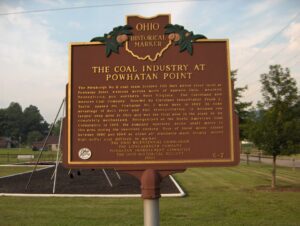
The Pittsburgh No. 8 coal seam, located 100 feet below river level at Powhatan Point, extends across much of eastern Ohio, western Pennsylvania, and northern West Virginia. The Cleveland and Western Coal Company, founded by Cleveland industrialist Frank E. Taplin, opened the Powhatan No. 1 mine here in 1922 to take advantage of both river and rail transportation. It became the largest deep mine in Ohio and was the first mine in the state to be completely mechanized. Reorganized as the North American Coal Corporation in 1925, the company operated seven shaft mines in this area during the twentieth century. Four of these mines closed between 1980 and 1984 as clean air standards made locally mined high-sulfur coal difficult to market.
Campbell Hill is named for Charles D. Campbell of Bellefontaine, who owned this land from 1898 to 1937. A marble stone marker atop the hill, set in 1900 by the U.S. Coast and Geodetic Survey, marks it as the highest point in Ohio at an elevation of 1549.09 feet. In 1951, the federal government established the 664th Aircraft Control and Warning (AC&W) Squadron here as part of the North American Air Defense Command (NORAD). Its military and civilian operators used sophisticated radar and computer equipment to locate and identify aircraft as friendly or suspicious, and relayed information to a central site in Battle Creek, Michigan. This Cold War site operated until 1969. It was converted to civilian use as a vocational education center in 1974.
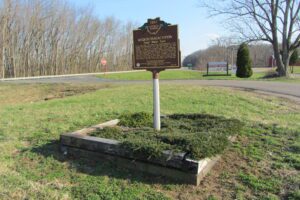
In the early 1770s, Chief White Eyes (Koquechagachton) of the Delaware tribe founded White Eyes Town approximately two miles southeast of this marker on a plain near present day West Lafayette. A friend of the Moravian leader David Zeisberger, White Eyes was an ardent supporter of Moravian missionary efforts and kept the Delawares neutral during the American Revolutionary War. White Eyes’s dream was to bring his people under the influence of Christianity. He also hoped to establish a fourteenth state for the Indian nations, which would join the other thirteen. White Eyes died at the height of his career in November 1778 near Pittsburgh. The cause of his death remains open to question.