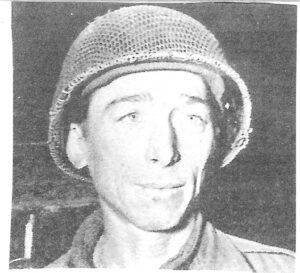
Alexander Albert Drabik was born here, in a log cabin, on December 28, 1910 to John Drabik and Frances Lewandowski, Polish immigrants from Szymborze, Germany, now Poland. Alex, youngest son of 14 children, attended Door Street School. A meat cutter, he enlisted in the United States Army in October 1942. Drabik fought in the Ardennes, Central Europe and Rhineland Campaigns of World War II. He received a Purple Heart during the Battle of the Bulge. On March 7, 1945, Sergeant Drabik led 10 Company A soldiers of the 27th Armored Infantry Battalion of the 9th Armored Division across the Ludendorff railroad bridge from Remagen, Germany to the Rhine River east bank. (Continued on other side)
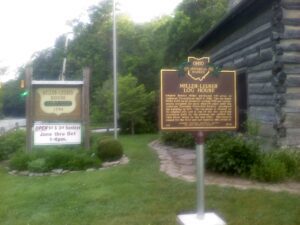
Ichabod Benton Miller purchased 440 acres in Anderson Township on April 2, 1796. The log house Miller built on his property around 1796 was continuously occupied for more than 170 years until the Anderson Township Historical Society purchased the building in 1971. The log house is located on its original site and is one of the few surviving structures built by the pioneers who settled the Ohio River Valley in the late 1700s. The house is named for the first and last families who owned it.
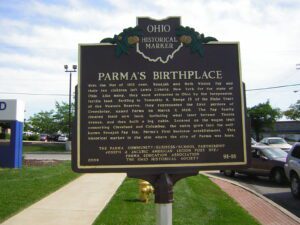
With the War of 1812 over, Benajah and Ruth Wilcox Fay and their ten children left Lewis County, New York for the state of Ohio. Like many, they were attracted to Ohio by the inexpensive, fertile land. Settling in Township 6, Range 13 of the Blake Tract of the Western Reserve, they represented the first settlers of Greenbriar, named Parma on March 7, 1826. The Fay family cleared their new land, including what later became Theota Avenue, and then built a log cabin. Located on the wagon trail connecting Cleveland and Columbus, the cabin grew into the well-known Benajah Fay Inn, Parma’s first business establishment. This historical marker is the site where the city of Parma was born.
NE corner of Broadview Road and Boston Road (across the street from Seves Glass Block Inc., 10576 Broadview Road, Broadview Heights, Ohio 44147)
Broadview Heights
, OH
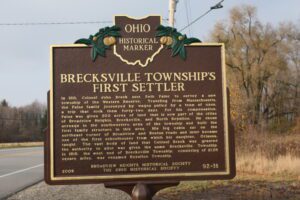
In 1811, Colonel John Breck sent Seth Paine to survey a new township of the Western Reserve. Traveling from Massachusetts, the Paine family journeyed by wagon pulled by a team of oxen, a trip that took them forty-two days. For his compensation, Paine was given 200 acres of land that is now part of the cities of Broadview Heights, Brecksville, and North Royalton. He chose acreage in the southwestern area of the township and built the first family structure in this area. His log cabin sat on the northeast corner of Broadview and Boston roads and later became one of the first schoolhouses from which his daughter, Orianna, taught. The vast body of land that Colonel Breck was granted the authority to allot was given the name Brecksville Township. In 1818, the west end of Brecksville Township, consisting of 21.28 square miles, was renamed Royalton Township.
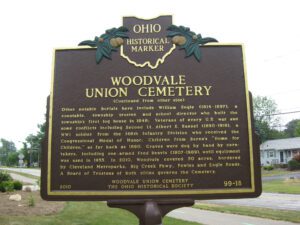
Woodvale Cemetery was established in the mid-1800s, in Middleburgh Township, Ohio. The oldest marked grave holds Fred G. Klink (1835-1858), whose family donated a half acre of land for burials. In 1876, Frank M. Stearns (1832-1911) suggested the unnamed cemetery be called Woodvale, after the wooded vale beside it. In 1908, a fire destroyed the caretaker’s house and many cemetery records. Woodvale became a non-profit, union cemetery in 1931, owned by Berea and the Village of Middleburg Hts. and covering 35 acres at 7535 Engle Road. Pioneer families buried here: Fowles, Kraft, Lovejoy, Sprague, and Stearns. Also buried here: John Baldwin (1799-1884) founder of Baldwin University and James Wallace (1878-1953) founder of German Wallace College (merged in 1913 to become Baldwin Wallace College) (Continued other side)
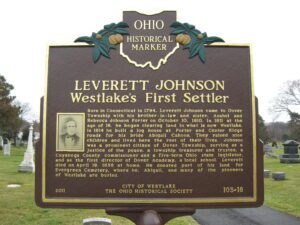
Born in Connecticut in 1794, Leverett Johnson came to Dover Township with his brother-in-law and sister, Asahel and Rebecca Johnson Porter on October 10, 1810. In 1811 at the age of 16, he began clearing land in what is now Westlake. In 1814 he built a log house at Porter and Center Ridge roads for his bride Abigail Cahoon. They raised nine children and lived here the rest of their lives. Johnson was a prominent citizen of Dover Township, serving as a justice of the peace, a township treasurer and trustee, a Cuyahoga County commissioner and a five-term Ohio state legislator, and as the first director of Dover Academy, a local school. Leverett died on April 19, 1856 at home. He donated part of his land for Evergreen Cemetery, where he, Abigail, and many of the pioneers of Westlake are buried.
In 1792, Captain Jacob White claimed land traditionally home to the Shawnee, Delaware (Lenni Lenape), Potawatomi, Miami, Wyandot, Seneca, Chippewa (Ojibwe or Anishinaabeg), Ottawa, and Wapakoneta indigenous nations. Located at the third crossing of Mill Creek, White’s Station, with a blockhouse and six cabins, served as a supply depot to nearby Cincinnati. On October 18, 1793, indigenous groups attacked the settlement in an effort to defend their ancestral lands. During the conflict, five people died: three members of David Flin’s family – Andrew Gobel and two of the Pryer children — as well as a tribal leader and his son whose names were not recorded. Andrew Pryer rushed to Fort Washington 10 miles away and returned with infantrymen who remained while a stockade was built to fortify the settlement.
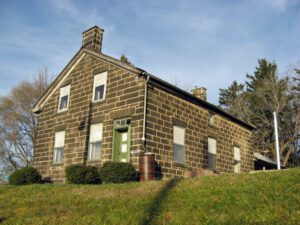
The Henninger Homestead was founded in an era when local quarries provided raw materials for the construction of the Ohio and Erie Canal. Bavarian immigrants Philip and Sophia Henninger came to Parma Township in 1840. Although Philip was a skilled tinsmith, he soon established a quarry on his property to supply sandstone for the breakwall of Cleveland’s harbor in Lake Erie, canal locks, and other building projects. In 1849, the Henningers replaced their log home with this Greek Revival house using stone from their quarry. Blocks at its base measure 30″ thick while upper walls are 14″ thick. Abandoned in 1988, the site was saved from demolition in 2003. The house and nearby carriage barn stand as the oldest buildings in the City of Parma.