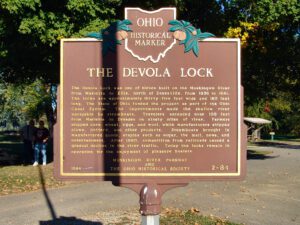
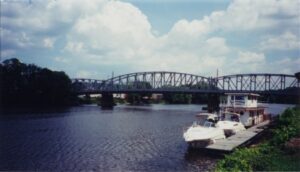
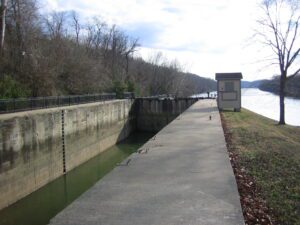
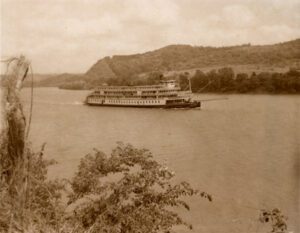
The Devola Lock was one of eleven built on the Muskingum River from Marietta to Ellis, north of Zanesville, from 1836 to 1841. The locks are approximately thirty-five feet wide and 160 feet long. The State of Ohio funded the project as part of the Ohio Canal System. The improvements made the shallow river navigable by steamboats. Travelers ascended over 100 feet from Marietta to Dresden on ninety miles of river. Farmers shipped corn, wheat, eggs, and wool, while manufacturers shipped goods, staples such as sugar, the mail, news, and entertainment. After 1880, competition from railroads caused a gradual decline in the river traffic. Today the locks remain in operation for the enjoyment of pleasure boaters.
OH 376/N. Riverside Drive, between Maple Avenue and 14th Street
McConnelsville
, OH
McConnelsville and Malta are two towns that prospered because of the locks and dams built on the Muskingum River from 1836 to 1841. Settlers came to both towns in 1817. In the 1820s and 1830s, flatboats carried grain, lumber, and livestock down the river. The locks and dams made the Muskingum navigable to steamboats, and both towns grew rapidly. Malta was the home of the Brown-Manly Plow Company, a leading maker of farm equipment in the 1800s. Brown-Manly depended on steamboats to bring in raw materials and to take products to markets. Mills at McConnelsville ground grain and shipped flour north to the Ohio Canal and to the east coast, and south to the Ohio River and the Mississippi trade.
Luke Chute is the site of an early mill that harnessed river power. About 1815, Luke Emerson and Samuel White built a dam part way across the river. This created a rapid between the shore and the end of the dam, the chute. Here they constructed a mill to grind grain. The system of locks and dams built on the river from 1836 to 1841 not only made the Muskingum River navigable by steamboats, but also harnessed the power of the river. After 1841, at least one mill was located at most of the dams. Water power encouraged industry in the Muskingum Valley.
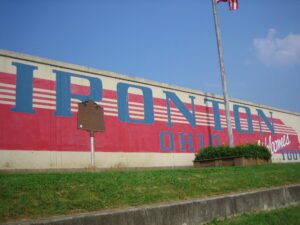
In 1849, the city of Ironton was founded by local ironmasters, railroaders, and financiers associated with the Ohio Iron and Coal Company. They saw the city as a manufacturing and shipping point for their products. As a young industrial city, Ironton prospered when river transportation facilitated the development and export of Lawrence County’s natural resources and manufactured items. The Iron Railroad Company was also established to transport pig iron and manufactured goods from nearby towns to Ironton, to awaiting steamboats on the Ohio River. Steamboats, in the form of towboats, packet boats, and showboats, traveled the river providing the city with goods, services, and entertainment. The Ironton wharf and boat landing once served the community as a gathering place to greet incoming passengers, receive mail, and hear the latest news.
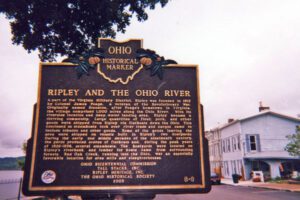
A part of the Virginia Military District, Ripley was founded in 1812 by Colonel James Poage, a veteran of the Revolutionary War. Originally named Staunton, after Poage’s hometown in Virginia, the village comprised 1,000 acres along the Ohio River. With its riverside location and deep water landing area, Ripley became a thriving community. Large quantities of flour, pork, and other goods were shipped from Ripley via flatboats down the Ohio. This continued as steamboats took over river trade and cargos came to include tobacco and other goods. Some of the goods leaving the area were shipped on vessels built in Ripley’s two boatyards. During the early and middle decades of the nineteenth century, the yards produced scores of flatboats and, during the peak years of 1826-1836, several steamboats. The boatyards were located on Ripley’s riverbank and lumber for boats came from surrounding forests. Red Oak Creek, running into the Ohio, was an especially favorable location for area mills and slaughterhouses.
The Wyandot called the Grand Reserve home nearly a century before Ohio statehood. They built houses, cultivated the land, and grew bountiful groves of fruit trees. They governed from the nearby Wyandot Council House and operated a productive saw and grist mill. Many sent their children to school and worshiped at the limestone church, built in 1824, and recognized as the first Methodist mission in the country. But Ohioans set their sights on Wyandot lands in the fertile Sandusky River Valley. State and federal governments were unwilling to allow the Wyandot to remain on their chosen homelands, despite their participation in American society and friendly relations with neighboring settlers. Following the Indian Removal Act of 1830, the Wyandot were the last tribe removed from the State of Ohio in 1843.
Muskingum River Parkway, S of the Putnam Avenue/6th Street Bridge
Zanesville
, OH
The Zanesville lock, canal, and dam were part of a series of eleven such built on the Muskingum River from Marietta to Ellis, north of Zanesville, from 1836 to 1841. The improvements made the shallow river navigable by steamboats. The State of Ohio funded the project as part of the Ohio Canal System. The locks are approximately 35 feet wide and 160 feet long. The river improvements spurred the development of industry in Zanesville, including pottery manufacture, shipbuilding, and grain milling. From Zanesville, goods could be shipped north to the Ohio Canal and Lake Erie. Products could also be sent south to Marietta and then east to Pittsburgh or southwest to New Orleans. Steamboats brought in manufactured goods, staples, mail, and entertainment. After 1880, competition from railroads caused a gradual decline in the river traffic. Today the locks remain in operation for the enjoyment of pleasure boaters.
Captain Gordon C. Greene, a veteran riverman, was born in Newport, Ohio, on September 8, 1862. In 1890 he started the “Greene Line” with the “Henry K. Bedford,” a small shallow draft steamer; he owned twenty-five packets in his lifetime. The “Greene Line” later became the “Greene Steamboat Line” then the “Delta Queen Steamboat Company,” with the original port at the Newport Landing. The Greene family launched packets for tours on the Ohio River and its tributaries. Captain Greene died in 1927 at Hyde Park, Cincinnati, and is buried in Newport Cemetery. (continued on other side)