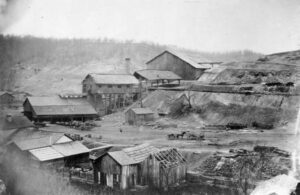
To furnish the needs of the early settlers, then to furnish ordnance for a nation at war, and finally to furnish merchant iron to the steel mills, 100 iron producing blast furnaces were built within these 1,800 square miles of the lower coal measures to become known as the Hanging Rock Region. Lawrence County, centrally located within the Region, had 23 blast furnaces constructed between 1826 and 1909.
War of 1812. Victoriously defended by Major George Croghan. Battle of Fort Stephenson. August 2, 1813. Built on this spot 1812-1813 and named for Col. Mills Stephenson, one of its builders.
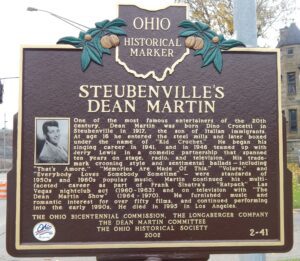
One of the most famous entertainers of the 20th century, Dean Martin was born Dino Crocetti in Steubenville in 1917, the son of Italian immigrants. At age 16 he entered the steel mills and later boxed under the name of “Kid Crochet.” He began his singing career in 1941, and in 1946 teamed up with Jerry Lewis in a comedic partnership that spanned ten years on stage, radio, and television. His trademark crooning style and sentimental ballads-including “That’s Amore,” “Memories Are Made Of This,” “Volare,” and “Everybody Loves Somebody Sometime”-were standards of 1950s and 1960s popular music. Martin continued his multifaceted career as part of Frank Sinatra’s “Ratpack” Las Vegas nightclub act (1960-1963) and on television with “The Dean Martin Show” (1964-1970). He furnished music and romantic interest for over fifty films, and continued performing into the early 1990s. He died in 1995 in Los Angeles.
The landscape of northwest Ohio was formed by melting ice and the glacial lakes left behind in its wake. Because of the low gradient (3 feet fall per mile) to the northeast, the flat lacustrine plain evolved into a large swamp. A massive swamp forest with huge hardwoods, broken only sporadically with intermittent wet prairies and savannahs, dominated the landscape. Both prehistoric and historic Indians farmed the flood plains of the Maumee River and its tributaries: Auglaize, Tiffin, and Blanchard rivers. (continued on other side)
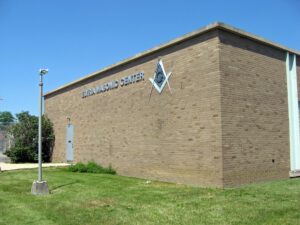
King Solomon Lodge, the first Masonic Lodge in Lorain County, was chartered on December 11, 1821, with Heman Ely as Worshipful Master. Ely (1775-1852), a prominent land developer, founded the City of Elyria in 1817, and built the first grist and saw mills and frame house in the village. Through his efforts, Elyria became the county seat in 1823.
OH 376/N. Riverside Drive, between Maple Avenue and 14th Street
McConnelsville
, OH
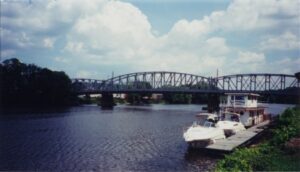
McConnelsville and Malta are two towns that prospered because of the locks and dams built on the Muskingum River from 1836 to 1841. Settlers came to both towns in 1817. In the 1820s and 1830s, flatboats carried grain, lumber, and livestock down the river. The locks and dams made the Muskingum navigable to steamboats, and both towns grew rapidly. Malta was the home of the Brown-Manly Plow Company, a leading maker of farm equipment in the 1800s. Brown-Manly depended on steamboats to bring in raw materials and to take products to markets. Mills at McConnelsville ground grain and shipped flour north to the Ohio Canal and to the east coast, and south to the Ohio River and the Mississippi trade.
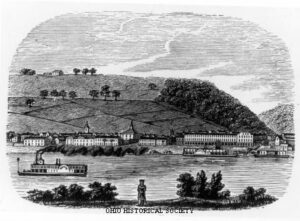
Ripley was incorporated as the village of Staunton in 1812. Its name was changed in 1816 to honor General Eleazer Wheelock Ripley, a hero of the War of 1812. In the years before railroads, Ripley was a principal Ohio River shipping center. Also important were its extensive boat-building, tobacco, pork, and timber industries. Ripley too was the home of saw and planing mills, iron foundries, and a piano factory. Such varied commerce enabled Ripley to remain vibrant throughout the nineteenth century. Although noted as a port, Ripley is best remembered as an abolitionist stronghold. Many of its citizens, including Rev. John Rankin and John P. Parker, served as conductors on the famed “Underground Railroad.” The notoriety of Ripley’s anti-slavery network perhaps eclipsed that of nearby Cincinnati, earning the town a reputation as the “Black Hole of Abolitionism.” (Continued on side two)
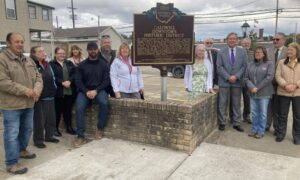
The Caldwell Downtown Historic District is the historic commercial and governmental core of the Village of Caldwell, which was founded in 1857 on farmland owned by Joseph and Samuel Caldwell. Caldwell serves as the county seat of Noble County, the last of Ohio’s 88 counties to be organized. The agricultural community prospered and by 1873 was the second-largest producer of tobacco in Ohio. The Pennsylvania Railroad arrived in 1872, and the development of salt, oil, coal, and natural gas extraction companies followed during the 1880s. Two separate fires in 1897 devastated portions of the north and south quadrants of the district. As a result, Caldwell formed a volunteer fire department and the Village Council introduced legislation prohibiting construction of wood buildings within a block of the public square. (Continued on other side)