On this site stood the home of Elisha and Polly Mygatt Whittlesey and their ten children. Also here was his law office and a records office that was moved in 1965 to Pioneer Village at the Canfield Fairgrounds. Already an attorney in his home state, Elisha (1783-1863) with Polly (1787-1855) emigrated from Danbury, Connecticut in June 1806 to Canfield in the Western Reserve where he was admitted to the Ohio bar and was prosecuting attorney from 1807 to 1823. During the War of 1812, Whittlesey was adjutant to Maj. Gen. Elijah Wadsworth and later a secretary to Gen. William Henry Harrison. Whittlesey opened a law office in Canfield in 1813, specialized in land cases, and was one of the founders of Norwalk, Ohio in 1815. In 1820, he was elected to the first of two terms in the Ohio General Assembly. (Continued on other side)
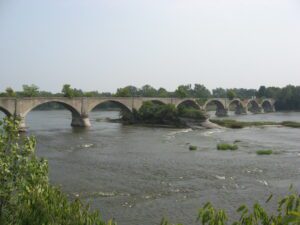
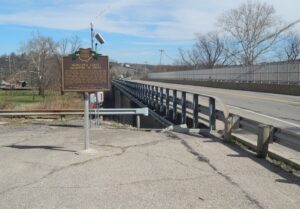
The Lima and Toledo Traction Company Bridge was construted in 1907 by the National Bridge Company of Indianapolis, and it was considered to be a revolutionary type of bridge construction. The Old Electric Bridge, as it was called, was built of steel reinforced concrete and filled with earth. In fact, for this period some considered the bridge to be the longest such railroad bridge in the world. Twelve spans of Roman aqueduct architectural design anchor the 1220-foot bridge in solid river bedrock. The bridge linked Lucas and Wood counties and connected a busy Toledo with points south by means of an electric trolley. This Interurban Bridge was placed on the National Register of Historic Places in 1972.
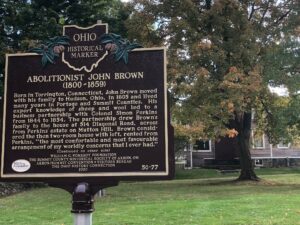
Born in Torrington, Connecticut, John Brown moved with his family to Hudson, Ohio, in 1805 and lived many years in Portage and Summit Counties. His expert knowledge of sheep and wool led to a business partnership with Colonel Simon Perkins from 1844 to 1854. The partnership drew Brown’s family to the house at 514 Diagonal Road, across from Perkins’ estate on Mutton Hill. Brown considered the then two-room house with loft, rented from Perkins, “the most comfortable and most favourable arrangement of my worldly concerns that I ever had.” (Continued on other side)
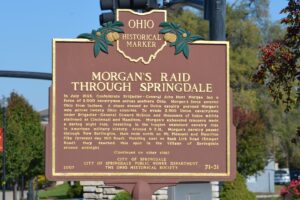
In July 1863, Confederate Brigadier-General John Hunt Morgan led a force of 2,000 cavalrymen across southern Ohio. Morgan’s force entered Ohio from Indiana. A chase ensued as Union cavalry pursued Morgan’s men across twenty Ohio counties. To evade 2,500 Union cavalrymen under Brigadier-General Edward Hobson and thousands of Union militia stationed at Cincinnati and Hamilton, Morgan’s exhausted troopers made a daring night ride, resulting in the longest sustained cavalry ride in American military history. Around 9 P.M., Morgan’s cavalry passed through New Burlington, then rode north on Mt. Pleasant and Hamilton Pike (present day Mill Road). Heading east on Bank Lick Road (Kemper Road), they reached this spot in the Village of Springdale around midnight. (Continued on other side)
Confederate Brigadier General John Hunt Morgan’s Indiana-Ohio Raid, or Great Raid, from July 2-26, 1863 covered nearly 1,000 miles and penetrated deeper into the North than any other Confederate incursion during the Civil War. The raid was also the only significant military action of the war in Ohio. Union cavalry chased Morgan’s 2,000 cavalrymen across twenty-four Ohio counties after the troopers entered the state from Indiana. On July 13, 1863 Morgan’s main column encountered no resistance as it passed through New Haven, about five miles north from this site. (Continued on other side)