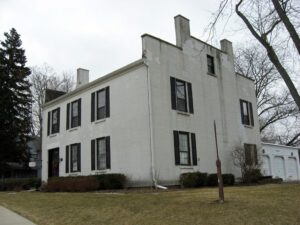
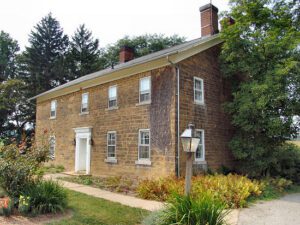
Old Wood County Jail 1847-1870. Built in 1847, during the Presidency of Polk, when Perrysburg was the County Seat, and used as the Jail and Infirmary until 1870. Continued to serve as the Perrysburg Jail until 1899, sold by the town in 1918. Acquired and restored by Mr. and Mrs. Charles W. Hoffmann in 1954. Listed in the Historic American Building Survey and National Register of Historical Landmarks, Library of Congress.
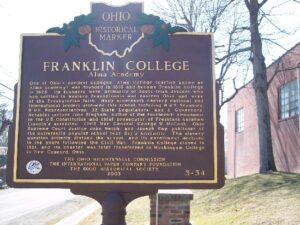
One of Ohio’s earliest colleges, Alma College (earlier known as Alma Academy) was founded in 1818 and became Franklin College in 1825. Its founders were primarily of Scots-Irish descent who had settled in western Pennsylvania and eastern Ohio and were of the Presbyterian faith. Many nineteenth-century national and international leaders attended this school, including 8 U.S. Senators, 9 U.S. Representatives, 32 State Legislators, and 2 Governors. Notables include John Bingham, author of the Fourteenth Amendment to the U.S. Constitution and chief prosecutor of President Abraham Lincoln’s assassins; Civil War General George W. McCook; Ohio Supreme Court Justice John Welch; and Joseph Ray, publisher of the universally popular school text Ray’s Arithmetic. The slavery question bitterly divided the school, and its enrollment declined in the years following the Civil War. Franklin College closed in 1921, and its charter was later transferred to Muskingum College in New Concord, Ohio.
Acclaimed author and illustrator of juvenile literature Lois Lenski was born in Springfield in 1893, grew up in Anna, and graduated from Sidney High School. In 1915, Lenski graduated from The Ohio State University and moved to New York City to work and study art. After illustrating several children’s books in the early 1920s, she began writing and illustrating her own stories. Lenski specialized in historical fiction and regional themes–eventually publishing nearly one hundred carefully-researched books.
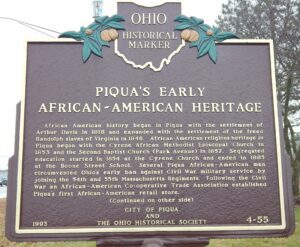
African-American history began in Piqua with the settlement of Arthur Davis in 1818 and expanded with the settlement of the freed Randolph slaves of Virginia in 1846. African-American religious heritage in Piqua began with the Cyrene African Methodist Episcopal Church in 1853 and the Second Baptist Church (Park Avenue) in 1857. Segregated education started in 1854 at the Cyrene Church and ended in 1885 at the Boone Street School. Several Piqua African-American men circumvented Ohio’s early ban against Civil War military service by joining the 54th and 55th Massachusetts Regiments. Following the Civil War an African-American Co-operative Trade Association established Piqua’s first African-American retail store. Continued on/from other side)
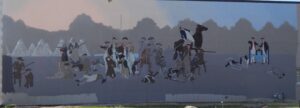
Native Americans inhabited and used much of the land in the Ohio valley as hunting grounds. As American settlers pushed west, conflicts resulted and attempts at peaceful settlement failed. Under political pressure, President George Washington resolved to subdue Indian resistance to American expansion in the Ohio country and appointed General Arthur St. Clair to lead the expedition. St. Clair’s troops camped on the Wabash River (just east of the Ohio-Indiana state line) after an exhausting two-month trek. The ill-prepared soldiers were no match for the forces of Miami, Shawnee, and Delaware Indians who attacked them at dawn of November 4, 1791. By the day’s end, warriors led by Little Turtle and Blue Jacket had killed or wounded nearly three-quarters of the American force-the worst-ever defeat of the U.S. Army by Native Americans in a single battle.
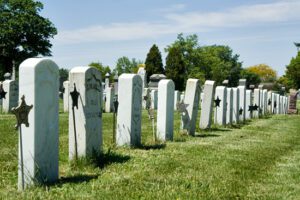
In 1884 the Ohio General Assembly authorized “the burial of the body of any honorably discharged union soldier, sailor or marine of this state who shall hereafter die without leaving means sufficient to defray funeral expenses.” Permanent government-issued headstones have been provided to veterans since the late 19th century. Between 1884 and the 1930s, Washington Cemetery buried 47 white soldiers (including 15 unknown) and 35 African-American soldiers. These veterans served in the Civil War, the Spanish-American War, and WWI. They are remembered for the sacrifices they made. In the fall of 2001, the cemetery underwent significant renovations, in which students of the Washington Senior High School Research History program aided in identifying the buried soldiers and restoring and replacing the gravestones. Here in Soldiers’ Row, the words of local United States Colored Troops veteran, Albert Bird, echo centuries later: “We have suffered to save the country; we ought to be remembered.”
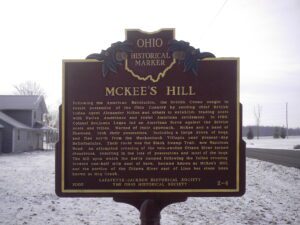
Following the American Revolution, the British Crown sought to retain possession of the Ohio Country by sending chief British Indian Agent Alexander McKee and others to establish trading posts with Native Americans and resist American settlement. In 1786, Colonel Benjamin Logan led an American force against the British posts and tribes. Warned of their approach, McKee and a band of Shawnee, took their possessions, including a large drove of hogs, and fled north from the Mackachack Villages near present-day Bellefontaine. Their route was the Black Swamp Trail, now Napoleon Road. An attempted crossing of the rain-swollen Ottawa River turned disastrous, resulting in the loss of possessions and most of the hogs. The hill upon which the party camped following the failed crossing, located one half mile east of here, became known as McKee’s Hill, and the portion of the Ottawa River east of Lima has since been known as Hog Creek.
Frederick Rice was born on September 29, 1753, near Bethlehem, Northampton County, Pennsylvania and moved to Westmoreland County, Pennsylvania around 1766. During the American Revolution he served under George Washington at Valley Forge and fought in the Battle of Trenton on December 26, 1776, in which American forces surprised and captured 1,000 Hessian mercenaries. He served for two more years as a spy working against Native American tribes in western Pennsylvania. After his service he married Catherine Lauffer, and they raised eleven children to adulthood. Rice chose this 320-acre site, transferred to him in a deed signed by President James Monroe on May 21, 1821, because it offered excellent springs. He assigned the west half to son Simon and the east half to son Barnhart in 1822. Ownership remained in the Rice family until acquired for the Ohio Agricultural Experiment Station in 1891, renamed the Ohio Agricultural Research and Development Center in 1965.