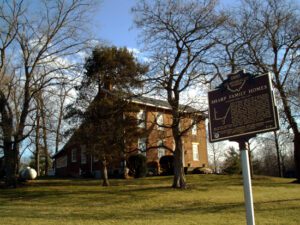
The Sharp family homes and their locations on N. State Street and Africa Road mark an important route through Westerville on the Underground Railroad. The family patriarch, Garrit Sharp, was an original settler of Sharp’s Settlement, now Westerville, and donated land for and helped organize the first Methodist church. He is also associated with the founding of Blendon Young Men’s Seminary, which was acquired by Otterbein College, an institution with enrollment open to African Americans and women from its inception in 1847. He and his sons were all noted abolitionists who, along with Bishop William Hanby and Otterbein president Lewis Davis, assisted southern slaves on their road to freedom. From the Sharp homes, slaves would have proceeded north to the house of Samuel Patterson on Africa Road and along Alum Creek to the Quaker settlement near Marengo in Morrow County.
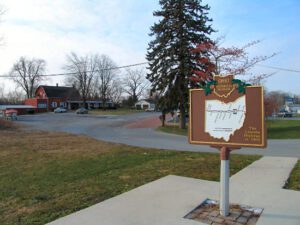
Conceived by leaders of the automobile industry to encourage the building of “good roads,” the Lincoln Highway was established in 1913 as the first transcontinental automobile route in the United States. It traversed twelve states and 3,389 miles from New York to San Francisco. The first route across Ohio connected Van Wert, Delphos, Lima, Ada, Upper Sandusky, Bucyrus, Galion, Mansfield, Ashland, Wooster, Massillon, Canton, Minerva, Lisbon, and East Liverpool. By the 1930s much of the original route had become part of the Federal Highway System and U.S. Route 30–many miles of which have, in turn, been bypassed by modern four-lane highways.
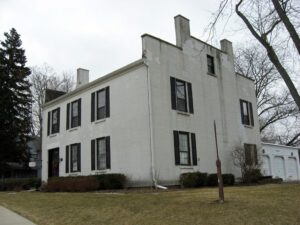
Old Wood County Jail 1847-1870. Built in 1847, during the Presidency of Polk, when Perrysburg was the County Seat, and used as the Jail and Infirmary until 1870. Continued to serve as the Perrysburg Jail until 1899, sold by the town in 1918. Acquired and restored by Mr. and Mrs. Charles W. Hoffmann in 1954. Listed in the Historic American Building Survey and National Register of Historical Landmarks, Library of Congress.
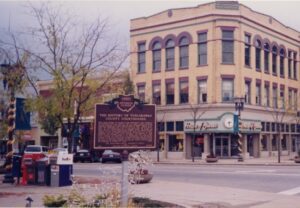
When David Knisely, the founder of New Philadelphia, first arrived in the Tuscarawas Valley on August 27, 1803, he found a sparsely populated, pristine wilderness. Five years later the state legislature approved a bill organizing Tuscarawas County effective March 15, 1808. Shortly thereafter, New Philadelphia was chosen as the county seat, and on April 16, 1808, the first commissioners met at Leininger’s tavern. By August, the tavern proved to be an inappropriate location for the county’s official business, and the commissioners approved the construction of a two-story, combination jail and county office building on land donated by John Knisely on the northeast corner of the square. By 1818 a new, larger brick courthouse was authorized by the commissioners. This building was occupied in 1825 and served as the courthouse until 1882 when the present structure was approved. Occupied in 1888, the building continues to be the center of the county’s business. The beautiful, state-of-the-art annex was dedicated on October 27, 1990.
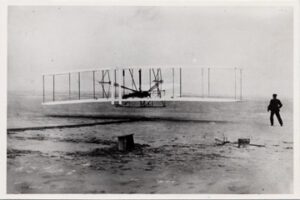
In 1899, Wilbur and Orville Wright of Dayton built a kite to test a revolutionary flight control system, and in 1900, built their first airplane (glider). With promising results, the Wrights built man-carrying gliders and airplanes to refine their ideas. Wind tunnel experiments led to accurate calculations of lift and drag. In 1903 in Kitty Hawk, North Carolina, they made the first sustained, controlled, powered flight in history, lasting 12 seconds. By 1905, the Wright brothers had developed the first practical airplane and the skills to pilot it. The U.S. Army Signal Corps purchased a Wright flyer, the first practical military aircraft, in 1909. Through public demonstrations beginning in 1908, the Wright brothers showed the world the future of aviation.
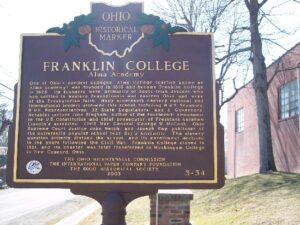
One of Ohio’s earliest colleges, Alma College (earlier known as Alma Academy) was founded in 1818 and became Franklin College in 1825. Its founders were primarily of Scots-Irish descent who had settled in western Pennsylvania and eastern Ohio and were of the Presbyterian faith. Many nineteenth-century national and international leaders attended this school, including 8 U.S. Senators, 9 U.S. Representatives, 32 State Legislators, and 2 Governors. Notables include John Bingham, author of the Fourteenth Amendment to the U.S. Constitution and chief prosecutor of President Abraham Lincoln’s assassins; Civil War General George W. McCook; Ohio Supreme Court Justice John Welch; and Joseph Ray, publisher of the universally popular school text Ray’s Arithmetic. The slavery question bitterly divided the school, and its enrollment declined in the years following the Civil War. Franklin College closed in 1921, and its charter was later transferred to Muskingum College in New Concord, Ohio.
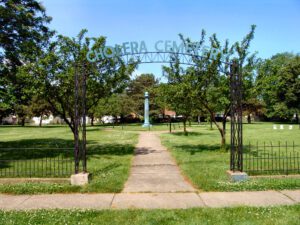
Of the city’s 5,667 people in 1849, 3,500 fled, and 400 of those remaining were victims of cholera. Most are buried here, some only in rough boxes in a common grave. The scourge came again in 1850 and 1852 but with less toll. “Dismay stalked abroad in the daytime and the drowsy night was hideous with the wailings of the disconsolate.”
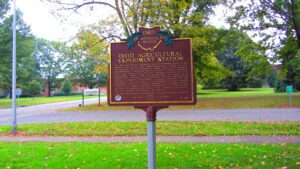
The Ohio General Assembly established the Ohio Agricultural Experiment Station in 1882. From its inception until 1892, the Station occupied 17 acres on the Columbus campus of The Ohio State University before relocating to 470 acres in Wayne County. In 1965, the Station changed its name to the Ohio Agricultural Research and Development Center (OARDC) to more accurately reflect its mission and programs. In 1982, the Center formally merged with The Ohio State University. Today, the Center encompasses nearly 2,100 acres in Wayne County with 10 branches located across the state for a total of approximately 7,100 acres dedicated to agricultural research.