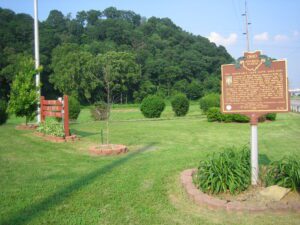
The Scioto Salts Licks, located in and around Jackson, is an area where naturally occurring salt water, known as brine, flowed to the surface as a salt-water spring. It is known that the spring existed since the Pleistocene Ice Age because numerous bones, probably including those of mammoth and ground sloth, were excavated there. Native Americans obtained salt here for at least 8,000 years and did so until 1795 when the Treaty of Greenville separated the Native American and European populations. Early pioneer settlers utilized the licks in the second half of the eighteenth and first half of the nineteenth centuries, constructing salt furnaces that extended for four miles up and down Salt Lick Creek. Salt was a precious and necessary commodity, and the early settlers in the area profited from its trade.
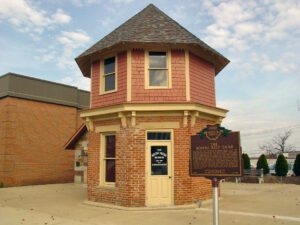
On this site in October of 1870 met a group of enlightened individuals dedicated to the reformation and improvement of penal systems. This first Congress of the National Prison Association, now known as the American Correctional Association, adopted a far-sighted philosophy of corrections. This philosophy, embodied in its Declaration of Principles, remains today as the basic guide for modern correctional systems.
Administration Building built in 1931. Chapter House built in 1962. Commemorating American Red Cross Centennial, 1881-1981.
Early Western Reserve burial grounds, 1804-1848. Grave sites of 12 Revolutionary War veterans and Mary Chesney, member of pioneer Warren family and for whom local D.A.R. chapter was named.
A native of New Boston, Vernal G. Riffe Jr. served the 92nd House District in the Ohio General Assembly from 1959 to 1994. As Speaker of the Ohio House of Representatives from 1974 through 1994, he served longer than any other speaker in the state’s history. Widely regarded as Ohio’s most influential legislator of the late 20th century, Riffe, a Democrat, built effective political alliances across party lines. A powerful advocate for southern Ohio, he was instrumental in the growth and expansion of Shawnee State University.
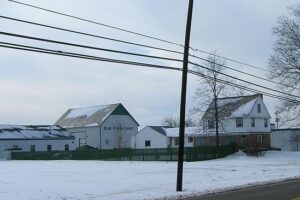
In 1927, Henry Abell, a master plumber, purchased a 100-acre dairy farm. When the Great Depression struck the nation two years later, Abell could find little work as a plumber and decided to develop his dairy farm. In 1934, he and his family began the Dairy, growing the farm to 500 acres and producing enough milk, ice cream, and other dairy products to supply five counties. The dairy closed in 1979, but today houses America’s Ice Cream and Dairy Museum, dedicated to the cultural history of the ice cream and dairy industry in Ohio and the United States.
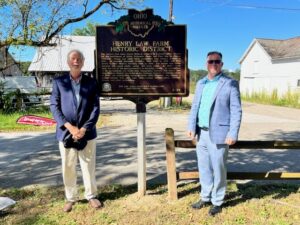
The historic Law Farm (circa 1846) is situated in a broad valley formed by the confluence of Little Stillwater Creek and Plum Run in Monroe Township. Henry Law (1812-1869) immigrated from Ireland to Ohio in 1830. He married Elizabeth McMillan (1818-1892) in 1839, and they moved to their Monroe Township farm by 1846. The couple had eleven children and raised cattle, sheep, and other crops. By 1860, their farm was one of the most productive in Harrison County. In recognition of its agricultural and Scots-Irish immigration history, the Henry Law Farm Historic District was listed on the National Register of Historic Places in 2002. Its contributing buildings (1846-1920) included: two houses; a summer kitchen; tool, milk, coal, smoke houses; multiple barns; carriage houses; and other outbuildings.
This historic village was a hub for early Ohio industry and travel. The natural geography of the area provided ideal conditions for the establishment of a variety of mills. Col. Robert Patterson, an ancestor of the founder of National Cash Register in Dayton, John Patterson, chose Clifton for the site of a woolen mill, which furnished material for the American army during the War of 1812. Davis Mill, established in 1802 and in operation today as Clifton Mill, produced meal and flour for Civil War troops. A major stop on the stagecoach trail, “The Accommodation Line,” which ran from Springfield to Cincinnati from 1827 to 1840, the village bustled with the commotion of travelers. The once flourishing industry of Clifton faded as railroad traffic bypassed the village and manufacturers left the area.
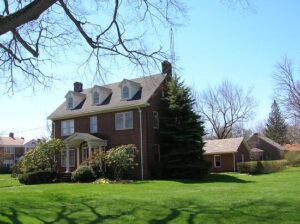
Harold Hart Crane was born at this site on July 21, 1899, to Grace Hart Crane and Clarence A. Crane, the inventor of Lifesaver Candies, and lived here until the age of three. “A born poet,” according to e.e. cummings, Crane dropped out of high school in 1916 and moved from Cleveland to New York City to focus on a literary career. Mainly self-educated, Crane drew his influence from the writings of Walt Whitman and Emily Dickinson. His major work, The Bridge (1930), uses the Brooklyn Bridge as the perfect metaphor to celebrate contemporary urban life. Uniquely lyrical in structure and full of imagery, it is considered one of the three major poetic sequences of the first half of the twentieth century along with T.S. Eliot’s The Waste Land and William Carlos Williams’ Paterson. Crane died on April 26, 1932.