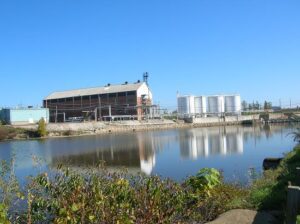
Attracted by the availability of raw materials and railroad transportation, the Pittsburgh Plate Glass Company (PPG) built a plant here in 1899 to make soda ash for the company’s glassmaking operations. This plant began production in 1900 as the Columbia Chemical Company and represents the beginning of PPG’s diversified chemical manufacturing operations. During the 20th century this plant operated the world’s deepest (at 2,200 feet) limestone mine and manufactured commodity chemicals such as chlorine, caustic soda, and calcium chloride. By 2000, manufacture of specialty chemicals for the optical, pharmaceutical, printing, and rubber industries superseded mining and commodity chemical manufacturing. PPG’s reclamation of its former soda ash waste disposal sites, known as “lime lakes,” has won recognition for environmental stewardship.
Parking area along the river E of intersection of Main Street and Lynn Street
Pomeroy
, OH
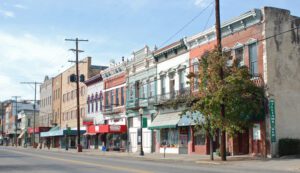
Since it was formed in 1819, Meigs County was fostered by its location on 57 miles of the Ohio River, named by the Indians”Oyo,” meaning beautiful river. Pomeroy, the county seat, was named for Samuel Wyllys Pomeroy, an early landholder. His company, Pomeroy, Sons & Company, and his son-in-law, Valentine B. Horton (1802-1888), were influential in developing the coal, salt, and iron industries of the region. Horton pioneered the transportation of coal by river, building the world’s first coal barges and, in 1835, the first coal-fueled towboat, the Condor. Coal, salt, and iron, in addition to other local products, were shipped from Pomeroy’s 125′ x 40′ wharf to ports from Pittsburgh to Cincinnati. Excursion, passenger, shanty and showboats also visited Pomeroy’s port. Today, the Ohio River continues to be a busy waterway carrying commodities such as coal, petroleum, chemicals, steel, sand, and gravel. It is also a busy haven for recreational crafts as well as stern wheel boats.
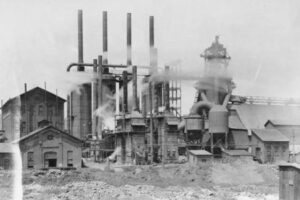
Believed to have been constructed in 1866, this facility is one of the largest of its kind in the nation. The complex of 200 ovens was erected by the Leetonia Iron and Coal Company, later known as the Cherry Valley Iron Works, to supply fuel for pig-iron producing blast furnaces that stood south of this site. The man-made “beehive” ovens were used to transform hard coal into coke. The “coking” process burnt impurities out of the coal. The end product — coke — was the best fuel source for the furnaces that were used to manufacture iron and steel. The facility discontinued operations in the early 1930s at the height of the Great Depression.
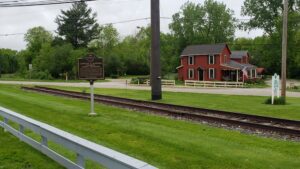
The Randall Secondary rail line dates to the 1850s when the independent Cleveland & Mahoning Railroad (C&M) laid tracks through Aurora, Ohio. C&M, chartered in 1848, linked the Mahoning Valley coal and iron ore fields to the industries and lake port at Cleveland. For over a century, the Randall Secondary contributed to Aurora’s economic life ? fueling the region’s rapid growth during the late 19th and early 20th centuries. In its heyday, the line was an important route for commuter transport and freight service along the 67 miles between Cleveland and Youngstown. Although passenger service into Aurora Train Station stopped in the 1960s, freight service continued into the 1990s. The last remaining track of the Randall Secondary in Aurora stands near the station it served.
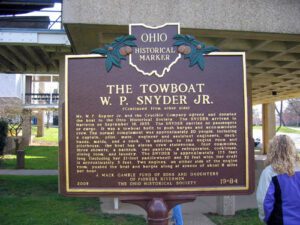
The W.P. SNYDER Jr. is one of the few links between the age of steam-powered, stern-wheeled towboats and the diesel-powered, propeller-driven vessels that push barges on America’s rivers today. The James Rees and Sons Company in Pittsburgh built the boat for the Carnegie Steel Company, and she was launched in 1918 as the W.H. CLINGERMAN. During the boat’s working life, she primarily pushed barges loaded with coal on the Monongahela and Ohio Rivers. After various changes in name, the Crucible Steel Company of America bought the boat in 1945 and named her the W.P. SNYDER Jr. after the company’s president. Crucible retired the SNYDER in 1954 and, as was the fate of her kind, she would have probably been scrapped. In 1955, however, the Sons and Daughters of Pioneer Rivermen and the Ohio Historical Society concluded that one example of a steam towboat should be preserved. (continued on the other side)
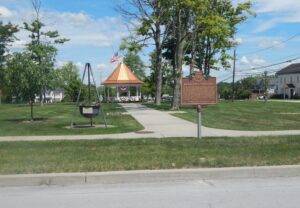
In 1798, Judge Samuel Hinckley of Northampton, Massachusetts, drew the 72nd draft in the land lottery held by the Connecticut Land Company and received 15,305 acres in Township 4, Range 1, for which he paid $12,903.23, less than one dollar per acre. The area had been inhabited for many years by trappers, missionaries, and Native Americans. One of the earliest settlers was James McMullen, who acquired the first 160-acre parcel from Hinckley in 1801. Brookfield Township became the crown jewel of Hinckley’s holdings. Hinckley named Brookfield after a city in England and set aside land for the village green and the cemetery stating that they were for public use forever. During the mid-1820s the Overland Stage Line had a run through Brookfield, linking it to Salem, Warren, and Youngstown in Ohio and Erie, Pennsylvania and Dunkirk, New York. (Continued on other side)
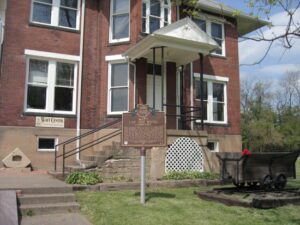
Joseph Watt and son James H. started a small foundry in 1862 making plow points, window sash weights, and heating stoves. Later, brothers Stewart, Ross, and John W. joined and the name became J.H. Watt and Brothers. Securing a patent for a self-oiling mine car wheel, the business expanded to this 27-acre site. In 1891, Ohio gubernatorial candidate, and later U.S. president, William McKinley, dedicated the buildings. By 1901, over 135 were employed by Watt Mining Car Wheel Company producing mine and rail cars for U.S. and foreign markets. The Watt Car and Wheel Company was sold in 1966 to German interests and closed in 1996, ending an era of employment for generations of local people.
Trumbull County Courthouse Square, 161 High Street NW
Warren
, OH
The decision to build the P&O Canal resulted from several canal conventions at Warren’s first courthouse in 1833. Canal advocates from Warren included Simon Perkins, Leicester King, David Tod, and Calvin Pease. Finished in 1840, this 82 mile canal linked two north-south canals, the Beaver Canal and the Ohio and Erie Canal, via an east-west route for passengers and commerce. By 1856, the Pennsylvania & Ohio Canal was replaced by the railroad and the entire route was abandoned by 1872. (Continued on other side)