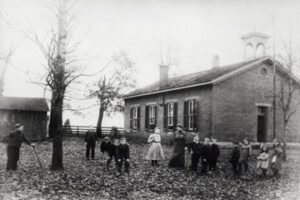
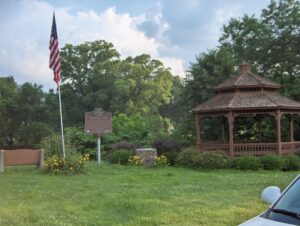
In 1854, Samuel and Rebecca McClellan Collins deeded 1.28 acres to Beavercreek Township, Greene County, for the purpose of building a schoolhouse. The first two schoolhouses were constructed of stone with fireplaces for heat. Collins neighborhood children in first through eighth grade were educated in the present red brick building until 1944, when decreased enrollment forced Xenia Township to close the school. Virgil and Helen Bryson Brantley, great-granddaughter of Samuel and Rebecca Collins, purchased the school property in 1982 and began the restoration of the vandalized and deteriorated schoolhouse. The pony/coal shed and privies were rebuilt on their foundations. (Continued on other side)
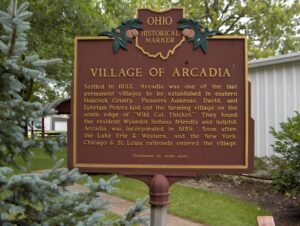
Settled in 1833, Arcadia was one of the last permanent villages to be established in eastern Hancock County. Pioneers Ambrose, David, and Ephriam Peters laid out the farming village on the south edge of “Wild Cat Thicket.” They found the resident Wyandot Indians friendly and helpful. Arcadia was incorporated in 1859. Soon after, the Lake Erie & Western, and the New York Chicago & St. Louis railroads entered the village. (Continued on other side)
During the 9-month Hocking Valley Coal Strike beginning in June 1884, tensions between the Columbus & Hocking Coal and Iron Company and striking miners led to violence and destruction. Starting October 11, 1884, unknown men pushed burning mine cars into six mines located around New Straitsville to protest being replaced by “scab” workers. Mine operators attempted to plug all fissures to no avail. As years passed, ground collapsed under buildings and roadbeds, and mine gases seeped into schools and homes. Residents were evicted and homes demolished. Potatoes baked in the heated soil and roses bloomed in the winter. At times, the fire soared 100 feet in the air and could be seen for five miles. (Continued on other side).
On July 3, 1872, 16 men and a 9-year old boy descended the 170 foot shaft in the Atwater Coal Company Mine located in Atwater Township south of Route 224 and East of Route 225. The mine was situated on the property known as the S.G. Shaffer Farm. By mid-day, 7 miners survived the brutal fire in the mine. Richard Roberts, Robert Roberts, William Roberts, Thomas Maines, Joseph Otey, John Williams, John Howells, John Jones and 9-year old George Hufford gave their lives to the first Mining Disaster in Ohio and the 19th mining disaster in the United States since 1839 with more than 5 fatalities. In 1873, Ohio was the second State to pass a law for the safety of Miners.
First surveyed in 1849, Powhatan Point was laid out by Franklin Knox. The “point” is the confluence of Captina Creek and the Ohio River. The small but thriving river and farming community served York Township and the rich Captina Valley as a shipping center for its first 75 years. Given impetus by the construction of the Powhatan Enterprise Flouring Mill and Woolen Factory in 1850, local businesses shipped grain, fruit, lumber, cheese, whiskey, livestock, wool, and tobacco to northern and southern ports. There were three boat landings: Boger’s, Hornbrook’s and Dorsey’s, each equipped with an incline car track from the warehouses to the river’s edge. With the opening of North American Coal Corporation’s Powhatan No. 1 Mine in 1922, the village became a mining community that continued to rely on the river. A disastrous mine fire took the lives of 66 men on July 5, 1944.
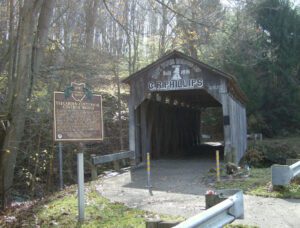
The Teegarden-Centennial Covered Bridge, constructed primarily of white oak is of Multiple King Post design spanning 67 feet. It was built nearly 100 years after the birth of the nation. Located on Eagleton Road, just off Teegarden Road, it is still at its original location, spanning the Middle Fork of the Little Beaver Creek in Eagleton’s Glen Park. It remained in use until 1992 when it was bypassed by a new concrete structure. The official contract for the construction of the bridge was awarded to Jeremiah C. Mountz in June of 1875. The stonework for the abutments was awarded to David Reese and painting of the original structure to George W. Akin in 1876. Members of Highland Christian Church came here to be baptized by immersion. There were over 250 covered bridges in Columbiana County, including at least 16 railroad covered bridges. The Teegarden-Centennial Covered Bridge is one of only five still remaining.
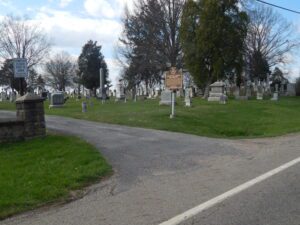
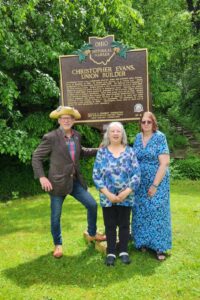
Christopher Evans was a celebrated district, state, and national union builder. Born in England in 1841, he began coal mining as a young boy. Evans immigrated to Pennsylvania around 1869-1870. By 1874 he was president of his local mining union. Evans moved to New Straitsville between 1875-1877, where he organized union meetings in Robinson’s Cave. During the miners’ strike of 1884-1885, Evans served as president of the Hocking Valley District of Ohio and its Relief Committee. After area mines were set on fire, miners were forced to abandon New Straitsville when its mines closed forever. Evans helped organize the United Mine Workers of America in 1890 and later authored a two-volume history of the movement. He remained in union leadership until retiring in 1908. Christopher Evans died in 1924 and is buried in New Straitsville Joint Cemetery.
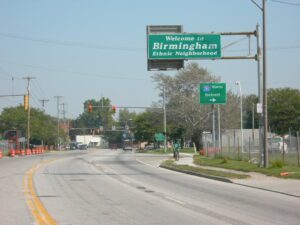
The Birmingham and Ironville neighborhoods were so named because of their early iron industries located along Front Street and the Maumee River. This became Toledo’s first area of heavy industrial development with iron manufacturing, coal shipping, oil refining, shipbuilding, and flour milling operations. In 1864 the Manhattan Iron Company built a charcoal blast furnace near the river’s mouth, securing fuel from nearby forests.