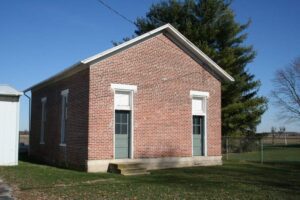
Elizabeth Township was founded in 1807. The Elizabeth Township House was built about 1870, serving as the community’s assembly hall. The building is similar to the seven remaining one-room, brick schoolhouses, built throughout the township between 1868 and 1873. In 1997, the township was added to the National Register of Historic Places as Ohio’s first rural historic district. The district includes all of Elizabeth Township and parts of Staunton and Bethel townships. This marker erected to commemorate the 200th anniversary of the township’s founding.
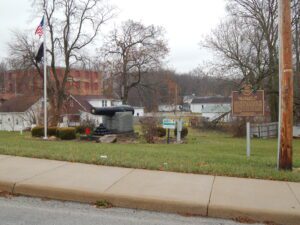
The roots of Huntersville began when John and Elizabeth Hilliard purchased this former Shawnee tribal land in 1797 from Ohio’s largest land speculator Judge John Symmes. When Symmes defaulted on his payments, the Hilliards found themselves repurchasing their own land from the federal government. These uncertain land claims defeated their 1799 attempt to found “Hilliardstown.” David Hunter purchased the abandoned village site in 1833. He re-surveyed the land in 1838 creating an eighteen lot, two street village that he named Huntersville. The village incorporated in 1848, but was annexed by the neighboring city of Piqua in 1893. At the time Huntersville had a population of over 760, its own school system, a volunteer fire department, gas lights, and an assortment of saloons, boarding houses, and grocery stores.
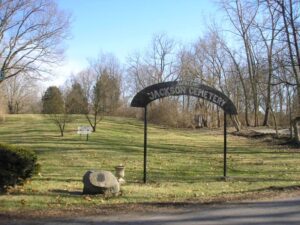
In 1833, John Randolph from Roanoke, Virginia, died leaving three wills that requested that all of his slaves be set free and that land be purchased for them. Although contested for thirteen years by his family, the slaves were freed and the executor of the wills, Randolph’s cousin Judge William Leigh purchased about 2,000 acres of farm land in Mercer County, Ohio. Traveling by wagon train, the freed slaves, 383 in all, reached their destination in 1846, but were forced to turn back by earlier established white settlers. They turned around and ended up north of Piqua where they purchased land and developed the Village of Rossville. Later some moved on to other places in Miami County and well as Shelby County. In Rossville, they established an African Baptist Church in 1869, cemetery in 1866, and public black school in 1872.
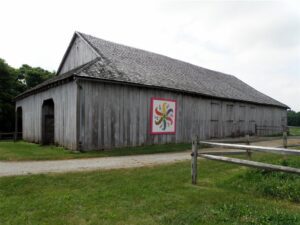
With the intention of becoming a “gentleman farmer,” John Johnston began development of his Upper Piqua farm in 1808 with a two-story log cabin and this double pen log barn. The surrounding outer sheds were built to protect the log pens from the weather. One of the oldest structures of its kind in Ohio, the barn is built around two hand-hewn log pens, each sixty-foot square. The barn served the family’s farming activities and was a storage facility for trade goods Johnston needed when the farm was the Piqua Indian Agency, 1811-1829.
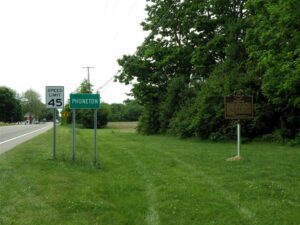
Once the center of telephone communications in America, Phoneton, originally platted as Phonetown, was established in 1893 by the American Telephone and Telegraph Company (AT&T) as the place to service and operate three major telephone and telegraph lines that intersected here on the National Road. AT&T built a repeater station to service the lines and employed as many as forty switchboard operators who lived in a hotel and boarding house constructed by the company. Other employees were bused in from neighboring towns. All operations were moved to Dayton in 1936.
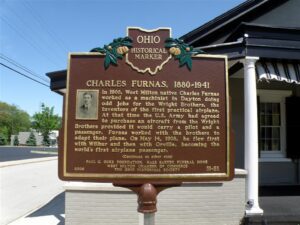
In 1908, West Milton native Charles Furnas worked as a machinist in Dayton doing odd jobs for the Wright Brothers, the inventors of the first practical airplane. At that time the U.S. Army had agreed to purchase an aircraft from the Wright Brothers provided it would carry a pilot and a passenger. Furnas worked with the brothers to adapt their plane. On May 14, 1908, he flew first with Wilbur and then with Orville, becoming the world’s first airplane passenger. (continued on other side)
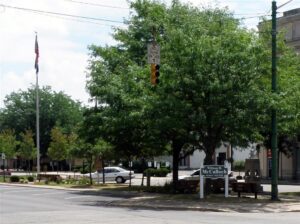
William McCulloch was born in Holmes County where he was educated in a one-room schoolhouse before moving to Wooster to attend high school and the College of Wooster. He attained prominence as Ohio’s Speaker of the House from 1939-1943 and House member from the Fourth Ohio Congressional District from 1948-1973. During his time in Washington, McCulloch was best known as a co-sponsor and staunch advocate of the Civil Rights Act of 1964. He was recognized by President Lyndon Johnson as the prime mover for passage of this landmark legislation. As a conservative Republican voice in the House, he was instrumental in championing other civil rights legislation, including fair housing and public accommodations. McCulloch was a founding partner in 1928 of the Piqua law firm that bears his name.
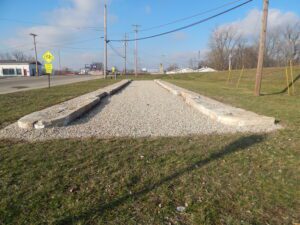
Construction of the Miami Extension of the Miami and Erie Canal, which included Troy, began around 1834. Lock 12 was built in 1836. General William Henry Harrison and other dignitaries officially opened the Troy section on July 4, 1837. The canal brought prosperity to the area, as its products were shipped to new markets and more people moved here. The last canal boat came through Lock 12 in 1912 and the disastrous flood of March 1913 finally ended Troy and Ohio’s canal era. Evidence suggests that in the late 1920s, the Hobart Brothers Company’s building on West Main Street covered part of the lock. The building and lock were razed in 2015. The footprint monument was dedicated June 7, 2017 and includes stones from Lock 12.