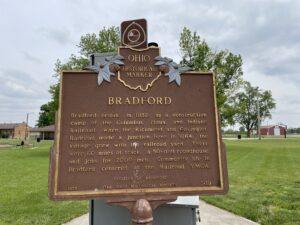
Bradford began, in 1852, as a construction camp of the Columbus, Piqua, and Indiana Railroad. When the Richmond and Covington Railroad made a junction here in 1864, the village grew with the railroad yard. There were 60 miles of track, a 50-stall roundhouse, and jobs for 2000 men. Community life in Bradford centered at the Railroad YMCA.
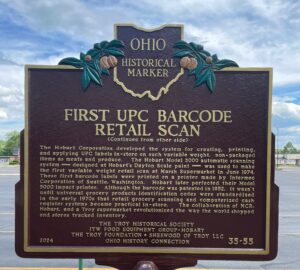
On June 26, 1974, the first retail scan of a product marked with a Universal Product Code (UPC or barcode) was made in the checkout line of Troy’s Marsh Supermarket located at 982 N. Market Street. A ten-pack of Wrigley’s Juicy Fruit chewing gum was scanned to simulate the purchase of a product. The barcode was scanned on the NCR 255 computerized check-out system developed by National Cash Register (NCR). The system featured a Spectra Physics Model A scanner and an NCR 726 in-store computerized cash register. The Troy grocery store, considered a “typical” American grocery, was conveniently located near NCR and Hobart facilities. Spectra Physics and NCR later donated one of the original scanners and cash registers used at Marsh’s to the National Museum of American History, Smithsonian. (Continued on other side)
The Piqua Nuclear Power Facility was part of the U.S. Atomic Energy Commission’s Power Demonstration Reactor Program. The program developed experimental nuclear reactors that could supplement steam generation for electricity production. In 1956, the commission accepted Director of Municipal Utilities John P. Gallagher’s proposal to build a reactor in Piqua and the following year Congress set aside $11,465,000 for the project. The Piqua Nuclear Power Facility was the first nuclear power plant of any type to be operated by a municipal utility. It reached criticality in 1963 and, for a few years, Piqua proudly called itself “The Atomic City.” The reactor was shut down due to technical issues and economic considerations in 1966. It was fully decommissioned by February 1969. The facilities were demolished in 2023.
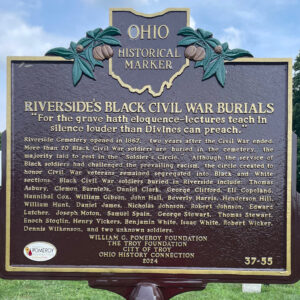
Black soldiers played a major role in the Civil War and more than 5,000 free Black Ohioans served in Union forces. While prejudice marginalized the Black man’s ability to serve early in the war, an 1862 Act of Congress authorized their admission into the Union Army and Navy. President Abraham Lincoln’s 1863 Emancipation Proclamation welcomed all freed men to join the fight. About 300 Black Ohioans joined the 54th and 55th Massachusetts (Colored) Volunteers – the first all-Black regiments raised in the North. Although offered $13 per month, the new recruits had to wait eighteen months to receive equal pay. In June 1863, Ohio’s Governor David Tod authorized a regiment of Black soldiers. The 127th Ohio Volunteer Infantry (OVI), the state’s first Black regiment, became known as the 5th U.S. Colored Troops (USCT).