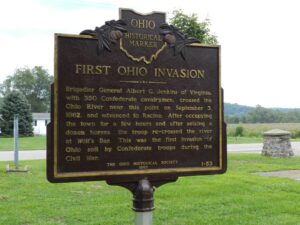
Brigadier General Albert G. Jenkins of Virginia, with 350 Confederate cavalrymen, crossed the Ohio River near this point on September 3, 1862, and advanced to Racine. After occupying the town for a few hours and after seizing a dozen horses, the troops re-crossed the river at Wolf’s Bar. This was the first invasion of Ohio soil by Confederate troops during the Civil War.
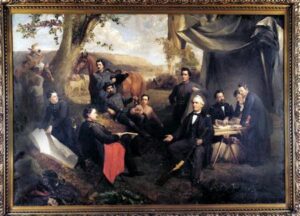
Major Daniel McCook of Carrollton and his 9 sons and their cousins, the 5 sons of Dr. John McCook of Steubenville, won popular acclaim for their outstanding service in the United States Army and Navy. “Tribe of Dan” Maj. Daniel: mortally wounded at Buffington Island. Maj. Latimer: a surgeon. Brig. Gen. George: early regimental commander. Midshipman John: died at sea. Brig Gen. Robert: murdered by guerrillas. Maj. Gen. Alexander: commander of the 20th Corps. Brig. Gen. Daniel Jr. mortally wounded at Kenesaw Mt. Maj. Gen. Edwin: served under Grant and Sherman. Pvt. Charles: killed at Bull Run. Col. John: seriously wounded in Virginia.
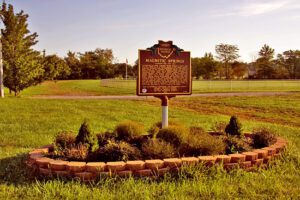
Near this site in 1879, J.E. Newhouse discovered a magnetic spring in his park, Green Bend Gardens. It was found that a knife blade dipped in the water could pick up small metal objects like a magnet. The spring became known for its curative powers and was advertised as a treatment for ailments including rheumatism, gout, insomnia, and diseases of the kidneys, bladder, and nerves. To share the health-giving water, Mr. Newhouse opened the Magnetic Bath House, which became famous for its water cures. To reach a larger market, the magnetic water was sterilized and bottled and sold under the Magnetic Springs label. Advances in medicine after World War II led to the decline in the popularity of mineral baths.
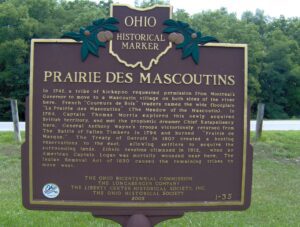
In 1742, a tribe of Kickapoo requested permission from Montreal’s Governor to move to a Mascoutin village on both sides of the river here. French “Coureurs de Bois” traders named the wide floodplain “La Prairie des Mascoutins” (The Meadow of the Mascoutin). In 1764, Captain Thomas Morris explored this newly acquired British territory, and met the prophetic dreamer Chief Katapelleecy here. General Anthony Wayne’s troops victoriously returned from The Battle of Fallen Timbers in 1794 and burned “Prairie de Masque.” The Treaty of Detroit in 1807 created a hunting reservation to the east, allowing settlers to acquire the surrounding lands. Ethnic tensions climaxed in 1812, when an American Captain Logan was mortally wounded near here. The Indian Removal Act of 1830 caused the remaining tribes to move west.
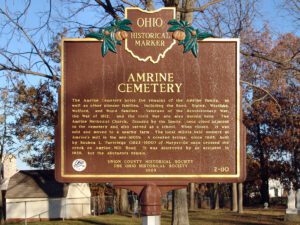
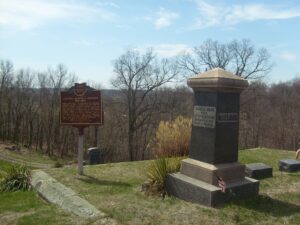
The first permanent settlement in the Marysville area, was founded in 1817 by Revolutionary War veteran Abraham Amrine (1761-1849) and his sons. The Amrines emigrated from Switzerland to Pennsylvania in the early 1700s and, after living in Belmont County, Ohio for 16 years, Abraham purchased 1000 acres here along Mill Creek circa 1817, paying $2 an acre. When Paris Township was organized in 1821, the township officers were elected in Amrine’s home on Newton Pike (now Raymond Road). All seven of his sons, John, Andrew, Moses, Frederick, Jeremiah, Abraham, Jr., and Henry, settled here. Andrew was a Justice of the Peace and leader in the church. Near this site, Henry built a sawmill in 1822 and a gristmill in 1825, which were operated by the family for more than 50 years.
In Greenwood Cemetery, at the end of Greenwood Road
Racine
, OH
Born at Oak Grove, prospected in the California goldfields in 1849. During the Civil War he raised a militia company at Racine, and was later promoted Captain of Co. K, 18th O.V.I. After the war, he served on the Racine Village council, Sheriff of Meigs County, and was a member of the Ohio General Assembly. He was Secretary-Treasurer of the Ohio Commission for the Chichamauga Battleground National Park, and served 14 years as Postmaster of the U.S. House of Representatives.
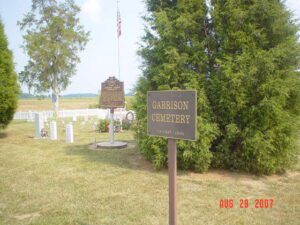
Descendants of Lemuel Garrison Sr., a Revolutionary War soldier, were among the first Europeans to own and settle land at Garrison Corner (intersection of State Route 123 and Shawnee Trace) . Garrison Cemetery burials took place from ca. 1837 to 1936. The cemetery has 327 lots. Eighty-six burials are documented including veterans John J. Garrsion, Benjamin Garritson, James Knicely, Nicodemus Rude, and William Rude. (continued on other side)
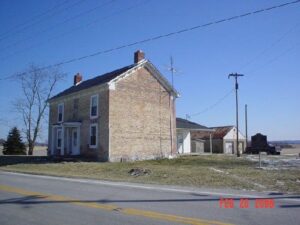
The inn was built 1800-01 by Peter Wickerham, a Revolutionary War veteran. It was used as an overnight stagecoach stop and tavern on Zane’s Trace until ca. 1850. Runaway slaves were hidden here when the “Underground Railroad” was in operation. Confederate soldiers, commanded by General John Hunt Morgan, slept in the inn on the night of July 15, 1863, when “Morgan’s Raiders” passed through Adams County.