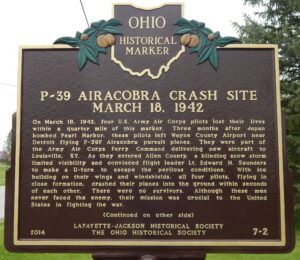
On March 18, 1942, four U.S. Army Air Corps pilots lost their lives within a quarter mile of this marker. Three months after Japan bombed Pearl Harbor, these pilots left Wayne County Airport near Detroit flying P-39F Airacobra pursuit planes. They were part of the Army Air Corps Ferry Command delivering new aircraft to Louisville, KY. As they entered Allen County, a blinding snow storm limited visibility and convinced flight leader Lt. Edward H. Saunders to make a U-turn to escape the perilous conditions. With ice building on their wings and windshields, all four pilots, flying in close formation, crashed their planes into the ground within seconds of each other. There were no survivors. Although these men never faced the enemy, their mission was crucial to the United States in fighting the war.
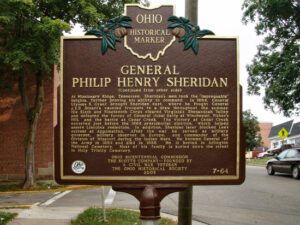
Philip Sheridan was most likely born in County Cavan, Ireland in 1831, but records do not indicate his actual birthplace. His family moved to Somerset when Philip was a child and lived down the avenue from this site. His family later owned the house across the street. His military interest was inspired by “Muster” day and frequent visits from a young West Pointer named William T. Sherman. Sheridan graduated from the United States Military Academy in 1853 and served on the Western Frontier Indian campaigns prior to the Civil War. In 1862, Sheridan became Colonel of the Second Michigan Calvary. At Stones River, Tennessee, he commanded a Division of the Twentieth Corps and stubbornly held General William S. Rosecrans’ right flank, distinguishing himself in battle. (continued on other side)
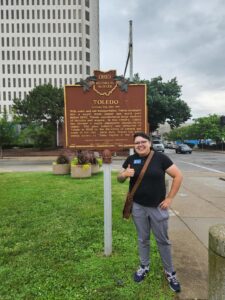
After consolidation of the villages of Fort Lawrence and Vistula, the City of Toledo was incorporated in 1837. Originally named “Toledo” in 1833, the site became part of Ohio when the “Toledo War,” a bloodless boundary conflict with Michigan, was resolved by Congress in 1836. Settlers were attracted by the commercial potential of the Maumee River, called “Miami of the Lake,” and later the Miami-Erie Canal. (Continued on other side)
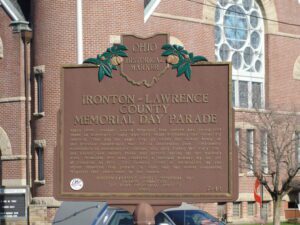
Since 1868, Ironton’s annual Memorial Day parade has recognized those in Lawrence County who died while defending our country’s freedom. This was the same year in which the Grand Army of the Republic established May 30 as Decoration Day. Originally established to commemorate soldiers who died during the Civil War, the parade now honors those who served during all the nation’s wars. Memorial Day was declared a national holiday by an act of Congress in 1971. The Ironton event is recognized as the oldest Memorial Day parade in Ohio and the oldest continuing Memorial Day observance in the nation.
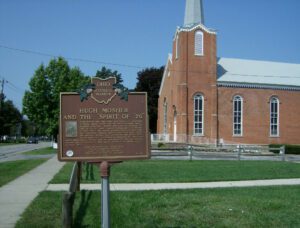
Hugh Mosher was the fifer portrayed in Archibald Willard’s “Spirit of ’76”, one of America”s most famous patriotic paintings. Mosher was born on January 29, 1819 in Perry, Lake County (then part of Geauga County), Ohio. He served as Fifer Major in the 43rd Ohio Volunteer Infantry during the Civil War. After the conflict, Mosher was considered the finest fifer in the state, and performed at veterans’ reunions and other celebrations. Always popular and noted for his generosity, Mosher died on August 15, 1896 and is buried in Brighton (Lorain County), Ohio.
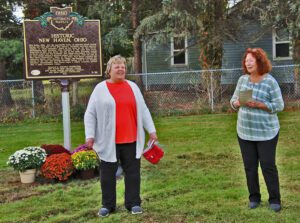
New Haven, Ohio, was the mercantile center of southwest Huron County during the first half of the 19th century. Residents described immense wagons, or “land schooners,” lined up for miles on the New Haven-Worthington Road traveling from Columbus to the Lake Erie ports. Organized in 1815, New Haven was one of the early townships formed in Huron County and the Firelands. The village was platted, with streets at right angles around a diamond-shaped town green, after the plan of New Haven, Connecticut. When, in the 1840s, New Haven rejected the railroad’s direct route through the village, the Sandusky & Newark was routed to the west and through Plymouth taking with it the shipping business. Subsequently, New Haven began a steady economic decline into a small crossroads village.
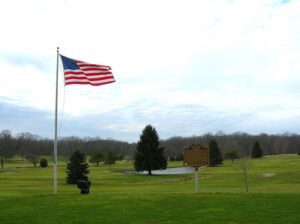
Golfer and World War II veteran William J. Powell, excluded from playing on many American golf courses because of his race, overcame the indignity of discrimination by creating his own course. Hand built in two years and opened in 1948, Clearview Golf Club is the first golf course in the United States designed, built, and owned by an African-American. The acclaimed course harmonizes with the landscape and bears many design elements of traditional British courses. A triumph of perseverance over discrimination, Clearview represents the historic postwar era when athletes first broke the “color line” in American sports.
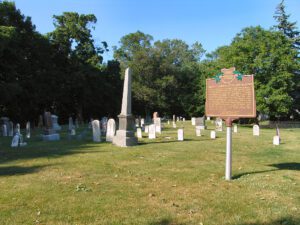
Israel Harrington (1779-1841) established a tavern at Lower Sandusky (now Fremont) shortly after the War of 1812. As a judge and land speculator, Harrington influenced the organization of much of northwestern Ohio. In 1824 he traded the tavern for land a short distance from this site, where an Indian trail crossed the Portage River. Elmore grew from this settlement. Harrington and his father (also Israel Harrington, a veteran of the American Revolution) are interred here, along with many of the pioneers who transformed this section of the Black Swamp into productive farmland.