

, OH
Charles Campbell Gard was born in Hamilton on January 13, 1895. He was the only child of Homer and Lutie Gard. His father, owner and publisher of the Hamilton Journal-News, taught him a love of the newspaper business and a devotion to public service. “Campbell” Gard graduated from Hamilton High School in 1913, attended Amherst College, and completed a one-year journalism course at the University of Wisconsin. After the U.S. entered World War I in 1917, the 22-year-old registered for military service. He saw active duty in Europe and was honorably discharged May 19, 1919. On October 25, 1921, while working at the Journal Publishing Company, 26-year-old Campbell Gard collapsed and died of myocarditis, an often-undetected heart disease, just days before marrying fiancée Helen Raymond. Gard was buried privately at Greenwood Cemetery two days later.
, OH
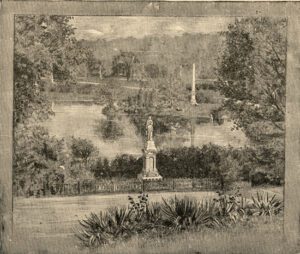
Spring Grove received its charter by an act of the Ohio Legislature in January 1845. Motivated by crowded conditions of small cemeteries created by the cholera epidemics of the 1830s and 1840s, the Cincinnati Horticultural Society formed a cemetery association in 1844 to find a location for a rural cemetery. Under the guidance of Robert Buchanan, local attorney Salmon P. Chase drafted the charter that was granted, and Spring Grove, consisting of 166 acres designed with a natural setting embellished with shrubbery, flowers, trees, and walks, was dedicated on August 28, 1845. A leader in cemetery design and the landscape “lawn plan” concept, Spring Grove officially changed its name to Spring Grove Cemetery & Arboretum in 1987.
, OH
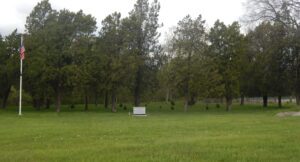
Toledo State Hospital opened in January 1888 as the Toledo Asylum for the Insane. Originally located immediately south of this cemetery, the hospital was designed to function as a self-contained community for 650 people. Patients lived in large cottages, surrounded by a post office, church, library, male and female hospital, strong wards, bakery, and dining hall. People were admitted with mild to severe forms of mental illness, and a variety of other disabling conditions, including developmental, medical or neurological, as well as for addictions, injuries, and old age. Work became a form of treatment, with patients involved in construction, farming, laundry, and other jobs to help maintain the hospital. Patients could also participate in recreational activities from gardening to playing in the hospital band. The State Hospital became home for many, as hospitalization could last a lifetime, often spanning decades. (continued on other side)
, OH
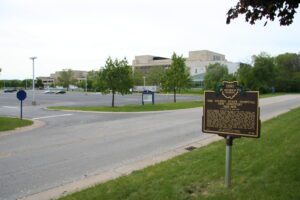
Toledo State Hospital opened in January 1888 as the Toledo Asylum for the Insane. People were admitted with mild to severe forms of mental illness, and a variety of developmental, medical and neurological conditions, as well as for addictions, injuries, and old age. Originally built to house 650 people, by the 1950s its campus had grown to accommodate over 3,000. Growing access to new medications and treatments then began a gradual decline in patient population. Eventually, most of the buildings were razed, and much of the hospital’s property was transferred, later becoming the site of The Medical College of Ohio. This transfer included the two Toledo State Hospital cemeteries, with documented burials (as of 2009) totaling 1,994 persons. Toledo State Hospital New Cemetery was opened in 1922, when the Old Cemetery (1888-1922), located .5 miles to the northeast, reached capacity. (continued on other side)
, OH
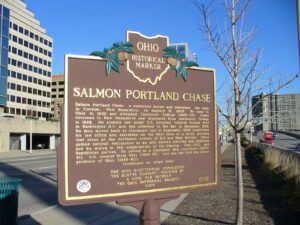
Salmon Portland Chase, a renowned lawyer and statesman, was born in Cornish, New Hampshire, on January 13, 1808. He came to Ohio in 1820 and attended Cincinnati College (1822-23). Chase returned to New Hampshire and graduated from Dartmouth College in 1826. He studied law under U.S. Attorney General William Wirt in Washington D.C. and was admitted to the bar in December 1829. He then moved back to Cincinnati and in September 1830 established his law office and residence on the first floor of a brick building that stood at the northeast corner of 3rd and Main Streets. Chase gained national recognition as an anti-slavery attorney and politician and by aiding in the organization of the Liberty, Free-Soil, and Republican parties. He served as a Cincinnati city councilman (1840-41), U.S. senator from Ohio (1849-55), and was the first Republican governor of Ohio (1856-60). (continued on other side)
, OH
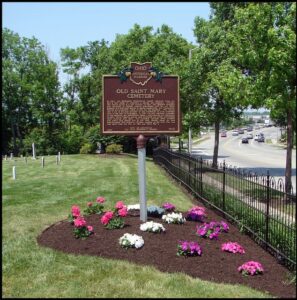
In 1801, the Springdale Presbyterian Church acquired these two and a half acres to construct a church and cemetery. Although the church moved to a new location in 1833, the cemetery remained and continued to receive regular internments until the mid 1950s. Because of a continued decline in church membership, the Presbyterian Church was eventually unable to care for the cemetery. The church felt it was in the best interest of the community to turn ownership over to the City of Springdale. In 1987, the city received ownership of the cemetery and immediately began a maintenance and restoration project. Many forgotten graves were uncovered and broken gravestones were restored and reset. The cemetery contains seven hundred and thirty nine graves and is the final resting place for nine Revolutionary War veterans, thirteen veterans of the Civil War, and one each from the War of 1812 and World War I.
, OH
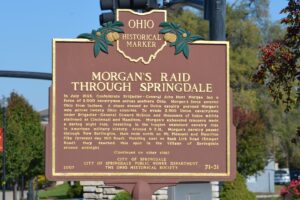
In July 1863, Confederate Brigadier-General John Hunt Morgan led a force of 2,000 cavalrymen across southern Ohio. Morgan’s force entered Ohio from Indiana. A chase ensued as Union cavalry pursued Morgan’s men across twenty Ohio counties. To evade 2,500 Union cavalrymen under Brigadier-General Edward Hobson and thousands of Union militia stationed at Cincinnati and Hamilton, Morgan’s exhausted troopers made a daring night ride, resulting in the longest sustained cavalry ride in American military history. Around 9 P.M., Morgan’s cavalry passed through New Burlington, then rode north on Mt. Pleasant and Hamilton Pike (present day Mill Road). Heading east on Bank Lick Road (Kemper Road), they reached this spot in the Village of Springdale around midnight. (Continued on other side)
, OH
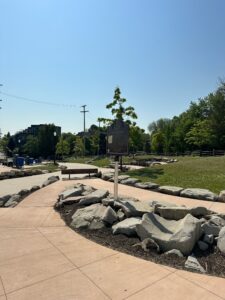
Opened in July 1862, the 35 1/2-acre site here in Brooklyn Township’s University Heights served as the largest Civil War army camp of rendezvous, organization, and training in northeast Ohio. It was bordered by Hershel (now West 5th) and University (now West 7th) streets and Railway and Marquard avenues. A wartime high of 4,151 volunteers occupied the barracks here on December 5, 1862. Lieutenant William Dustin of the 19th Ohio Volunteer Artillery wrote, “It was a table land above the city and admirably suited to the use of a camp of instruction. It was as level as a floor and carpeted with grass. The capacious pine barracks held about 25 each of the battery’s men.” A total of 15,230 men trained here during the war–4.9 percent of the 310,646 enlistments in Ohio. More than 11,000 soldiers were discharged here at war’s end. It closed in August 1865. (continued on other side)