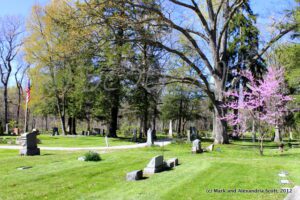
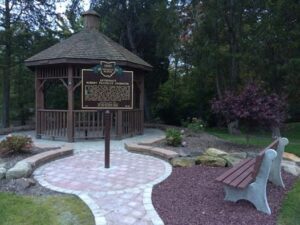
The northward course of the west branch of Rocky River forms a boundary for this cemetery, which lies above the river valley. Old trees convey stateliness and solemnity to these seven acres, often called “Turkey Foot” because turkeys roosted in the trees. Settlers from New England are buried here and include descendants of William Bradford, second governor of the Plymouth Colony. Julie Carter Northrop, granddaughter of one of Cleveland’s early settlers, Lorenzo Carter, is buried here. Veterans of six wars are honored here. The Daughters of the American Revolution recorded the cemetery’s tombstone engravings and cenotaphs in 1961. (Continued on other side)
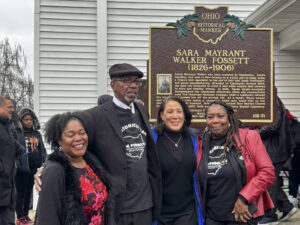
Sarah Mayrant Walker was born enslaved in Charleston, South Carolina, and sent to New Orleans as a young girl to study under a French hair specialist in the art of hair and scalp treatment, and goods manufacturing. Brought to Cincinnati around 1840, she used her networks to build a hair salon empire that catered to elite and wealthy women. In 1859, Sarah single-handedly desegregated the Cincinnati streetcars when she successfully sued The Passenger Railroad Company after a conductor refused her passage and pushed her off the moving car. As a result, Black women and children could ride inside a streetcar while men could ride on the platform. She and her husband, Peter Fossett, founded First Baptist Church of Cumminsville circa 1870. Both are buried in the Union Baptist Cemetery.
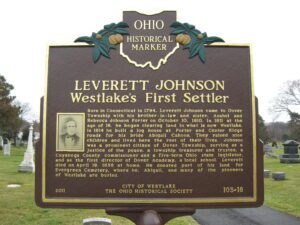
Born in Connecticut in 1794, Leverett Johnson came to Dover Township with his brother-in-law and sister, Asahel and Rebecca Johnson Porter on October 10, 1810. In 1811 at the age of 16, he began clearing land in what is now Westlake. In 1814 he built a log house at Porter and Center Ridge roads for his bride Abigail Cahoon. They raised nine children and lived here the rest of their lives. Johnson was a prominent citizen of Dover Township, serving as a justice of the peace, a township treasurer and trustee, a Cuyahoga County commissioner and a five-term Ohio state legislator, and as the first director of Dover Academy, a local school. Leverett died on April 19, 1856 at home. He donated part of his land for Evergreen Cemetery, where he, Abigail, and many of the pioneers of Westlake are buried.
United Colored American Cemetery is among the earliest in situ African American cemeteries in Hamilton County. The 11.6 acres in Madisonville were purchased by the United Colored American Association (UCAA) after the legislated closure of their earlier Avondale cemetery. Many Avondale burials and headstones were moved prior to the new cemetery’s dedication on May 30, 1883. Designed by Adolph Strauch, United Colored American Cemetery features the looping roads and picturesque elements typical of his designs at Spring Grove and Eden Park. After the dissolution of the UCAA, Cincinnati mayor Charles P. Taft asked Union Baptist Church to take ownership and maintenance of the cemetery. Union Baptist assumed ownership in 1968 and burials continued until 2019. United Colored American Cemetery was listed on the National Register of Historic Places in 2022.
Marine Colonel Robert F. Overmyer was born July 14, 1936 in Lorain, but always considered Westlake, where his family had lived since 1941, to be his hometown. He graduated from Westlake High School in 1954. After earning a bachelor’s degree in physics from Baldwin Wallace College in 1957, he entered active duty in the Marine Corps in 1958. He completed Navy flight training and was assigned to Marine Attack Squadron 214 in 1959. Overmyer logged over 7,500 flight hours, with more than 6,000 of those in jet aircraft. After earning a master’s degree in aeronautics from the U.S. Naval Postgraduate School in 1964, he was chosen as an astronaut for the USAF Manned Orbiting Laboratory Program in 1966. (Continued on other side)
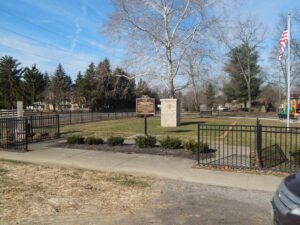
The first Blendon Presbyterian Church was located at the intersection of Dempsey and Hempstead Roads on what is part of Blendon Central Cemetery. Timothy Lee (1785-1862) donated land at the northeast corner for a church and cemetery. The church was dedicated on December 6, 1829, but it burned that same night under suspicious circumstances. Following the fire, the congregation’s members built another edifice on “Phelps Acre,” across Hempstead Road and so named for benefactor Edward Phelps. Sr. (1759-1840). The congregation held services there from 1830 to 1865. It was believed that the church was finally abandoned and dismantled piecemeal after the Central College Presbyterian Church was finished in 1870.
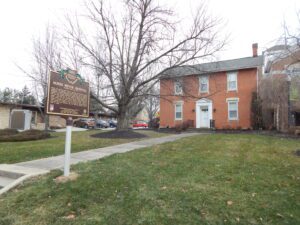
The house at this location, 110 South State Street, was the childhood home of Agnes Meyer Driscoll (1889-1971). Known as “the first lady of naval cryptology,” her career spanned from World War I to the Cold War. Driscoll attended Otterbein University before graduating from the Ohio State University, with majors in physics, math, music, and foreign languages. During World War I, she enlisted in the U.S. Navy as a chief yeoman, the highest rank possible for a woman at the time. After the war, Driscoll rose to become the chief civilian cryptanalyst for the U.S. Navy, breaking major Imperial Japanese Navy codes prior to World War II. (Continued on other side)
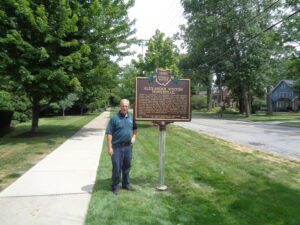
On this site, Alexander Winton (1860-1932), an American automobile pioneer, built and lived in a lakefront estate named Roseneath. Winton was born in Scotland and immigrated to the United States as a young man, settling in Cleveland. In the early 1890s, Winton founded the Winton Bicycle Company; six years later, he incorporated the Winton Motor Carriage Company. In 1903, Winton’s auto plant on Berea Road was one of the largest in the world, and he produced the first car to cross America from coast to coast. These business successes enabled him to build the 25-room Roseneath. In 1912, Winton founded the Winton Gas Engine & Manufacturing Company, which would eventually become part of General Motors Corporation. Winton is buried in Lakeview Cemetery. A fire in 1962 destroyed Roseneath.