


, OH
“Uncle” George Lathrop Cooley (1861-1939) was known as the “Champion of the Farmer” for his advocacy on behalf of rural interests. He was born on a farm at the northwest corner of Dover and Hilliard Roads in Dover Township (Westlake). He attended area schools and Ohio Northern University and, in 1887, married Clara Hall. Cooley served as Dover Township trustee from 1901-1905 and as president of Dover’s village council in 1916. Cooley’s interest in better roads led him to supervise the hard-surfacing of Dover Center Road, which ran by his house. From about 1900 to 1913, he was involved in road construction and helped to organize state highway departments in Ohio, Louisiana and California. (Continued on other side)
, OH
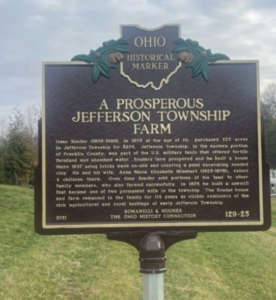
Isaac Souder (1809-1889), in 1835 at the age of 26, purchased 225 acres in Jefferson Township for $674. Jefferson Township, in the eastern portion of Franklin County, was part of the U.S. military lands that offered fertile farmland and abundant water. Souder’s farm prospered and he built a house there 1837 using bricks made on-site and creating a pond excavating needed clay. He and his wife, Anna Maria Elizabeth Minehart (1825-1878), raised 4 children there. Over time Souder sold portions of his land to other family members, who also farmed successfully. In 1874 he built a sawmill that became one of two permanent mills in the township. The Souder house and farm remained in the family for 114 years as visible reminders of the rich agricultural and rural heritage of early Jefferson Township.
, OH
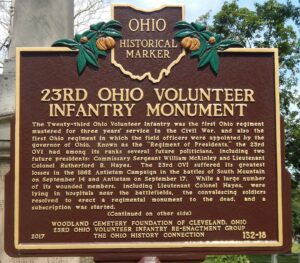
The Twenty-third Ohio Volunteer Infantry was the first Ohio regiment mustered for three years’ service in the Civil War, and also the first Ohio regiment in which the field officers were appointed by the governor of Ohio. Known as the “Regiment of Presidents,” the 23rd OVI had among its ranks several future politicians, including two future presidents: Commissary Sergeant William McKinley and Lieutenant Colonel Rutherford B. Hayes. The 23rd OVI suffered its greatest losses in the 1862 Antietam Campaign in the battles of South Mountain on September 14 and Antietam on September 17. While a large number of its wounded members, including Lieutenant Colonel Hayes, were lying in hospitals near the battlefields, the convalescing soldiers resolved to erect a regimental monument to the dead, and a subscription was started. (Continued on other side)
, OH
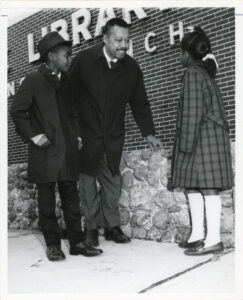
On November 19, 1968, the Columbus Metropolitan Library dedicated the first public library in the nation named after Dr. Martin Luther King Jr. After King’s assassination on April 4, 1968, the East Side Community Council requested that the new library being planned for the King-Lincoln Bronzeville community bear his name. The King family had both family and civic ties to Columbus and were honored by the tribute. More than 1,000 people gathered outside 1600 E. Long Street to hear Martin Luther King Sr. deliver the November dedication speech. Continuing the King family tradition, Martin Luther King III cut the ribbon to open a new branch building at 1487 E. Long Street on October 18, 2018. The Martin Luther King Branch was the first Columbus public library to bear an individual’s name.
, OH
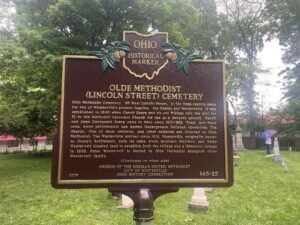
Olde Methodist Cemetery, 66 West Lincoln Street, is the final resting place for two of Westerville’s pioneer families, the Sharps and Westervelts. It was established in 1849 when Garrit Sharp and his son William sold the plot for $1 to the Methodist Episcopal Church for use as a burying ground. Garrit and Anna Goodspeed Sharp came to Ohio circa 1810-1812. They, and their sons, were abolitionists and known Underground Railroad operatives. The Sharps, five of their children, and other relatives are interred in Olde Methodist. The Westervelts arrived circa 1818. Westerville, originally known as Sharp’s Settlement, took its name when brothers Matthew and Peter Westervelt donated land to establish both the village and a Methodist college in 1839. Peter Westervelt is buried in Olde Methodist alongside other Westervelt family. (Continued on other side)

, OH
The Central Avenue Public Bath House was designed by Frederic Betz, the City of Cleveland’s first appointed architect. Opened in February 1920, it served the Black population in the congested Central neighborhood. The brick building featured symmetrical windows and entrances at either end that led into men’s and women’s waiting rooms and individual shower rooms. Larger group showers for children were in the basement. The second floor featured club rooms as well as a physician’s room and a nurse’s room. In 1926, a swimming pool and gymnasium were added. In 1940, as the need for public bathing facilities waned, Central Avenue Public Bath House was converted into a recreation center. One of Cleveland’s five remaining Bath Houses, Central Avenue stands as a manifestation of the city’s commitment to the health and welfare of its citizens.