

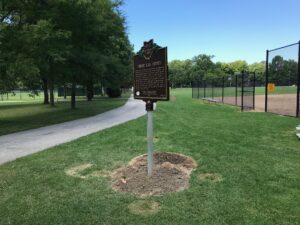
, OH
Beginning in 1873, oil magnate and philanthropist John D. Rockefeller purchased 700 acres of land in East Cleveland Township, now located in East Cleveland and Cleveland Heights. A failed hotel built in 1874-1875 served as the family’s summer home until it was destroyed by fire in 1917, although Rockefeller’s son, John, Jr., continued to visit the grounds. The Rockefellers spent much of their time outdoors, where they built on the land’s natural beauty and carefully designed and built carriage, foot and bridle paths, scenic views, lakes, a lily pond, stone bridges, a horse track and a gold course. John, Jr. purhcased all of his father’s Forest Hill property in 1923 and continued to buy adjacent land.
, OH
Pleasant Litchford was born into slavery in Virginia in 1789. He purchased his freedom and moved his family to Ohio by 1831. A master blacksmith, Litchford bought a small farm four miles north of Columbus in 1833. By the time of his death in 1879, he was the fourth largest landowner in Perry Township. Described as “a man of iron constitution,” Litchford served as a lay-preacher, founding member, and deacon at Second Baptist Church. The church and James Poindexter, its pastor in 1847, provided an important voice during the anti-slavery movement. In 1869, Litchford sold, for $1, a parcel of land to establish a school for African American children. He was married three times and was survived by seven living children, twenty-five grandchildren, and three great-grandchildren. Pleasant Litchford was buried in the Litchford Family Cemetery.
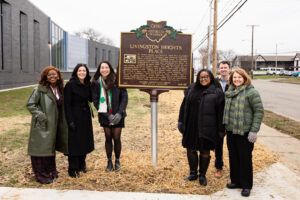
, OH
Dr. Harley Manuel and Charles E. Jones were frustrated by the restrictive covenants and redlining that kept Black residents from purchasing homes in desirable Columbus neighborhoods. Deciding to create their own neighborhood, the two men purchased 10.5 acres of farmland in March 1945. They divided it into 42 lots that became Livingston Heights Place. The first lots were sold to pharmacist Waldo W. and Harriet Tyler in 1946. Other early residents included Edward J. Cox, William and Esther Toler, David D. White, Dr. William K. Allen, and Dr. Harry Jefferson. Later residents were Dr. John H. Rosemond, Llewellyn (Jack) A. Coles, Captain Amos A. Carter Jr., Sammy Hopkins, William “Bill” Willis, and Dr. Richard Ruffin. Twenty homes were built between 1948 and 1967 within the subdivision’s boundaries of Johnson Park, Livingston, Byron, and Waverly.
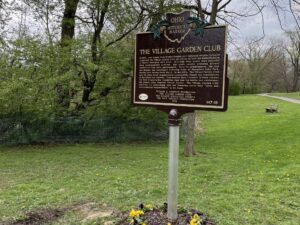
, OH
In 1930, nine women from Shaker Heights and Cleveland Heights formally organized The Village Garden Club and set as its goal the beautification of Shaker Parklands with trees. At a time when women were excluded from environmental activism, the club’s careful planning allowed members to lead civic improvements. Since its establishment, the club has planted and maintained flowering trees at Horseshoe Lake Park, pausing only during World War II. In the 1960s, The Village Garden Club and 34 other local organizations successfully fought the construction of the Clark-Lee Freeway. Club member Mary Elizabeth Croxton chaired the Park Conservation Committee that won the battle and established the Shaker Lakes Regional Nature Center. The Village Garden Club continues its stewardship over the flowering grove with “civic and environmental responsibility” as its focus.

, OH
The Central Avenue Public Bath House was designed by Frederic Betz, the City of Cleveland’s first appointed architect. Opened in February 1920, it served the Black population in the congested Central neighborhood. The brick building featured symmetrical windows and entrances at either end that led into men’s and women’s waiting rooms and individual shower rooms. Larger group showers for children were in the basement. The second floor featured club rooms as well as a physician’s room and a nurse’s room. In 1926, a swimming pool and gymnasium were added. In 1940, as the need for public bathing facilities waned, Central Avenue Public Bath House was converted into a recreation center. One of Cleveland’s five remaining Bath Houses, Central Avenue stands as a manifestation of the city’s commitment to the health and welfare of its citizens.