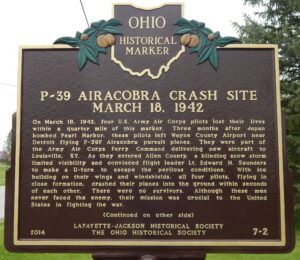
On March 18, 1942, four U.S. Army Air Corps pilots lost their lives within a quarter mile of this marker. Three months after Japan bombed Pearl Harbor, these pilots left Wayne County Airport near Detroit flying P-39F Airacobra pursuit planes. They were part of the Army Air Corps Ferry Command delivering new aircraft to Louisville, KY. As they entered Allen County, a blinding snow storm limited visibility and convinced flight leader Lt. Edward H. Saunders to make a U-turn to escape the perilous conditions. With ice building on their wings and windshields, all four pilots, flying in close formation, crashed their planes into the ground within seconds of each other. There were no survivors. Although these men never faced the enemy, their mission was crucial to the United States in fighting the war.
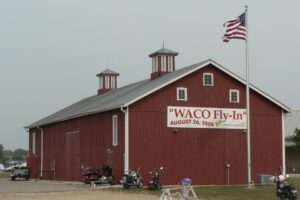
Founded in 1921 as the Weaver Aircraft Company and located in Lorain, Ohio, the Waco Aircraft Company relocated to Troy in March 1923. It was the first aircraft company to use assembly line production and shock strut landing gear. Leading all civilian aircraft production at a ratio of two to one from 1927-1929, the company had sales distributors in 24 countries worldwide. The United States government became the prime contractor of Waco Aircraft Company’s troop/cargo gliders (CG-4A) used extensively during World War II. The company also managed the U.S. Army’s glider program for 15 companies that produced gliders nationwide. The last WACO, model W “Aristrocrat,” was built in Troy in June 1947.
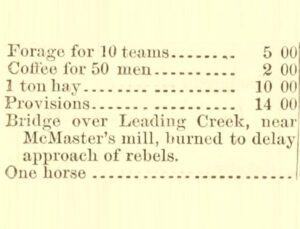
General John Hunt Morgan led a force of 2,000 Confederate cavalrymen into Meigs County on July 18, 1863, during a raid north of the Ohio River. More than 50,000 Union troops and mlitia pursued Morgan across the State of Ohio. At Langsville, in an attempt to delay the Confederate approach, local militia burned the bridge near McMaster’s grist mill. This was the first burned bridge encountered by the Confederates on their trek across Kentucky, Indiana and Ohio. A young Confederate soldier, shot and killed by a local resident, was buried near this site. After suffering losses at Buffington Island, Morgan surrendered eight days later near West Point in Columbiana County. The surrender field was the northernmost point reached by Confederate forces during the Civil War.
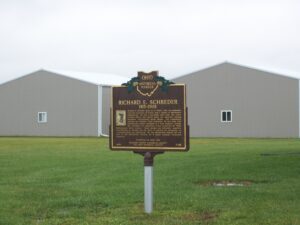
Richard E. Schreder grew up in Toledo, Ohio and graduated from the University of Toledo with a degree in Mechanical Engineering. He was a decorated navy pilot and iconic aviation figure who helped shape the American soaring movement, international glider design, and competitive soaring and piloting flight strategies. He also made high performance gliders available to a wide audience through the affordable kit production of his distinctive HP (High Performance) glider designs. These designs and Schreder’s numerous contributions to aviation and the sport of soaring are recognized as “groundbreaking and pioneering” by the Smithsonian Museum and are part of the Smithsonian National Air & Space Museum’s permanent collection. (continued on other side)
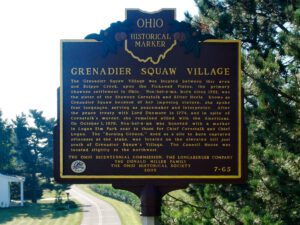
The Grenadier Squaw Village was located between this area and Scippo Creek, upon the Pickaway Plains, the primary Shawnee settlement in Ohio. Non-hel-e-ma, born circa 1722, was the sister of the Shawnee Cornstalk and Silver Heels. Known as Grenadier Squaw because of her imposing stature, she spoke four languages, serving as peacemaker and interpreter. After the peace treaty with Lord Dunmore in 1774, and in spite of Cornstalk’s murder, she remained allied with the Americans. On October 1, 1978, Non-hel-e-ma was honored with a marker in Logan Elm Park near to those for Chief Cornstalk and Chief Logan. The “Burning Ground,” used as a site to burn captured prisoners at the stake, was located on the elevated hill just south of Grenadier Squaw’s Village. The Council House was located slightly to the northwest.
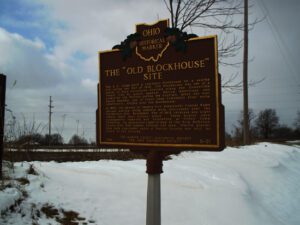
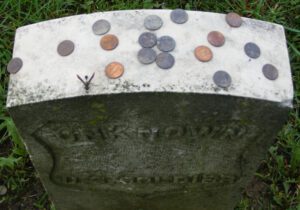
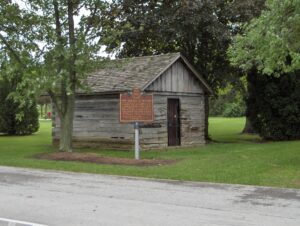
The U.S. Army built a two-story blockhouse on a nearby hill during the War of 1812. The blockhouse was one of a series of such structures erected along the Greenville Treaty line to guard against Native Americans who supported the British during the conflict. After the war, Daniel Markley, one of Green Camp Township’s first white inhabitants, settled near the blockhouse. In 1963, the graves of twenty-five prehistoric Glacial Kame Indians and six white settlers were discovered near the blockhouse site. Seventeen War of 1812 veterans and eight others were also buried there. These bodies were subsequently removed and reinterred at Green Camp Cemetery. An abandoned right-of-way of the Erie Railroad, Dayton line, also passes through the area. Prairie grasses that once dominated parts of Marion County can still be found in the vicinity.
Approximately 1000 feet east of this marker lies the graves of sixteen American soldiers from Fort McArthur who gave their lives during the War of 1812. The fort, a one-half acre timber stockade containing huts, was built in the summer of 1812 to guard the Scioto River crossing of Gen. William Hull’s “Trace” to Detroit. Construction of the fort was under the command of a future Ohio governor, Col. Duncan McArthur.
The village was laid out on August 18, 1847, by Benjamin Todd, and consisted of 18 lots in Section 26 of Pleasant Township. Originally named Pleasantville, it was incorporated in 1858 and the name was changed in honor of Maj. Gen. Alexander Macomb, famous for defending Plattsburgh, N.Y., during the War of 1812 and later Commander of the U.S. Army. William Chapman was the first mayor.