

, OH
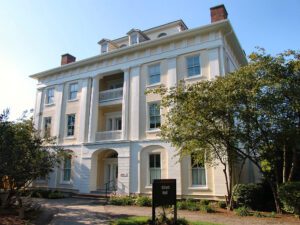
Built in 1833 as a health resort named the Mansion House Hotel, Elliott Hall is noted as Ohio’s oldest collegiate Greek Revival building. The closure of the Bank of the United States and an economic panic in 1837 created nation-wide financial difficulties, which led to the decline of the luxury resort. Under the leadership of Reverend Adam Poe, minister of William Street Methodist Church, the citizens of Delaware purchased the building for the establishment of a Methodist college for men. Ohio Wesleyan University was chartered on March 7, 1842, and the founding building was named for Dr. Charles Elliott, Ohio Conference leader who helped examine the site and establish the university. In 1877, Ohio Wesleyan University and the Ohio Wesleyan Female College merged into a co-educational institution. Elliott Hall was moved to its present location in 1892 when University Hall was built.
, OH
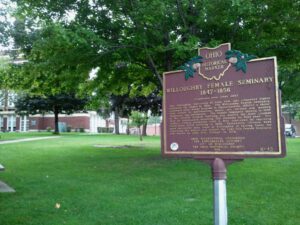
The village of Chagrin, founded in 1798, changed its name in 1834 to honor Dr. Westel Willoughby, a pioneer medical educator. That same year, the Willoughby University of Lake Erie was chartered, and the Willoughby Medical College opened its doors, signaling the beginning of medical education in northern Ohio. The Medical College trained 160 doctors, educated in contemporary methods of medicine, anatomy, chemistry, and surgery. Financial struggles and public outcry against grave-robbing — which supplied cadavers for anatomy classes — hampered the college’s development. The movement of faculty to Cleveland and the transfer of the state charter to Columbus hastened the demise of the Medical College in 1847, and laid the foundation for the establishment of the medical schools of Case Western and Ohio State universities. (Continued on side two)
, OH
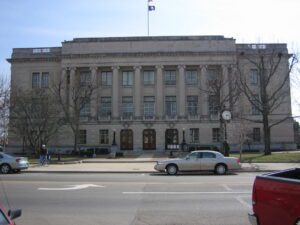
The current Preble County Courthouse, the third courthouse erected on this site, was designed by noted architect and Preble County native Harvey Heistand. Its cornerstone was laid on March 17, 1917, with a copper box containing a bible, historic papers, and other memorabilia placed under the stone. Upon completion, the building was dedicated on September 10, 1918, with three thousand people attending the ceremony. Designed in the Neo-Classical style, the exterior was constructed of Indiana Bedford limestone with ten immense columns that extend upward from the second floor. Above the colonnade, a dentiled entablature is inscribed, Salus Populi Suprema Lex, meaning “The health of the people is the supreme law.” The façade is enhanced with a bricked courtyard flanked by balustraded terraces. [continued on other side]
, OH
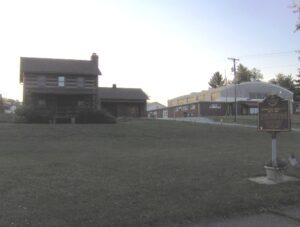
Surgeon and songwriter Brewster Higley VI was born in Rutland in 1823, the grandson of Brewster Higley IV, a veteran of the American Revolution and founder of Rutland. Higley began studying medicine at age 18 and opened his first practice in Pomeroy, moving to Indiana and then to Kansas in 1871. The following year he penned the words to the famous Western song, “Home on the Range.” This perennial favorite became the state song of Kansas in 1947. Oh, give me a home where the buffalo roam, And the deer and the antelope play, Where seldom is heard a discouraging word, And the skies are not cloudy all day.
, OH
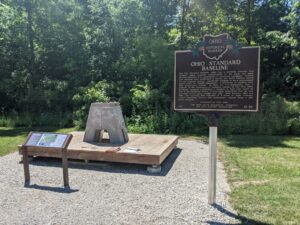
The Ohio Standard Baseline (OSB) was a geodetic baseline that provided highly accurate measurements of the earth and made possible extremely fine calibrations of surveying equipment. Several such baselines were established in Europe and South America during the mid-twentieth century, specifically designed to use a measurement device called the Vaisala Comparator, a precursor of modern laser light measurement systems. In 1953, Dr. T.J. Kukkamaki, then a professor in the Department of Geodetic Science at The Ohio State University, proposed establishing a baseline in Ohio that would be part of the worldwide efforts to accurately understand how the size and shape of the earth change over time. Built between 1965 and 1966, the resulting OSB consisted of a series of eight concrete pillars supporting mirrors and instruments, spaced along a 500 meter distance. (Continued on other side)
, OH
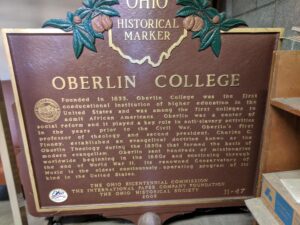
Founded in 1833, Oberlin College was the first coeducational institution of higher education in the United States and was among the first colleges to admit African Americans. Oberlin was a center of social reform and it played a key role in anti-slavery activities in the years prior to the Civil War. Oberlin’s first professor of theology and second president, Charles G. Finney, established an evangelical doctrine known as the Oberlin Theology during the 1850s that formed the basis of modern evangelism. Oberlin sent hundreds of missionaries worldwide beginning in the 1880s and continuing through the end of World War II. Its renowned Conservatory of Music is the oldest continuously operating program of its kind in the United States.
, OH
Completed in 1892 at the height of the region’s oil boom, the Pemberville Town Hall followed a late-1800s municipal trend to house many civic functions under one roof. The fire station, jail, and council chambers occupied the ground level, while the entire second floor hosted a public auditorium, or “opera house,” that seated 250. The 1897 debut of The Mikado featured new electric lighting. The ornate Opera House was the center of Pemberville’s social activities for decades, hosting dances, plays, socials, graduation ceremonies, political meetings, lectures, and husking bees. Traveling companies performed concerts, vaudeville, minstrel, and medicine shows. Following World War II the Opera House fell into disuse. It was restored in 1999 to both its former grandeur and its place in Pemberville’s cultural life.
, OH
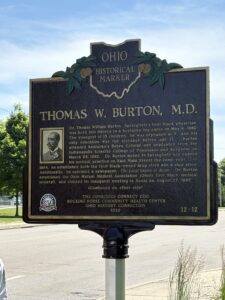
Dr. Thomas William Burton, Springfield’s first Black physician, was born into slavery in a Kentucky log cabin on May 4, 1860. The youngest of 15 children, he was orphaned at 9, and his only education was the alphabet before age 21. Burton attended Kentucky’s Berea College and graduated from the Indianapolis Eclectic College of Physicians and Surgeons on March 24, 1892. Dr. Burton moved to Springfield and opened his medical practice on East Main Street the same year. In 1894, he established both the first Black-owned drug store and a shoe store. Additionally, he operated a newspaper, The Loyal Legion of Honor. Dr. Burton established the Ohio Mutual Medical Association (Ohio’s first Black medical society), and chaired its inaugural meeting in Xenia on August 27, 1897. (Continued on other side)