

, OH
Fout Hall was one of three original buildings on the Bonebrake Theological Seminary campus. Constructed 1920-1923, it was named for Dr. J. E. Fout, who managed campus construction. Bonebrake Seminary was founded in 1871 by Dayton’s United Brethren in Christ Church and became co-educational in 1873. Generous cash and land gifts (1909-1911) enabled the construction of a new campus. Fout Hall, the administration building, and a powerhouse were designed by Dayton architect Frederick J. Hughes in the Jacobethan Revival style. The three-story buff-brick dormitory was the largest of the buildings and cost $250,000. As well as dining hall, laundry, and storage facilities, it featured 12 single rooms, 54 two-room suites, and 6 three-room suites. Fout Hall was an integral part of the National Register listing of the Dayton View Triangle Historic District in 2022.
, OH
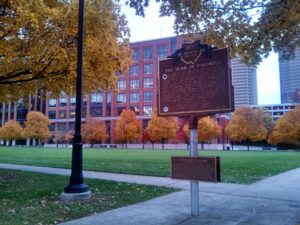
Thousands of Irish immigrants came to Columbus to seek personal and religious freedom. With the “Great Hunger” in Ireland and the completion of the Ohio and Erie Canal and the National Road, immigration to Columbus increased in the mid nineteenth century. They initially settled in the north side of the city in the swamp flats, where inexpensive land was available and work could be had on the railroads. Settlement spread to Franklinton, on Naghten Street, later known as “Irish Broadway”- part of which is now Nationwide Boulevard, and to nearby Flytown. The immigrants became domestic workers, civil servants, entrepreneurs, and served the city in police and fire departments. Others were leaders in government, law, medicine, and education. Their legacy continues today in the Irish-American population of Columbus, Ohio.
, OH
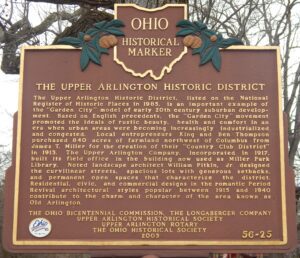
The Upper Arlington Historic District, listed on the National Register of Historic Places in 1985, is an important example of the “Garden City” model of early 20th century suburban development. Based on English precedents, the “Garden City” movement promoted the ideals of rustic beauty, health and comfort in an era when urban areas were becoming increasingly industrialized and congested. Local entrepreneurs King and Ben Thompson purchased 840 acres of farmland northwest of Columbus from James T. Miller for the creation of their “Country Club District” in 1913. The Upper Arlington Company, incorporated in 1917, built its field office in the building now used as Miller Park Library. Noted landscape architect William Pitkin, Jr. designed the curvilinear streets, spacious lots with generous setbacks, and permanent open spaces that characterize the district. Residential, civic, and commercial designs in the romantic Period Revival architectural styles popular between 1915 and 1940 contribute to the charm and character of the area known as Old Arlington.
, OH
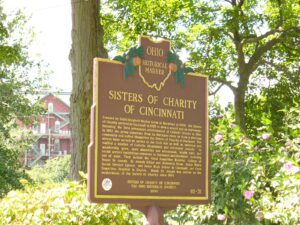
Founded by Saint Elizabeth Bayley Seton in Maryland in 1809, the Sisters of Charity arrived in Cincinnati in 1829 to open a school and an orphanage, becoming the first permanent establishment of Catholic sisters in Ohio. In 1852 the group separated from its Maryland roots to form a diocesan community and called themselves the Sisters of Charity of Cincinnati. The sisters later served as nurses in the Civil War as well as operated and staffed a number of Catholic elementary and secondary schools. As membership grew, their ministries and educational, health care, and social service institutions expanded in Cincinnati and elsewhere, including out of state. They include the Good Samaritan Hospital, College of Mount St. Joseph, St. Joseph Infant and Maternity Home, Santa Maria Social Service Agency, and Seton High School in Cincinnati and Good Samaritan Hospital in Dayton. Mount St. Joseph has served as the motherhouse of the Sisters of Charity since 1884.
, OH
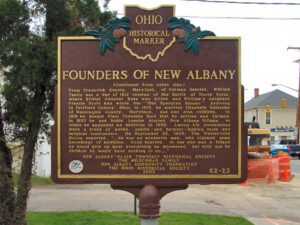
A tavern and inn, for which Noble Landon (1783-1866) obtained a liquor license in 1835, formerly occupied the southeast corner of High and Main streets. In 1837 Landon and William Yantis laid out the town of New Albany in 50-by-100-foot lots, with Landon’s lots lying on the east side and Yantis’ on the west side of High Street. Landon was born in Litchfield, Connecticut, lived as a young man in St. Albans, Vermont, and migrated to Licking County, Ohio, in 1810. He was the first clerk and first Justice of the Peace in St. Albans Township and first postmaster in Johnstown and later in New Albany. In addition to contributions as a builder-developer, Landon gave to the village lore the story of a remarkable conversion. Long known as a heavy drinker, he suddenly ordered kegs of whiskey he owned to be carried into the street and broken. He then attended church regularly. (continued on other side)
, OH
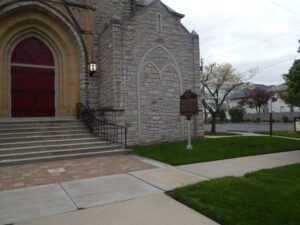
In 1886, thirty-six members from Toledo’s downtown Lutheran church, St. Paul’s, met to form a German-speaking Lutheran congregation for immigrants from Pommern, Mecklenburg and Hanover. Initially worshipping at St. Stephen’s at the corner of Harrison and Oliver Street, the congregation built a frame church on this site in 1887. That same year St. Lucas pioneered an early form of health insurance, The Mutual Sick Benefit Society, that later became a larger fraternal organization called The Mutual Sick Benefit Society for Ohio and Other States. In 1999, after joining a program called Reconciling in Christ, St. Lucas became the first Lutheran congregation in northern Ohio to publicaly welcome the LGBT communities. Named after Saint Luke, the patron saint of physicians, the church’s history is one of healing.
, OH
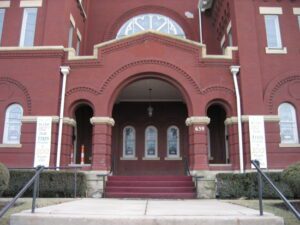
Organized in 1823 as Bethel African Methodist Episcopal Church, St. Paul A.M.E. Church is the oldest congregation of African descent in Columbus. The church, founded by Moses Freeman and 13 other members from the Town Street Church, was originally located on the east side of Lazelle Street. Several buildings were erected to meet the needs of the growing congregation. The present edifice, located at 639 E. Long Street, was completed in 1906. St. Paul has several outreach ministries, including The Prison Ministry, Alzheimer Ministry, Karen’s House, Community Development Corporation, Health Concerns Committee, St. Paul Tutorial and Enrichment Program (STEP), St. Paul Scholarship Program, St. Paul Drama Ministry, Jam’N Jefferson Park Festival, and Church Without Walls.
, OH
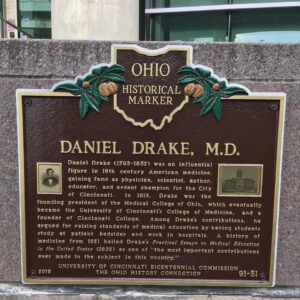
Daniel Drake, M.D.. Daniel Drake (1785-1852) was an influential figure in 19th century American medicine, gaining fame as physician, scientist, author, educator, and ardent champion for the City of Cincinnati. In 1819, Drake was the founding president of the Medical College of Ohio, which eventually became the University of Cincinnati’s College of Medicine, and a founder of Cincinnati College. Among Drake’s contributions, he argued for raising standards of medical education by having students study at patient bedsides and work in hospitals. A history of medicine from 1921 hailed Drake’s Practical Essays on Medical Education in the United States (1832) as one of “the most important contributions ever made to the subject in this country.”