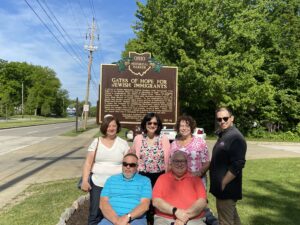
A group of Jewish immigrants fleeing Germany after Kristallnacht (The Night of the Broken Glass) settled in Cleveland in 1940. The refugees formed a congregation and named it Shaarey Tikvah, “Gates of Hope” in Hebrew. They met in private homes until obtaining premises above the Tasty Shop Bakery on Euclid Avenue. As the congregation thrived it moved and merged several times before settling in Beachwood in 1986. Rabbi Jacob Shtull, Shaarey Tikvah’s first English-speaking Rabbi, sought to honor the founders by establishing Cleveland’s annual Kristallnacht commemoration. “Face to Face,” a Holocaust education program that shares the refugee story with local schools, began in 1994. Today, this “Small Shul. Large Community” remains a tribute to the German immigrants that found their way to Cleveland to unite in friendship and faith.
The building at 1380 E. 6th Street, designed by Walker and Weeks, served as the Cleveland Board of Education 1931-2013. During the 1950s and 1960s, the segregation of Cleveland Public Schools was the center of the city’s civil rights movement. Parents, like Daisy Craggett and Eddie Gill, protested relay classes and intact busing. The United Freedom Movement, a coalition of 50 civic, religious, and parent organizations, initiated demonstrations, sit-ins, and pickets, to galvanize the fight for education equality. On April 7, 1964, Reverend Bruce Klunder, vice president of Cleveland’s Congress of Racial Equality, was accidentally killed by a bulldozer at the future Stephen E. Howe Elementary School while he lay in a construction ditch to protest school re-segregation. His death ignited an April 20 boycott in which 85-95% of Cleveland’s Black students participated. (Continued on other side)
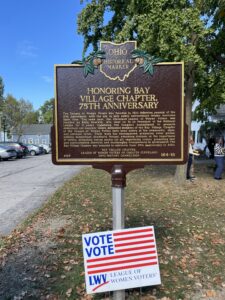
The Bay Village Chapter of the League of Women Voters was established in Spring 1948, with Dorothy M. Austin as president. The goal of the chapter was to ensure all citizens of Bay Village had the information they needed to cast an educated vote. They first met in the Cahoon family homestead, which then served as the city library and later as Rose Hill Museum. Gladys H. Luecke led the group on its first study, a city charter form of government for the village. Voters approved the charter on April 12, 1949, and the Village of Bay officially became the “City of Bay Village” in 1951. Since its founding, the Bay Village Chapter has made an educated voter its first priority by supporting citizen participation in government and influencing public policy through education and advocacy.
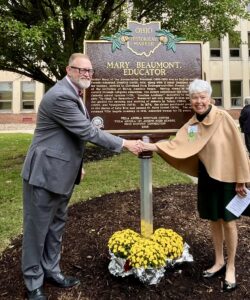
Mother Mary of the Annunciation Beaumont (1818-1881) was an English-born, French educated Ursuline Sister, she arrived in Cleveland from Boulogne-sur-Mer, France, in 1850, accompanied by three other Ursulines and a lay teacher. Invited to Ohio by Bishop Amadeus Rappe, the Ursulines vowed to improve society through religious education. That same year, Beaumont established the city’s first Catholic school (grades 1-12), “Ursuline Academy,” and dedicated it to teaching girls “to think for themselves.” Beaumont not only taught at area parishes, she ably guided the opening and staffing of schools in Toledo (1854), Tiffin (1863), and Youngstown (1874). In 1874, the Ursulines purchased property on the Shores of Lake Erie and opened St. Mary’s School (1878). The school, re-named Villa Angela Academy in 1941, educated women for 112 years.