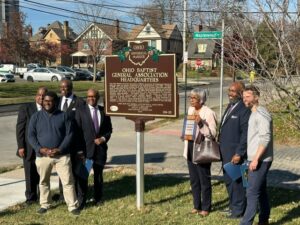
The Ohio Baptist General Association (OBGA) acquired 48 Parkwood Avenue in 1954 and used the former residence as its headquarters until 1996. Formed in 1896, the Association includes more than forty African American churches, many formed prior to the Civil War. Baptist general associations nationwide became an important voice during the 1960s Civil Rights Movement as they addressed the wrongs of racial violence and discrimination in business, housing, and education. The OGBA fought for the ideals of justice and freedom with its strongly-held Baptist beliefs. “America with her wealth as a great nation,“ OGBA President Wilber A. Page declared in 1957, “is well able to face integration and give a democracy to all her citizens.” The former Association Headquarters was listed in the National Register of Historic Places on December 3, 2020.
Pleasant Litchford was born into slavery in Virginia in 1789. He purchased his freedom and moved his family to Ohio by 1831. A master blacksmith, Litchford bought a small farm four miles north of Columbus in 1833. By the time of his death in 1879, he was the fourth largest landowner in Perry Township. Described as “a man of iron constitution,” Litchford served as a lay-preacher, founding member, and deacon at Second Baptist Church. The church and James Poindexter, its pastor in 1847, provided an important voice during the anti-slavery movement. In 1869, Litchford sold, for $1, a parcel of land to establish a school for African American children. He was married three times and was survived by seven living children, twenty-five grandchildren, and three great-grandchildren. Pleasant Litchford was buried in the Litchford Family Cemetery.
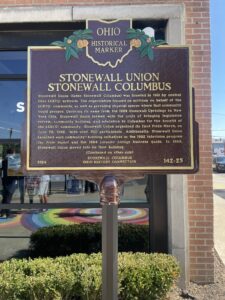
Stonewall Union (later Stonewall Columbus) was founded in 1981 by central Ohio LGBTQ+ activists. The organization focused on activism on behalf of the LGBTQ+ community, as well as providing physical spaces where that community could prosper. Deriving its name from the 1969 Stonewall Uprisings in New York City, Stonewall Union formed with the goals of bringing legislative reform, community building, and education to Columbus for the benefit of the LGBTQ+ community. Stonewall Union organized its first Pride March, on June 26, 1982, with over 500 participants. Additionally, Stonewall Union launched such community-building initiatives as the 1982 television program Gay Pride Report and the 1984 Lavender Listings business guide. In 1985, Stonewall Union moved into its first building. (Continued on other side)
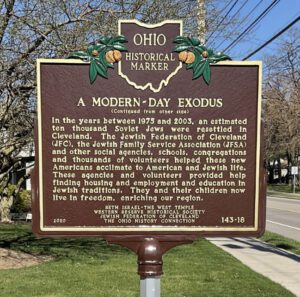
Here in 1963 congregants of Beth Israel-The West Temple, led by Louis Rosenblum, Herb Caron, and Rabbi Daniel Litt, founded the Cleveland Committee (later Council) on Soviet Anti-Semitism, the first American organization created to advocate for freedom for Soviet Jews. In 1970 this work led to the formation of the Union of Councils for Soviet Jews (UCSJ) under the leadership of Louis Rosenblum. The UCSJ, whose national office was located here 1970-1973, became the largest independent Soviet Jewry organization in the world. By the turn of the 21st century, the efforts begun here helped 1.6 million Jews leave the former Soviet Union. (Continued on other side)
Cory United Methodist Church is an icon of Cleveland’s civil rights movement. As one of the city’s largest Black-owned churches during the 1960s, Cory hosted events for national, local, and grassroots organizations such as the Fair Employment Practices Committee, NAACP Cleveland Branch, Cleveland Chapter of the Congress of Racial Equality (CORE), and United Freedom Movement. Over 75 years later, Cory UMC continues its long tradition of community programming that promotes equity and education. Originally designed by architect Albert F. Janowitz to house the Anshe Emeth Beth Tefilo congregation, the building served as the Cleveland Jewish Center from 1922 to 1945. The Methodist congregation purchased it in 1946. Since 1961, the building has also been home to the Glenville Recreation Center. Cory UMC was designated as a local landmark by the Cleveland Landmarks Commission in 2012.
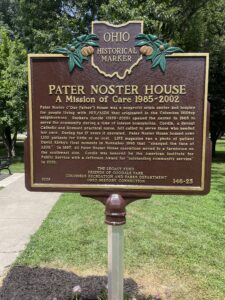
Pater Noster (“Our Father”) House was a nonprofit crisis center and hospice for people living with HIV/AIDS that originated in the Columbus Hilltop neighborhood. Barbara Cordle (1939-2020) opened the center in 1985 to serve the community during a time of intense homophobia. Cordle, a devout Catholic and licensed practical nurse, felt called to serve those who needed her care. During the 17 years it operated, Pater Noster housed over 1,100 patients for little or no cost. LIFE magazine ran a photo of patient David Kirby’s final moments in November 1990 that “changed the face of AIDS.” In 1997, all Pater Noster House operations moved to a farmhouse on the southwest side. Cordle was honored by the American Institute for Public Service with a Jefferson Award for “outstanding community service” in 2002.
William Henry Fouse was born in Westerville to former slaves Squire Fouse and “Sallie” Syler. The first Black student to graduate from Westerville High School (1884), he worked as a bootblack and waiter to earn college tuition. Fouse graduated cum laude from Otterbein (1893), and as the college’s first Black graduate, delivered “A Plea for the Afro-American” at commencement. For forty-five years Fouse worked as a teacher and administrator in Corydon (Indiana), Gallipolis (Ohio), Covington (Kentucky), and Lexington (Kentucky). He served as principal at Lexington’s Paul Lawrence Dunbar High School from its opening in 1923 until his retirement in 1938. During that time, Fouse developed the Bluegrass Oratorical Association, served as president of the Kentucky Negro Education Association, and earned his MA in Education. In 1937, Otterbein conferred a Doctor of Pedagogy upon the distinguished educator.
Civil unrest rocked the Hough neighborhood for five nights during the summer of 1966.When the white owners of the Seventy-Niners Cafe refused to serve a Black customer a glass of water, a sign bearing a racial epithet subsequently appeared outside the bar. Decades of institutionalized racial practices that had caused Hough’s substandard and overcrowded housing, high unemployment, economic exploitation, lack of access to quality education, and systemic police harassment sparked an urban uprising in response on July 18. Angry crowds gathered outside the bar only to be confronted by the owners brandishing firearms. When the police belatedly responded, tensions escalated into targeted firebombing, looting, and vandalism. On Tuesday night, July 19, Cleveland’s Mayor Ralph Locher requested that the Ohio National Guard restore order. (Continued on other side)