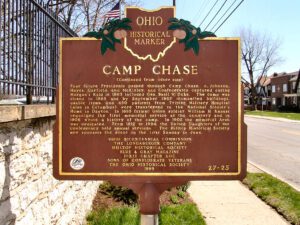
Camp Chase was a Civil War camp established in May 1861, on land leased by the U.S. Government. Four miles west of Columbus, the main entrance was on the National Road. Boundaries of the camp were present-day Broad Street (north), Hague Avenue (east), Sullivant Avenue (south), and near Westgate Avenue (west). Named for former Ohio Governor and Lincoln’s Secretary of the Treasury Salmon P. Chase, it was a training camp for Ohio soldiers, a parole camp, a muster-out post, and a prisoner-of-war camp. As many as 150,000 Union soldiers and 25,000 Confederate prisoners passed through its gates from 1861-1865. By February 1865, over 9,400 men were held at the prison. More than 2,000 Confederates are buried in the Camp Chase Cemetery.
Waldschmidt Cemetery is located on land purchased from former New Jersey judge and Congressman John Cleves Symmes in 1795 by Christian Waldschmidt, one of the first settlers in the Little Miami River Valley. Waldschmidt, from Lancaster, Pennsylvania, was a veteran of the American Revolution, and he and his family are buried here. During the Civil War this area, named for Governor William Dennison, served as a training site and hospital for the Union effort. A portion of the cemetery was the temporary interment site for 349 Union soldiers and 31 Confederate prisoners of war, most of whom died at the camp hospital. On July 4, 1869, the Union soldiers were moved to Spring Grove Cemetery in Cincinnati. About the same time, the Confederate soldiers were reinterred in Chase Cemetery in Columbus, Ohio.
Colonel William Henry Morgan was born in Pittston, Pennsylvania, to parents Thomas Rees Morgan and Elizabeth Nicholas Morgan. The family relocated to Alliance in 1871. Educated in the Alliance Public Schools, Morgan completed his grade 12 exams and began working for his father’s engineering firm. Possessed of an inventive electrical and engineering mind, Morgan and his father patented the overhead traveling crane that revolutionized the steel industry. Upon his father’s death in 1897, Morgan became president of Morgan Engineering Company. He was appointed an honorary “Colonel” when Ohio Governor George K. Nash (1900-1904) made him an aide-de-camp on his staff.
In 1918, Charles Young made a desperate attempt to convince the U.S. Army that he was fit for duty. The Army’s highest-ranking Black officer, he had been medically retired and not given a command during World War I. To demonstrate his fitness, he rode 497 miles from his home in Wilberforce, Ohio, to Washington, D.C. Leaving on June 6 he made the journey in 17 days, 16 on horseback and 1 resting. Averaging 31 miles each day, he rode 45 minutes and walked 15 minutes every hour. Upon his arrival, Young met with Secretary of War Newton Baker. Pressured by the Black press and the White House, Baker hedged. He recalled Young to active duty a year later and assigned him to Camp Grant, Illinois, just five days before the end of the war.
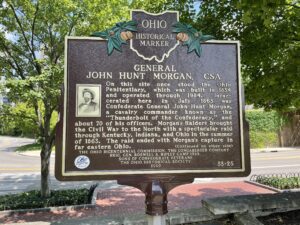
On this site once stood the Ohio Penitentiary, which was built in 1834 and operated through 1984. Incarcerated here in July 1863 was Confederate General John Hunt Morgan, a cavalry commander known as the “Thunderbolt of the Confederacy,” and about 70 of his officers. Morgan’s Raiders brought the Civil War to the North with a spectacular raid through Kentucky, Indiana, and Ohio in the summer of 1863. The raid ended with Morgan’s capture in far eastern Ohio. (continued on other side)
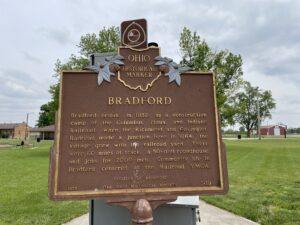
Bradford began, in 1852, as a construction camp of the Columbus, Piqua, and Indiana Railroad. When the Richmond and Covington Railroad made a junction here in 1864, the village grew with the railroad yard. There were 60 miles of track, a 50-stall roundhouse, and jobs for 2000 men. Community life in Bradford centered at the Railroad YMCA.
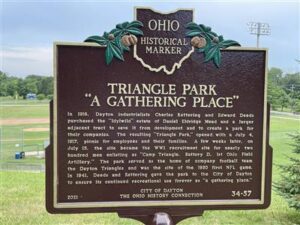
In 1916, Dayton industrialists Charles Kettering and Edward Deeds purchased the “Idylwild” estate of Daniel Eldridge Mead and a larger adjacent tract to save it from development and to create a park for their companies. The resulting “Triangle Park,” opened with a July 4, 1917, picnic for employees and their families. A few weeks later, on July 15, the site became the WWI recruitment site for nearly two hundred men enlisting as “Camp Triangle, Battery D, 1st Ohio Field Artillery.” The park served as the home of company football team the Dayton Triangles and was the site of the 1920 first NFL game. In 1941, Deeds and Kettering gave the park to the City of Dayton to ensure its continued recreational use forever as “a gathering place.”
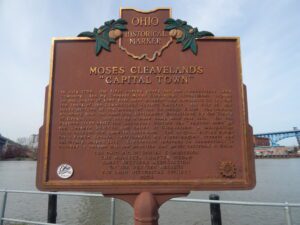
In July 1796, the first survey party for the Connecticut Land Company, led by General Moses Cleaveland (1754-1806), landed on the shore of Lake Erie near present-day Ashtabula to lay out the lands of the Connecticut Western Reserve. On July 22, the party arrived at the mouth of the Cuyahoga River, the western boundary line for American settlement established by the Treaty of Greenville, and set up a base camp near this site. On the eastern river bluff the surveyors platted the “capital town” of the Western Reserve and called it Cleaveland; a misspelling later changed the name to Cleveland. The original survey called for a Public Square, surrounded by right-angled streets and uniformly-shaped lots. Cleaveland returned to Connecticut in October to resume his law practice and never returned to Ohio.