

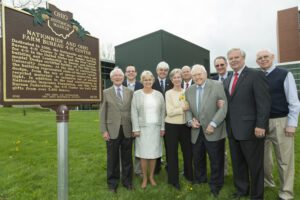
, OH
In 1902, Albert Belmont Graham (1868-1960), a school teacher and superintendent, established the Boys and Girls Agricultural Experiment Club in Springfield, Ohio. Graham believed in learning by doing, a concept at the core of 4-H, which stands for Head, Heart, Hands, and Health. In 1905, Graham became the first Superintendent of Agricultural Extension at The Ohio State University and he brought the idea of 4-H with him. 4-H is in all 50 states and over 70 countries, and more than 7 million members enroll annually. One in six Ohioans have been members.
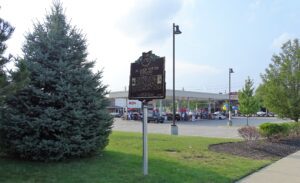
, OH
Dr. Jared Potter Kirtland was a prominent nineteenth century professor, physician, naturalist and horticulturist. In 1837, Kirtland purchased land in Rockport Township that stretched from Madison Avenue to Lake Erie. Kirtland used that land as a natural laboratory and filled it with gardens, greenhouses and an arboretum where he developed fruit and grape varieties best suited for the region. His success with new varieties inspired area farmers to successfully concentrate on fruit and grape growing. In 1839, he built a home at Detroit and Bunts Roads and lived there unitl his death in 1877. (Continued on other side)
, OH
Puritas Mineral Spring Company bottled and sold mineral water from the natural springs in the area. In 1894, the Cleveland and Berea Street Railway bought Puritas Springs and expanded the area into a picnic grove with a dance hall and pavilion to increase passenger traffic on the inter-urban line. Puritas Springs Park opened June 10, 1900- the first day the railways operated all the way to the entrance gates. John E. Gooding bought Puritas Springs in June 1915 and added and indoor roller rink, amusement rides, and the mighty Cyclone roller coaster. Labor Day 1958 the park closed, and on May 9, 1059 a fire destroyed many parts of the abondoned park.
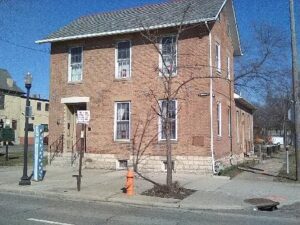
, OH
Thomas Jefferson was president when the original two-story Federal-style brick building was built in 1807. The house is located on the east half of in-lot 123, a part of Franklinton since its beginning. Surveyed by Nathanial Massie on October 28, 1796, the lot was part of Virginia Military District entry #1393, comprising 1,000 acres on the west fork of the Scioto River. Captain Robert Vance, a veteran of Virginia Continental Line during the Revolution, claimed the land. Lucas Sullivant, the founder of Franklinton, acquired it from Vance. The acreage was a part of the 1797 plat of Franklinton, recorded by Sullivant in 1802 at the Ross County Courthouse in Chillicothe. Franklinton became Franklin County’s first seat in 1803 and preceded the founding of Columbus by 15 years. In its early years, Franklinton’s nearest neighbors were the Wyndat and Haudenosaunee people. (Continued on other side)
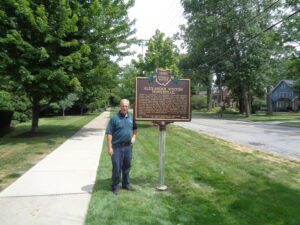
, OH
On this site, Alexander Winton (1860-1932), an American automobile pioneer, built and lived in a lakefront estate named Roseneath. Winton was born in Scotland and immigrated to the United States as a young man, settling in Cleveland. In the early 1890s, Winton founded the Winton Bicycle Company; six years later, he incorporated the Winton Motor Carriage Company. In 1903, Winton’s auto plant on Berea Road was one of the largest in the world, and he produced the first car to cross America from coast to coast. These business successes enabled him to build the 25-room Roseneath. In 1912, Winton founded the Winton Gas Engine & Manufacturing Company, which would eventually become part of General Motors Corporation. Winton is buried in Lakeview Cemetery. A fire in 1962 destroyed Roseneath.

, OH
Iuka Ravine, developed on land from the “Indianola Farm” that belonged to the Neil Family, is significant for its early 20th century architecture. The ravine’s natural beauty influenced architects to design homes for the upper middle class that incorporated “features of the old oak forest and glacial boulders.” Several ravine homes were designed by Frank Packard and Charles Inscho. Two classically-designed bridges built in 1912 insulated the area from traffic to create what became known during the 1920s-1950s as a “quiet professor enclave.” Iuka’s curvilinear street, one of the first in Columbus, as well as its stone walls, glacial erratics, and mature hardwoods created a “unique urban experience.” The Iuka Ravine Historic District was listed in The National Register of Historic Places in 1986 and added to the Columbus Register of Historic Properties in 1985.
, OH
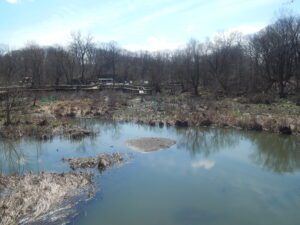
Around 1895 a park system was created connecting the corridor of Doan Brook from Shaker Lakes to Gordon Park on Lake Erie. In 1915, the Shaker Heights Land Company and Van Sweringen Company deeded property to the City of Cleveland for the park. In 1947, Cleveland leased to the cities of Shaker Heights and Cleveland Heights portions of the park within their boundaries. A proposed “Clark Freeway” (I-290) linking I-271 to downtown Cleveland through the park threatened the area in the 1960s. The proposal faced strong opposition from the Park Conservation Committee, a coalition of 30 garden clubs, the City of Shaker Heights, the Cleveland Heights PTA Council, the Shaker Historical Society, and other organizations. Governor James Rhodes withdrew the plans in 1970. The Clark Freeway was defeated and the park preserved.
, OH
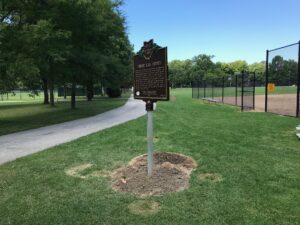
Beginning in 1873, oil magnate and philanthropist John D. Rockefeller purchased 700 acres of land in East Cleveland Township, now located in East Cleveland and Cleveland Heights. A failed hotel built in 1874-1875 served as the family’s summer home until it was destroyed by fire in 1917, although Rockefeller’s son, John, Jr., continued to visit the grounds. The Rockefellers spent much of their time outdoors, where they built on the land’s natural beauty and carefully designed and built carriage, foot and bridle paths, scenic views, lakes, a lily pond, stone bridges, a horse track and a gold course. John, Jr. purhcased all of his father’s Forest Hill property in 1923 and continued to buy adjacent land.