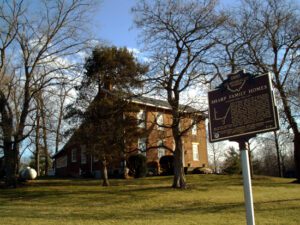
The Sharp family homes and their locations on N. State Street and Africa Road mark an important route through Westerville on the Underground Railroad. The family patriarch, Garrit Sharp, was an original settler of Sharp’s Settlement, now Westerville, and donated land for and helped organize the first Methodist church. He is also associated with the founding of Blendon Young Men’s Seminary, which was acquired by Otterbein College, an institution with enrollment open to African Americans and women from its inception in 1847. He and his sons were all noted abolitionists who, along with Bishop William Hanby and Otterbein president Lewis Davis, assisted southern slaves on their road to freedom. From the Sharp homes, slaves would have proceeded north to the house of Samuel Patterson on Africa Road and along Alum Creek to the Quaker settlement near Marengo in Morrow County.
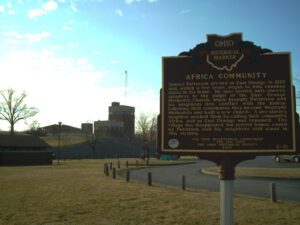
Samuel Patterson arrived in East Orange in 1824 and, within a few years, began to hide runaway slaves in his home. He also invited anti-slavery speakers to the pulpit of the East Orange Methodist Church, which brought Patterson and his neighbors into conflict with the bishop. Following their consciences, they became Wesleyan Methodists and built a new church. A pro-slavery neighbor mocked them by calling their community Africa, and so East Orange was renamed. The village has disappeared, but several homes owned by Patterson and his neighbors still stand in this vicinity.
Song writer and minister of the United Brethren Church, Hanby was an Otterbein College graduate, class of 1858, known throughout the world for the inspiring songs, “Darling Nellie Gray,” “Up on the Housetop,” and “Who is He in Yonder Stall.” Hanby House in Westerville is maintained as a memorial honoring Benjamin and his father, Bishop William Hanby.
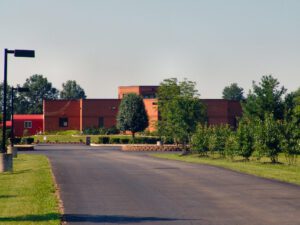
In 1985, Hindu immigrants from India formed a celestial organization, The Bharatiya Temple Society of Central Ohio, and through its membership adopted the Constitution and Bylaws and named the place of worship Bharatiya Hindu Temple. Later they bought a house at 3903 Westerville Road in Columbus for prayer and worship. In 1994, the membership moved to the current location and built this temple to serve the religious, spiritual, educational, and cultural needs of those who wish to live an active peaceful life in accordance with the Vedic dharma, philosophies, and traditions.
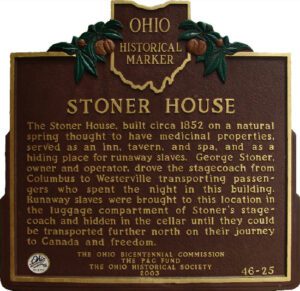
The Stoner House, built circa 1852 on a natural spring thought to have medicinal properties, served as an inn, tavern, and spa, and as a hiding place for runaway slaves. George Stoner, owner and operator, drove the stagecoach from Columbus to Westerville transporting passengers who spent the night in this building. Runaway slaves were brought to this location in the luggage compartment of Stoner’s stagecoach and hidden in the cellar until they could be transported further north on their journey to Canada and freedom.
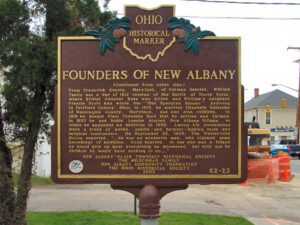
A tavern and inn, for which Noble Landon (1783-1866) obtained a liquor license in 1835, formerly occupied the southeast corner of High and Main streets. In 1837 Landon and William Yantis laid out the town of New Albany in 50-by-100-foot lots, with Landon’s lots lying on the east side and Yantis’ on the west side of High Street. Landon was born in Litchfield, Connecticut, lived as a young man in St. Albans, Vermont, and migrated to Licking County, Ohio, in 1810. He was the first clerk and first Justice of the Peace in St. Albans Township and first postmaster in Johnstown and later in New Albany. In addition to contributions as a builder-developer, Landon gave to the village lore the story of a remarkable conversion. Long known as a heavy drinker, he suddenly ordered kegs of whiskey he owned to be carried into the street and broken. He then attended church regularly. (continued on other side)
For seven glorious summers, from July 13, 1895 to July 27, 1902, laughter and gaiety rang forth from the first amusement park in Franklin County. With intoxicants banned, the Park was enjoyed by the “respectable” folk of the Gay ’90s – the stone water tower/jail was quick to house any ruffian who threatened disharmony. Delighting young and old were the Zoological Garden, Ornithological Museum, the Scenic Railway roller coaster, Shoot the Chutes (the water slide of its day), swimming, boating, baseball, bowling, concerts, dancing, picnics, strolls in the cool woodlands, pony rides, fireworks, the orchestrion replicating a 36-piece orchestra, grande vaudeville, and theater. Minerva Park’s popularity faded with the opening of Olentangy Park, only 3 miles from downtown Columbus.
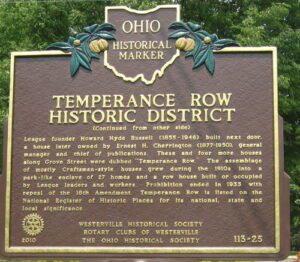
Here lived the reformers of the Anti-Saloon League of America who led the movement that turned the United States “dry” in 1920 with the 18th Amendment prohibiting the manufacture, sale or transportation of intoxicating liquor. Moving its headquarters to Westerville in 1909, the League built a publishing house that buried the liquor industry in a 10-year avalanche of books, pamphlets and periodicals that helped win Prohibition and made Westerville the “Dry Capital of the World.” Rev. Purley A. Baker (1858-1924), the League’s general superintendent, bought 11 acres and erected his rustic home at Park and Grove streets in 1910. (Continued other side)