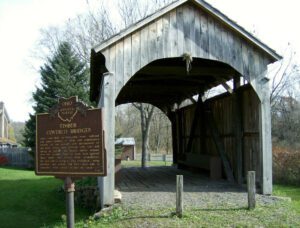
This covered bridge, over Middle Run, Elkrun Township, Columbiana County, is the shortest covered bridge in the United States still standing on a once-used public highway, having a clear span of 19 feet and 3 inches. It is an example, rarely found covered, of the simplest, most basic truss design, the two-panel king post truss. It has withstood the rigors of time and traffic since the 1870s and stands in eloquent testimony of the fine craftsmanship of the early Ohio bridge builders.
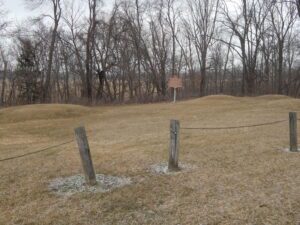
The Nettle Lake Mound Group consists of 4 low mounds overlooking a stream that runs into Nettle Lake. The mounds vary in height from 1 to 3 feet and in diameter from 18 to 30 feet. The mounds are composed primarily of reddish-brown sand (secondary mound) covering a layer of darker sand and loam (primary mound). These mounds have been partially excavated in the past by pot hunters in search of relics. Although the records of these excavations are vague and incomplete, pottery fragments, burials, and flint artifacts found in the mounds indicate that they were constructed by the Hopewell Indians.
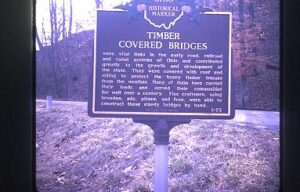
This bridge, spanning Brush Creek in Brush Creek Township, Scioto County, was erected in 1874 by the Smith Bridge Company of Toledo, Ohio. Robert W. Smith was granted patents for timber trusses in 1867 and 1869, and the design for this bridge is a Smith patented truss. The supplemental arches were added in 1896. Original length of 200 feet had been shortened to its present 171 feet. This plaque has been erected to give due honor to these early timber covered bridge builders and to the men of the community who so ably assisted them. [This side of the marker contains a bridge illustration in the upper left corner]
On Allen Street between Lower and Upper Market Streets
Lebanon
, OH
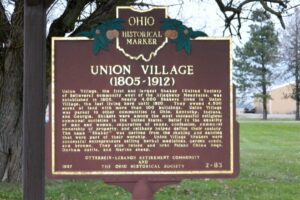
Union Village, the first and largest Shaker (United Society of Believers) community west of the Allegheny Mountains, was established in 1805. Nearly 4,000 Shakers lived in Union Village, the last living here until 1920. They owned 4,500 acres of land with more than 100 buildings. Union Village was parent to other communities in Ohio, Kentucky, Indiana, and Georgia. Shakers were among the most successful religious communal societies in the United States. Believe in equality of men and women, separation of sexes, confession, communal ownership of property, and celibacy helped define their society. The name “Shaker” was derived from the shaking and dancing that were part of their worship. Union Village Shakers were successful entrepreneurs selling herbal medicines, garden seeds, and brooms. They also raised and bred Poland China hogs, Durham cattle, and Merino sheep.
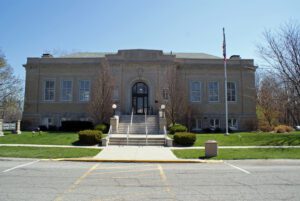
In 1912, the president of the Public Library Association in Paulding requested funding from philanthropist Andrew Carnegie to build a library in Paulding. At first the Carnegie Corporation of New York refused, stating that it only provided funding to communities with larger populations, but when the Library Association said it would serve the entire county, which had a larger population, the request was granted. As a result Paulding became the site for the first “county” Carnegie library in the United States, built for a total cost of $40,000. Carnegie provided funding for 2,811 libraries, of which 1,946 were built in the United States. Placed on the National Register of Historic Places in 1984, the Paulding County Carnegie Library continues to service the needs of all citizens of Paulding County.
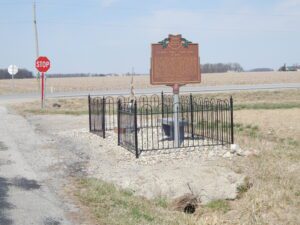
One of Ohio’s greatest manhunts ended here on the morning of July 23, 1948. Robert M. Daniels and John C. West, parolees from the state prison in Mansfield, had gone on a killing spree that left six people dead. Driving west on U.S. Route 224 in a stolen auto transport truck, the pair approached this intersection and encountered a roadblock. It was manned by Van Wert County Sheriff Roy Shaffer, Frank Friemoth, the county game warden, and Sergeant Leonard Conn of the Van Wert city police. West was driving the truck; Daniels was asleep in a car overhead. As Sheriff Shaffer climbed onto the truck and apprehended Daniels, West leaped from the cab and shot Conn in the chest and Friemoth in the arm. Conn returned fire and killed West. The officers survived their wounds. Daniels was convicted, sentenced to die, and electrocuted at the Ohio Penitentiary in Columbus on January 3, 1949. This marker pays tribute to all law enforcement officers who risk their lives to protect the citizens of their communities.
Behind the Cridersville Fire Department, 100 E. Main Street
Cridersville
, OH
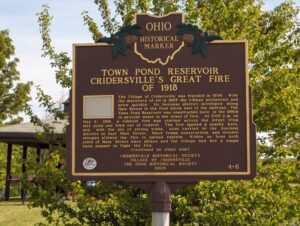
The Village of Cridersville was founded in 1856. With the discovery of oil in 1885 the village prospered and grew quickly. Its business district developed along Main Street in the first block east of the railroad. The Town Pond Reservoir was constructed here in the 1890s to provide water in the event of fire. At 3:00 p.m. on May 2, 1918, a rubbish fire was started across the street from this pond and blew out of control. The fire ignited a nearby barn, and, with the aid of strong winds, soon carried to the business district on East Main Street. Wood frame construction and wooden shingles allowed the fire to spread rapidly. Within an hour both sides of Main Street were ablaze and the village had but a single hand pumper to fight the fire. (continued on other side)
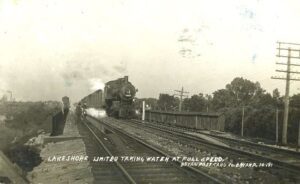
Like many nineteenth century communities in Ohio, Stryker owes its birth and early growth to the railroad industry. Stryker, named for Rome, New York, attorney and railroad executive John Stryker, was surveyed on September 19, 1853, beside the proposed Northern Indiana Railroad. For more than fifty years, “track pans” at Stryker allowed steam locomotives to take on 5,000 gallons of water while traveling at forty to fifty miles per hour, saving valuable time, “the principal enemy of railroad schedules.” On July 23, 1966, the U.S. rail speed record of 183.85 miles per hour was set through Williams County, including through Stryker. The Stryker depot was constructed in 1900 and placed on the National Register of Historic Places on August 7, 1989. (continued on other side)