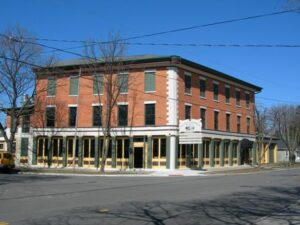
Levi Beebe built in 1836 this structure then known as the Commercial Building housing stores, bank, and post office. During the canal era, the building was a stagecoach stop and social center for Maumee, the Lucas County seat until 1853. Later the inn was called the Neely House, Schiely House, the Bismark, Seurin Hotel Langley Inn, and, after 1940, The Old Plantation.
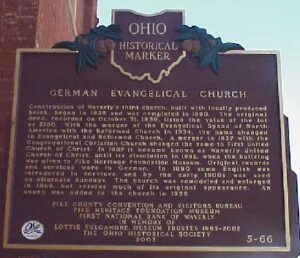
Construction of Waverly’s third church, built with locally produced brick, began in 1859 and was completed in 1860. The original deed, recorded on October 31, 1859, listed the value of the lot as $180. With the merger of the Evangelical Synod of North America with the Reformed Church in 1934, the name changed to Evangelical and Reformed Church. A merger in 1957 with the Congregational Christian Church changed the name to First United Church of Christ. In 1987 it became known as Waverly United Church of Christ, until its dissolution in 1992, when the building was given to Pike Heritage Foundation Museum. Original records and services were in German. In 1890 some English was introduced in services, and by the early 1900s was used on alternate Sundays. The church was remodeled and enlarged in 1869, but retains much of its original appearance. An annex was added to the church in 1959.
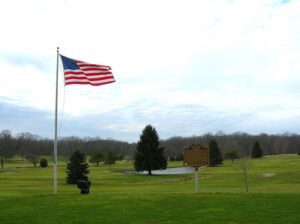
Golfer and World War II veteran William J. Powell, excluded from playing on many American golf courses because of his race, overcame the indignity of discrimination by creating his own course. Hand built in two years and opened in 1948, Clearview Golf Club is the first golf course in the United States designed, built, and owned by an African-American. The acclaimed course harmonizes with the landscape and bears many design elements of traditional British courses. A triumph of perseverance over discrimination, Clearview represents the historic postwar era when athletes first broke the “color line” in American sports.
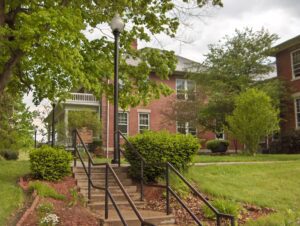
In the first quarter of the nineteenth century, when the general public believed that the insane and paupers could be rehabilitated into productive citizens, the Ohio Legislature gave authorization to county commissioners to establish county “poor houses.” The Athens County Home, formerly known as the Athens County Infirmary, opened on this site in 1857 to provide care for indigent citizens of Athens County. When fire destroyed the original building in 1903, a new building was constructed from 1904-1905, designed with the capacity to house up to one hundred people. When it was built, it was considered to be one of the finest and most modern charitable institutions of its time. The facility continued to provide housing for indigent and elderly residents until 1997 when the County Commissioners closed the home and it became a primary location for the delivery of social services in Athens County. (continued on the other side)
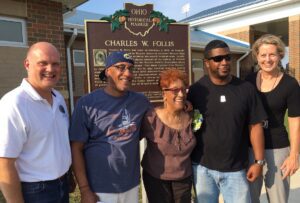
Charles W. Follis was born on February 3, 1879, in Virginia. His family moved to Wooster where he attended Wooster High School and helped establish the school’s football team. In 1901, Follis enrolled and played baseball at the College of Wooster and played football for the Wooster Athletic Association where he earned the nickname “The Black Cyclone from Wooster.” In 1904, Follis signed a contract to play football with Shelby Athletic Club, making him the first African-American professional football player. Follis faced discrimination on and off the field leading to many injuries. After a career-ending injury in 1906, Follis played baseball for the Cuban Giants of Long Island. He died of pneumonia in 1910 at the age of 31 and is buried in Wooster Cemetery.
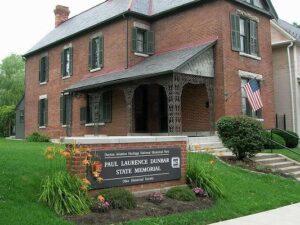
The first African-American to achieve prominence as a poet, Paul Laurence Dunbar was born and raised in Dayton, the son of former slaves. Working as an elevator operator while he established himself as a writer, Dunbar published his first book of poems, Oak and Ivy, in 1893. His third collection, Lyrics of a Lowly Life (1896) with an introduction by another Ohio-born author William Dean Howells, gained Dunbar widespread critical acclaim and popular recognition. Widely published in contemporary journals and literary magazines, Dunbar employed both turn-of-the-century African-American dialect and standard English verse to give a voice to the themes of everyday discrimination and struggles for racial equality. Tuberculosis cut his life short at age 33. Dunbar’s body of work includes twelve volumes of poetry, four books of short stories, a play, and five novels.
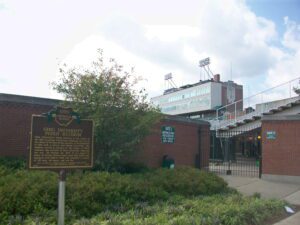
Ohio University’s Peden Stadium is the oldest of the Mid-American Conference stadiums and one of the oldest of its type in the country. It was dedicated in 1929 with a victory over Miami University. The stadium served as housing for the influx of WWII veterans who enrolled at Ohio University following the war. On October 22, 1960, it was named in honor of former Bobcat head coach Don Peden who coached from 1929 to 1946 and compiled a record of 121 wins, 46 losses, and one tie.
Intersection of State Route 554 and Depot Road, Springfield Township
Bidwell
, OH
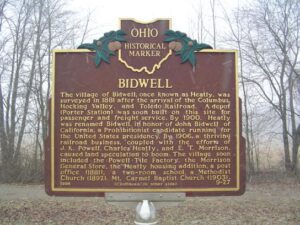
The village of Bidwell, once known as Heatly, was surveyed in 1881 after the arrival of the Columbus, Hocking Valley, and Toledo Railroad. A depot (Porter Station) was soon built on this site for passenger and freight service. By 1900, Heatly was renamed Bidwell, in honor of John Bidwell of California, a Prohibitionist candidate running for the United States presidency. By 1906, a thriving railroad business, coupled with the efforts of J.K. Powell, Charles Heatly, and E.T. Morrison, caused land speculation to boom. The village soon included the Powell Tile Factory, the Morrison General Store, the Heatly housing addition, a post office (1881), a two-room school, a Methodist Church (1892), Mt. Carmel Baptist Church (1903), (Continued)