

, OH
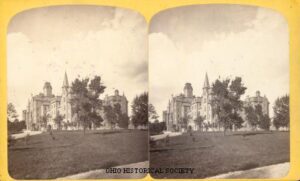
In 1835, Dr. William Awl of Columbus and Dr. Daniel Drake of Cincinnati presented recommendations to the Ohio General Assembly to establish a school for the blind. Legislation, signed by then governor of Ohio Duncan McArthur on April 3, 1837, provided funding to create the first state-supported residential school for the blind in the United States. The Institution for the Education of the Blind opened July 4, 1837, with five students. A year later, the first permanent structure, housing 60 students, was built on a nine-acre tract of land on the eastern edge of the city, and that was followed in 1874 with a larger facility near Fulton and Main streets. The school was honored and recognized in 1937 as being one of the finest schools for the blind in the country. In 1953, a new school for the blind was built at its present location at 5220 North High Street.
, OH
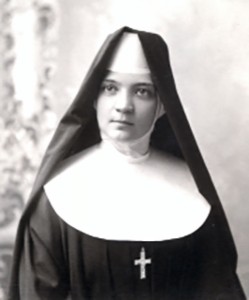
In 1916, Bishop of Toledo Joseph Schrembs requested that the Sisters of Saint Francis, Rochester, Minnesota, send nuns to work with Polish immigrant children that were flooding into greater Toledo. Mother Mary Adelaide Sandusky (1874-1964) brought 22 sisters who quickly established a new order, their Toledo motherhouse, and began teaching in parish schools. Under her steady guidance, the Sisters of St. Francis of the Congregation of Our Lady of Lourdes, Sylvania, Ohio, transformed 89-acres of farmland into a tranquil campus that included gardens, shrines, and an arboretum. Mother Adelaide designed buildings modeled on the California missions and filled them with European art as well as original ceramic murals made by the Sisters. The Sylvania Franciscans flourished and over 500 new members joined between 1916 and 1964. (Continued on other side)
, OH
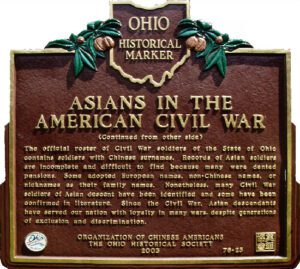
Despite exclusionary laws preventing U.S. citizenship, Asians served in the Union and Confederate armies and navies during the American Civil War (1861-1865). Many of these soldiers were denied citizenship following their services due to the anti-Asian sentiment, which culminated in the Naturalization Act of 1870 and the Chinese Exclusion Act of 1882. The exclusionary laws continued until 1943, and all restrictions on national origin or race were abolished in 1965. In April 2003, House Joint Resolution 45 was introduced to Congress to posthumously proclaim Civil War soldiers of Asian descent to be honorary citizens of the United States as recognition of their honorable services. (continued on other side)
, OH
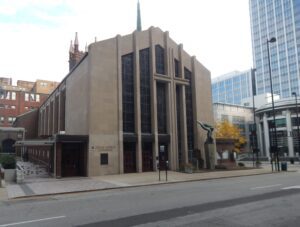
In 1817 twenty-two men, including future President William Henry Harrison, chartered Cincinnati’s first Episcopal parish, Christ Church. In 1835 members erected a Gothic Revival-style church on this site. The neighborhood evolved as the city grew with the influx of immigrants. Parish women raised funds to teach, feed, clothe, and shelter tenement families, and alleviate suffering during floods and disease outbreaks. In 1883 the women helped establish what became Cincinnati Children’s Hospital. In 1909 members opened the Late Gothic-style Parish House, a community center with kitchen, classrooms, library, auditorium, clinic, gymnasium, and bowling alley. By the parish’s centennial in 1917, music had expanded beyond worship to public concerts. In 1940 the annual Boar’s Head Festival of music and pageantry began. Since the 1960s, members have collaborated with local agencies to advocate for social and economic justice, a mission continuing into the 21st century. (Continued on other side)
, OH
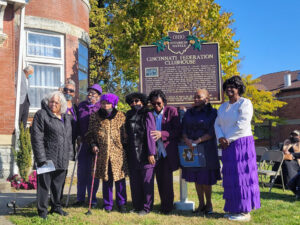
“Lifting As We Climb”: The Cincinnati Federation of Colored Women’s Clubs (CFCWC) was organized May 6, 1904, during a meeting called by Mary Fletcher Ross at the Allen Temple A.M.E. Church. Gathering together eight existing African-American women’s clubs, the CFCWC sought to unite in their work promoting “the betterment of the community.” At a time when both government and private philanthropies overlooked the needs of Black Americans, CFCWC members helped to organize the city’s first kindergartens for Black children, taught in Cincinnati African-American public schools –including the Walnut Hills Douglass and Stowe schools—and raised money for the Home of Aged Colored Women. Since 1904, the Cincinnati Federation of Colored Women’s Clubs has ensured the civic and constitutional rights of all African Americans while meeting the needs of their city.
, OH
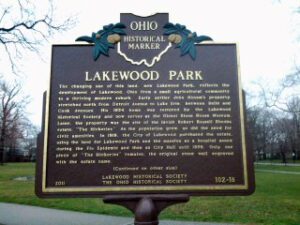
The changing use of this land, now Lakewood Park, reflects the development of Lakewood, Ohio from a small agricultural community to a thriving modern suburb. Early settler John Honam’s property stretched north from Detroit Avenue to Lake Erie, between Belle and Cook Avenues. His 1834 home was restored by the Lakewood Historical Society and now serves as the Oldest Stone House Museum. Later, the property was the site of the lavish Robert Russell Rhodes estate, “The Hickories.” As the population grew, so did the need for civic amenities. In 1919, the City of Lakewood purchased the estate, using the land for Lakewood Park and the mansion as a hospital annex during the Flu Epidemic and then as City Hall until 1959. Only one piece of “The Hickories” remains; the original stone wall engraved with the estate name.
, OH
The Cincinnati Club, a prominent Jewish social club founded in 1889, opened their clubhouse at 2840 Melrose Avenue in 1894. A.E. Elzner designed the brick and stone building in the Norman-Gothic style. It featured massive round towers, wide porches, a ballroom, billiard rooms, bowling alley, as well as ornate club rooms. The Cincinnati Club hosted lavish events that celebrated Jewish identity and community. As the Jewish population migrated north and east of Walnut Hills, the club dissolved. In 1922, the vacant clubhouse was purchased by the Disabled American Veterans of the World War (DAV). The DAV Clubhouse provided recreation, resources, and shelter to disabled veterans for over twenty years. The organization, founded in Cincinnati in 1920, led to the establishment of the Veterans Administration and improved support for wounded veterans nationwide.
, OH
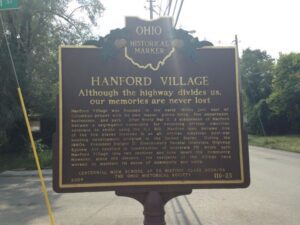
Hanford Village was founded in the early 1900s just east of Columbus proper with its own mayor, police force, fire department, businesses, and park. After World War II, a subdivision of Hanford became a segregated community for returning African American veterans to settle using the G.I. Bill. Hanford then became one of the few places involved in an all African American post-war housing development program in the United States. During the 1960s, President Dwight D. Eisenhower’s Federal Interstate Highway System Act resulted in construction of Interstate 70 which split Hanford Village into two sections and tore apart the community. However, since the division, the residents of the village have worked to maintain its sense of community and unity.