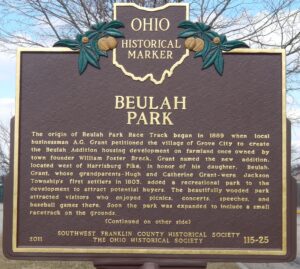
The origin of Beulah Park Race Track began in 1889 when local businessman A. G. Grant petitioned the village of Grove City to create the Beulah Addition housing development on farmland once owned by town founder William Foster Breck. Grant named the new addition, located west of Harrisburg Pike, in honor of his daughter, Beulah. Grant, whose grandparents, Hugh and Catherine Grant, were Jackson Township’s first settlers in 1803, added a recreational park to the development to attract potential buyers. The beautifully wooded park attracted visitors who enjoyed picnics, concerts, speeches, and baseball games there. Soon the park was expanded to include a small racetrack on the grounds.
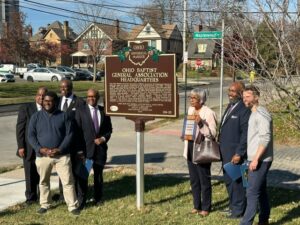
The Ohio Baptist General Association (OBGA) acquired 48 Parkwood Avenue in 1954 and used the former residence as its headquarters until 1996. Formed in 1896, the Association includes more than forty African American churches, many formed prior to the Civil War. Baptist general associations nationwide became an important voice during the 1960s Civil Rights Movement as they addressed the wrongs of racial violence and discrimination in business, housing, and education. The OGBA fought for the ideals of justice and freedom with its strongly-held Baptist beliefs. “America with her wealth as a great nation,“ OGBA President Wilber A. Page declared in 1957, “is well able to face integration and give a democracy to all her citizens.” The former Association Headquarters was listed in the National Register of Historic Places on December 3, 2020.
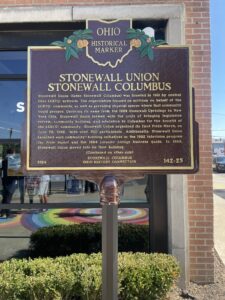
Stonewall Union (later Stonewall Columbus) was founded in 1981 by central Ohio LGBTQ+ activists. The organization focused on activism on behalf of the LGBTQ+ community, as well as providing physical spaces where that community could prosper. Deriving its name from the 1969 Stonewall Uprisings in New York City, Stonewall Union formed with the goals of bringing legislative reform, community building, and education to Columbus for the benefit of the LGBTQ+ community. Stonewall Union organized its first Pride March, on June 26, 1982, with over 500 participants. Additionally, Stonewall Union launched such community-building initiatives as the 1982 television program Gay Pride Report and the 1984 Lavender Listings business guide. In 1985, Stonewall Union moved into its first building. (Continued on other side)
Here in 1963 congregants of Beth Israel-The West Temple, led by Louis Rosenblum, Herb Caron, and Rabbi Daniel Litt, founded the Cleveland Committee (later Council) on Soviet Anti-Semitism, the first American organization created to advocate for freedom for Soviet Jews. In 1970 this work led to the formation of the Union of Councils for Soviet Jews (UCSJ) under the leadership of Louis Rosenblum. The UCSJ, whose national office was located here 1970-1973, became the largest independent Soviet Jewry organization in the world. By the turn of the 21st century, the efforts begun here helped 1.6 million Jews leave the former Soviet Union. (Continued on other side)
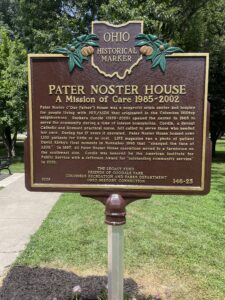
Pater Noster (“Our Father”) House was a nonprofit crisis center and hospice for people living with HIV/AIDS that originated in the Columbus Hilltop neighborhood. Barbara Cordle (1939-2020) opened the center in 1985 to serve the community during a time of intense homophobia. Cordle, a devout Catholic and licensed practical nurse, felt called to serve those who needed her care. During the 17 years it operated, Pater Noster housed over 1,100 patients for little or no cost. LIFE magazine ran a photo of patient David Kirby’s final moments in November 1990 that “changed the face of AIDS.” In 1997, all Pater Noster House operations moved to a farmhouse on the southwest side. Cordle was honored by the American Institute for Public Service with a Jefferson Award for “outstanding community service” in 2002.
Civil unrest rocked the Hough neighborhood for five nights during the summer of 1966.When the white owners of the Seventy-Niners Cafe refused to serve a Black customer a glass of water, a sign bearing a racial epithet subsequently appeared outside the bar. Decades of institutionalized racial practices that had caused Hough’s substandard and overcrowded housing, high unemployment, economic exploitation, lack of access to quality education, and systemic police harassment sparked an urban uprising in response on July 18. Angry crowds gathered outside the bar only to be confronted by the owners brandishing firearms. When the police belatedly responded, tensions escalated into targeted firebombing, looting, and vandalism. On Tuesday night, July 19, Cleveland’s Mayor Ralph Locher requested that the Ohio National Guard restore order. (Continued on other side)
Ludlow, a neighborhood straddling Shaker Heights and Cleveland, was developed in 1905 by Otis and Mantis Van Sweringen. By 1920, they imposed restrictive deed covenants that racially excluded Black home ownership in the community. In 1948, the Supreme Court ruled in Shelley v. Kraemer that such covenants violated the Equal Protection Clause of the Fourteenth Amendment. As a result, affluent African American professionals began to buy homes in Ludlow, seeking the suburban atmosphere and good schools for their families. While illegal, the Van Sweringen Company continued to require prospective African American buyers to gain approval from neighbors before they could purchase homes. Subsequently, the idea of African American families moving into Ludlow created white flight as realtors perpetuated unfounded fears that property values would decline in order to “blockbust” and purchase properties at depressed prices.