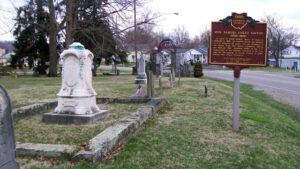
(1792-1862) A native of South Hadley, Massachusetts, he came to Gallipolis ca. 1818. An eminent lawyer and member of U.S. Congress 22 years, he was chairman of the House Ways and Means Committee during the Mexican War, founding father of the U.S. Department of the Interior, honored in his own time by the naming of Vinton County in 1850. Buried Pine Street Cemetery.
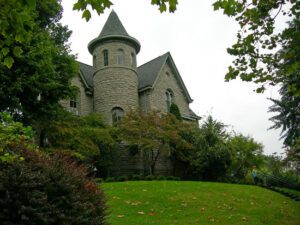
George W. Campbell originally built this highly picturesque structure in 1854. Designed with Romanesque and Norman Revival architectural features – a round tower, arched windows and doorways – and constructed of locally mined blue limestone, the home is representative of the work of architect W. Russell West. Campbell, a nationally eminent horticulturist, had a small vineyard to the east of the house where he developed and improved a variety of fruits, most notably the world famous Delaware Grape. Following Campbell’s death in 1898, the house was sold to Dr. Aaron J. Lyons and Mrs. Abbie Parish and presented to Ohio Wesleyan University, serving for more than 70 years as Lyons Art Hall.
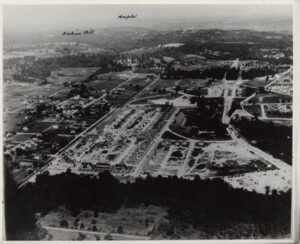
Ground was broken for Mariemont by Mary M. Emery, the village’s founder, on April 23, 1923. This planned community was designed by eminent town planner John Nolen and twenty-five of America’s leading architects. As part of the “garden city movement,” Mariemont was influenced by English models. Mariemont was incorporated July 12, 1941, and was listed on the National Register of Historic Places on July 24, 1979.
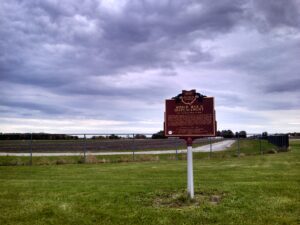
During the early months of World War II, ordinary citizens as well as soldiers made enormous sacrifices for the war effort. In March 1942 the War Department announced plans to build a 13,000-acre munitions manufacturing complex northeast of Marion. Using the power of eminent domain, the U.S. Government purchased the homes and farms of 126 families in the Likens Chapel community. Given only two months to vacate their property, many displaced farmers found the government-appraised values for their land inadequate for buying similar farms elsewhere and the growing season too advanced to plant new crops. (continued on other side)
The first African American congregation and first African American Methodist Episcopal (AME) Church in Dayton trace their roots back to the early 1830s. They were organized by Father Thomas Willis and a small group of faithful men and women. After several moves, the congregation settled on Eaker Street and the church was dedicated in the early 1870s. The church was rededicated in 1882 and renamed Wayman Chapel AME Church. The eminent poet Paul Laurence Dunbar and his mother Matilda attended and worshiped at the Eaker Street church. His untimely death in 1906 brought family and friends to his funeral services held at the church. By 1923 church leadership felt the need for more secure space for the growing congregation and moved to a new building at Fifth and Banks streets. Three elegant chandeliers for the sanctuary were donated by the city’s newspaper, the Dayton Daily News. (Continued on other side)
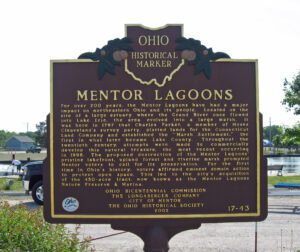
For over 200 years, the Mentor Lagoons have had a major impact on northeastern Ohio and its people. Located on the site of a large estuary where the Grand River once flowed into Lake Erie, the area evolved into a large marsh. It was here in 1797 that Charles Parker, a member of Moses Cleaveland’s survey party, platted lands for the Connecticut Land Company and established the “Marsh Settlement,” the first in what later became Lake County. Throughout the twentieth century, attempts were made to commercially develop this natural treasure, the most recent occurring in 1996. The proposed destruction of the Mentor Lagoons’ pristine lakefront, upland forest and riverine marsh prompted Mentor voters to call for its preservation. For the first time in Ohio’s history, voters affirmed eminent domain action to protect open space. This led to the city’s acquisition of the 450-acre tract, now known as the Mentor Lagoons Nature Preserve & Marina.
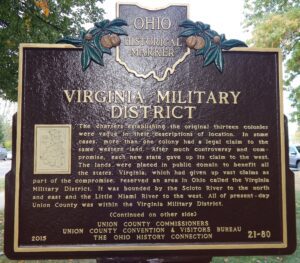
The charter establishing the original thirteen colonies were vague in their descriptions of location. In some cases, more than one colony had a legal claim to the same western land, After much controversy and compromise, each new state gave up its claim to the west. The lands were placed in public domain to benefit all the states. Virginia, which had given up vast claims as part of the compromise, reserved an area in Ohio called the Virginia Military District. It was bounded by the Scioto River to the north and east and by the Little Miami River to the west. All of present-day Union County was within the Virginia Military District. (Continued on other side)
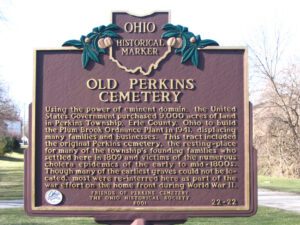
Using the power of eminent domain, the United States Government purchased 9,000 acres of land in Perkins Township, Erie County, Ohio to build the Plum Brook Ordnance Plant in 1941, displacing many families and businesses. This tract included the original Perkins cemetery, the resting-place for many of the township’s founding families who settled here in 1809 and victims of the numerous cholera epidemics of the early to mid-1800s. Though many of the earliest graves could not be located, most were re-interred here as part of the war effort on the home front during World War II.