

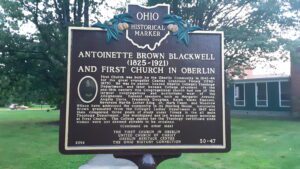
, OH
First Church was built by the Oberlin Community in 1842-44 for the great evangelist Charles Grandison Finney (1792-1875). He was its pastor, headed Oberlin College’s Theology Department, and later became College president. In the mid-19th century this Congregational church had one of the largest congregations and auditoriums west of the Alleghenies. Eminent speakers such as Margaret Atwood, Angela Davis, Frederick Douglass, Ralph Waldo Emerson, Reverend Martin Luther King, Jr., Mark Twain, and Woodrow Wilson have addressed the community in its Meeting House. Antoinette Brown graduated from the College’s Ladies’ Department in 1847 and then completed three years of study under Finney in the all male Theology Department. She worshipped and led women’s prayer meetings at First Church. The College denied her the Theology certificate since women were not deemed suitable to be ordained. (continued on other side)
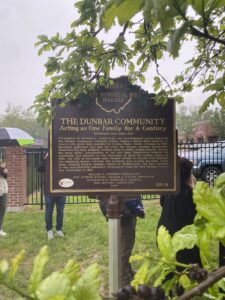
, OH
Dunbar, or Corsica Hollow, was an African American neighborhood on the western edge of Madisonville. Its streets and lots were laid out in 1886 after Mahlon and Anna Leonard subdivided their 10-acre tract near Duck Creek and sold lots to African Americans. Many early Dunbar residents were from the South; some born there prior to emancipation. Prominent early citizens included Harriet Deatherage, Elihu Parks, Gandison Embry, Thomas Duett, and James Murphy. Dunbar was home to the New Mission Missionary Baptist Church, founded in 1907. Originally meeting in a one-room building, the extant congregation relocated to Ravenna Street in 1963. By the late 1920s, Dunbar had about forty houses, a grocery run by Henry Lowman, and a hair salon run by Flora Hector. (Continued on other side)
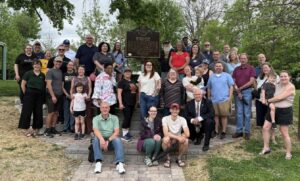
, OH
Miranda Boulden Parker lived at 2644 Marsh Avenue from 1907 to 1915. She moved into the four-family rental home with her daughters Bianca and Portia, who both worked as teachers. Miranda Parker was the widow of John P. Parker, Ripley’s Underground Railroad hero, born into slavery who famously helped more than 400 fugitives escape to freedom. In March 1914, after several vacant apartments in their Marsh Avenue home were repeatedly vandalized, daughter Bianca assumed the role as building caretaker. When she appealed to the police for help against vandals breaking windowpanes, shutters, and transoms, the police made no effort to arrest the offenders. Instead, the Health Department issued a 24-hour eviction notice. Bianca Parker sued Norwood’s Health Officer and Chief of Police unsuccessfully. The Parker family left Norwood for the more welcoming and integrated Madisonville neighborhood.
Miranda Boulden Parker lived in a home on this site from 1907(1) to 1915(2). She was the widow of Underground Railroad hero John P. Parker, who had been born into slavery. They lived in Ripley, Ohio, where John P. Parker helped more than 400 fugitives escape to freedom.(3) After his death in 1900, Miranda and their daughters Bianca and Portia, both teachers, came to Norwood. Here they rented an apartment in a four-family dwelling where Bianca became the caretaker.(4) From 1913-‘14, vandals broke over 63 windowpanes, shutters, and transoms. Bianca appealed to the police for help. Instead, the police notified the Health Department, who gave the Parkers a 24-hour eviction notice. The Parkers moved out of Norwood after unsuccessfully suing the city. (123 words)
City of Norwood, Ohio
Norwood Historical Society
The Ohio History Connection
This park was established by the City of Norwood in 1923(5) for the purpose of preventing Black Americans from owning homes here.(6) From 1907(7) to 1922(8), a four-family house on this site was rented by Black families.(9) George and Sarah Hirst lived in one of those units. On July 5, 1922, the Hirsts purchased a vacant lot next door(10) to the four-family dwelling and hired a Black contractor to build them a home.(11) White neighbors, fearing that a “Negro colony” might be developing, petitioned(12) Norwood City Council to take action.(13)(14) The Council used the right of eminent domain to seize the vacant lot from George and Sarah Hirst.(15) The Council also seized several other adjacent lots and demolished the four-family dwelling, creating Marsh Park.(16) (125 words)
City of Norwood, Ohio
Norwood Historical Society
The Ohio History Connection
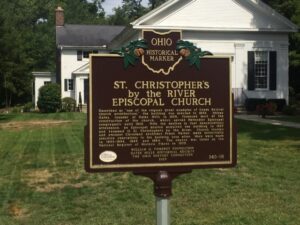
, OH
Described as “one of the region’s great examples of Greek Revival church architecture,” the building was erected in 1853. Holsey Gates, founder of Gates Mills in 1826, financed most of the construction of the church, which served Methodist Episcopal congregants until 1926. With the decline in that denomination’s attendance, an Episcopal mission acquired the building in 1927 and renamed it St. Christopher’s by the River. Church trustee and eminent Cleveland architect Frank Walker made historically sensitive renovations to the building soon after. More were made in 1953-1954, 1965, and 1984. The church was listed on the National Register of Historic Places in 1975.