 Skip to content

15-31 Greenhills

Considered a bold experiment in community planning, Greenhills was intended to relieve an acute housing shortage and to provide jobs during the Great Depression. In 1935, the administration of President Franklin Roosevelt authorized the construction of three greenbelt communities: Greendale, Wisconsin; Greenbelt, Maryland; and Greenhills, Ohio. The construction of Greenhills began on December 16, 1935. […]
14-31 The Irish in Cincinnati

In memory of the Irish people who left a country where only their rivers run free. The Irish came to Cincinnati where they contributed to housing, education, employment, religious freedom, medical care and recreation, and embraced all aspects of life in the city. The descendants of Irish immigrants hope that our hands will ever be […]
13-31 Maple Knoll Village

A group of concerned Cincinnati women organized, in 1855, The Protestant Home for the Friendless and Female Guardian Society as a private, not-for-profit maternity home for destitute women and children. These public minded social leaders were aware that Cincinnati had grown beyond the time when the poor or unfortunate were cared for by their neighbors. […]
12-31 1749 French Claims to Ohio River Valley
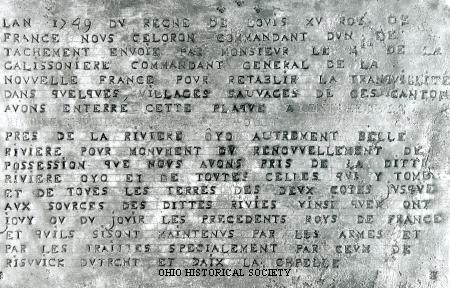
In 1749, the French in North America perceived a threat by British expansion west of the Allegheny Mountains to the Ohio River Valley and beyond. The French commander, Pierre Joseph Celeron, sieur de Blainville, with 250 men, left Montreal, New France, to establish French claims. They buried inscribed lead plates at the mouths of six […]
11-31 Anti-German Hysteria

The United States’ declaration of war on Germany in April 1917 resulted in a tragic display of hysteria directed against everything and anything German. In Cincinnati, German teachers were dismissed from public schools, German professors were censored, German collections and publications were removed from circulation at the Public Library, businesses with German names had their […]
10-31 Vorhees Town / Plan of the Town of Reading

In 1794 Abraham Voorhees, a Revolutionary War veteran, brought his family from New Jersey to the Northwest Territory to settle on 640 acres of land, part of the Miami Purchase, for which he paid John Cleves Symmes “533 dollars 30/90ths” in United States Treasury Certificates. By 1798 the town was platted and lots were being […]
9-31 Garard/Martin Station, 1790
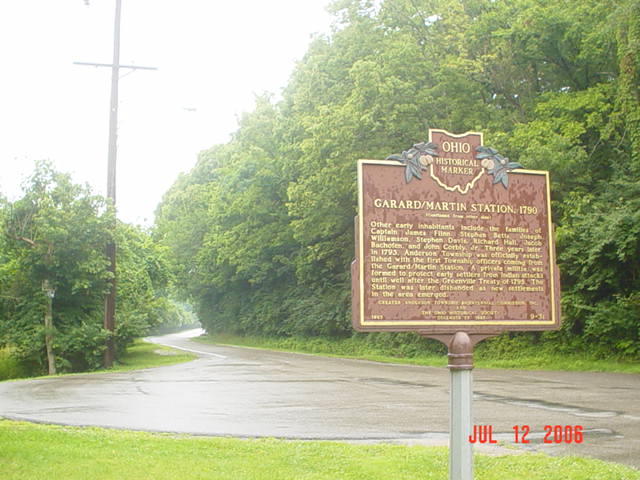
Site of the first fortified settlement in Anderson Township and one of the first in the Virginia Military District. John Garard and Joseph Martin were the founders of this Station, who, with Elias Garard, Joseph Frazee, and others, came by two flatboats with families and livestock from Garards Fort, Pennsylvania, via the Ohio and Little […]
8-31 Congress Green Cemetery / John Cleves Symmes

Originally belonging to the William Henry Harrison family, this cemetery was known as “The Pasture Graveyard” until the Civil War era. It became the final resting place of many members of the Harrison and Symmes families as well as other early settlers to the North Bend area. It was in use until 1884 when Maple […]
7-31 Mariemont
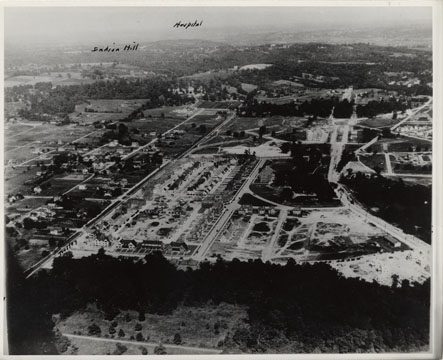
Ground was broken for Mariemont by Mary M. Emery, the village’s founder, on April 23, 1923. This planned community was designed by eminent town planner John Nolen and twenty-five of America’s leading architects. As part of the “garden city movement,” Mariemont was influenced by English models. Mariemont was incorporated July 12, 1941, and was listed […]
5-31 First National Correctional Congress / Declaration of Principles of 1870

On this site in October of 1870 met a group of enlightened individuals dedicated to the reformation and improvement of penal systems. This first Congress of the National Prison Association, now known as the American Correctional Association, adopted a far-sighted philosophy of corrections. This philosophy, embodied in its Declaration of Principles, remains today as the […]