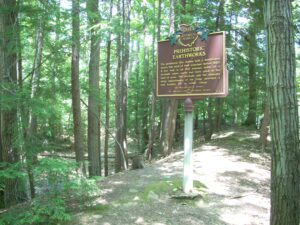
The prehistoric Erie Indians built a fortification across this neck of land sometime before 1650. A low wall is all that remains today of a stockade where earth had been piled at the base of posts. The stockade and the naturally steep embankments of the ridge provided a safe location for an Indian village.
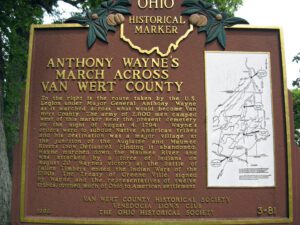
To the right is the route taken by the U.S. Legion under Major General Anthony Wayne as it marched across what would become Van Wert County. The army of 2,800 men camped west of this marker near the present cemetery on the night of August 4, 1794. Wayne’s orders were to subdue Native American tribes and his destination was a major village at the junction of the Auglaize and Maumee Rivers (now Defiance). Finding it abandoned, Wayne marched down the Maumee River and was attacked by a force of Indians on August 20. Wayne’s victory at the Battle of Fallen Timbers ended the Indian Wars of the 1790s. The Treaty of Greene Ville, signed by Wayne and the representatives of twelve tribes, opened much of Ohio to American settlement. Side one includes a map on the right hand side of the marker showing the route of Wayne’s army through the eastern third of Van Wert County.
One of the most influential icons of American popular culture in the mid-20th century, Roy Rogers was born Leonard Franklin Sly on November 5, 1911 in Cincinnati. He moved to this farm at age 8 from Portsmouth and lived here with his family until the Great Depression. He went to California in 1930, working as a truck driver, fruit picker, and country musician before signing a movie contract with Republic Pictures in 1937. Immediately popular, the clean-cut singing cowboy appeared in more than 100 western films, often making six or more movies a year during the 1940s. With his nearly equally-famous horse Trigger and his wife and partner Dale Evans-“the Queen of the West”-he subsequently starred in more than 100 television episodes of the family-oriented Roy Rogers Show from 1951 to 1957. A perennial hero and “good guy,” Rogers personified the mythical American cowboy who always fought fairly and lived by a strong moral code. He died in California on July 6, 1998.
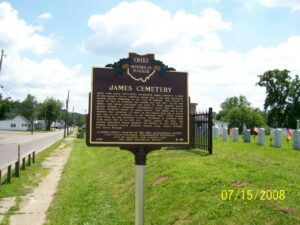
Major John James (1772-1854) established James Cemetery in 1828 on and around a Native American mound that is the only significant ancient mound remaining in the city of Jackson. The mound is about 70 feet in diameter and nearly six feet tall. In the late 1800s, this mound comprised one point of three ancient mound groups forming a triangular configuration along East Broadway Street, formerly known as James Street. One group was a few hundred feet northeast of here on the Watson farm and a second was just to the northwest on the Warnicke farm. These mounds were built by the Hopewell Culture, prominent in southern Ohio from about 100 BC to 400 AD. Major James, his wife, and several immediate family members are buried on the mound including Jackson County pioneers Andrew Long, Daniel Hoffman, and David Mitchell.
The history of New Knoxville provides one of the best examples of chain migration to America. After the Shawnee were removed from what would become Auglaize County, James Knox Lytle, cousin to James Knox Polk, purchased land in Washington Township. Lytle platted a village of 102 lots in 1836, calling it Knoxville to honor his mother’s family. Meanwhile, newly married Wilhelm and Elisabeth Fledderjohann Kuckhermann (later Kuck) immigrated from Ladbergen in northwest Germany. Having missed their boat to St. Louis, the couple lived briefly in Stallostown (Minster) and Bremen (New Bremen). They wrote home, encouraging others to emigrate; in the summer of 1835 the Fledderjohanns (Elisabeth’s family), Meckstroths, and Lutterbecks arrived. The families bought land near the site of Knoxville. (continued on other side)
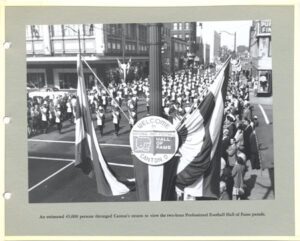
On September 17, 1920, representatives from ten professional football teams met in Canton and formed the American Professional Football Association, which in 1922 became the National Football League (NFL). Pro football evolved from club football in the 1890s, and by the early 1900s had begun to spread across the country, concentrating in the Midwest. Jim Thorpe, the first nationally prominent pro, started with the Canton Bulldogs-an early pro football power-in 1915. In 1959, Canton citizens launched a well-organized and ultimately successful effort to have their city, “the cradle of professional football,” designated as the site of a monument to the sport’s historic stars. The Professional Football Hall of Fame opened on September 7, 1963, inducting seventeen charter members. The Hall of Fame interprets and promotes the study of the role of professional football in American culture.
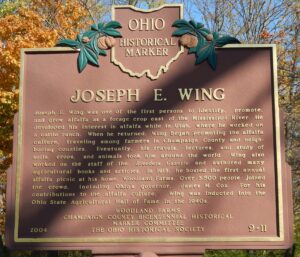
Joseph E. Wing was one of the first persons to identify, promote, and grow alfalfa as a forage crop east of the Mississippi River. He developed his interest in alfalfa while in Utah, where he worked on a cattle ranch. When he returned, Wing began promoting the alfalfa culture, traveling among farmers in Champaign County and neighboring counties. Eventually, his travels, lectures, and study of soils, crops, and animals took him around the world. Wing also worked on the staff of the Breeders Gazette and authored many agricultural books and articles. In 1913, he hosted the first annual alfalfa picnic at his home, Woodland Farms. Over 3,500 people joined the crowd, including Ohio’s governor, James M. Cox. For his contributions to the alfalfa culture, Wing was inducted into the Ohio State Agricultural Hall of Fame in the 1940s.
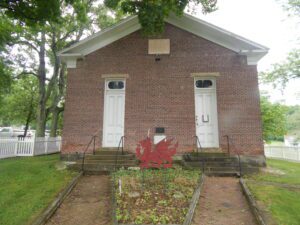
In 1972 a group of Welsh-Americans chartered the Welsh-American Heritage Museum to preserve Welsh history and culture, and to preserve the Welsh Congregational Church. The old brick church was where songs of praises rang, as the Welsh gathered and sang beloved hymns of their homeland in four-part harmony. The church is a link in a long, unbroken chain of memories and still serves the community as a center of Welsh-American activities and a keeper of the community’s heritage. The red dragon and daffodil are symbols of Wales.