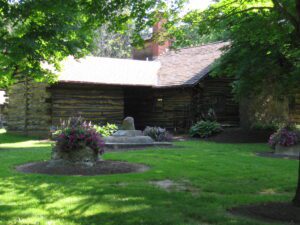
In recognition of its noteworthy representation of the history, culture, and architecture of the Western Reserve, Burton Village’s Historic District was placed on the National Register of Historic Places in 1974. The Historic District, an area of approximately 20 acres surrounding the Village Green and along streets at the north end of the Green, includes 15 buildings of historical significance built between 1815 and 1891. Preserved within the District are commercial and public buildings and private dwellings that reflect the cultural and architectural development of a village of the Western Reserve of Ohio during the 19th century. Buildings in the predominant architectural styles of the 19th century are all represented in the Historic District, including Western Reserve, Greek Revival, Second Empire, Italianate, and Queen Anne. [Continued on other side]
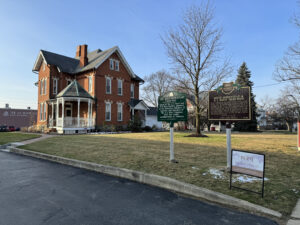
The Root Homestead was built in 1879 by Amos Ives Root, founder of the A. I. Root Company, shortly after he moved his business from the town square. The homestead housed several generations of the Root family until 1953 and was listed on the National Register of Historic Places in 1975. A pioneer of the beekeeping industry, Root helped to standardize such beekeeping equipment and tools as the Langstroth removable frame hive and the centrifugal honey extractor. As a result, beekeepers were able to harvest more honey every season without harming the bees. A prolific author and publisher, Root educated beekeepers across the globe and built a sense of community within the profession. (Continued on other side)
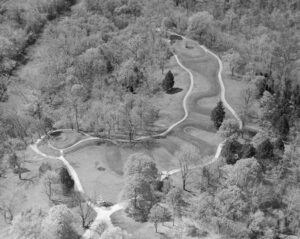
One of North America’s most spectacular effigy mounds, Serpent Mound is a gigantic earthen sculpture representative of a snake. Built on a spur of rock overlooking Ohio Brush Creek around 1000 A.D. by the Fort Ancient culture, the earthwork was likely a place of ceremonies dedicated to a powerful serpent spirit. The site is located on the edge of a massive crater, possibly formed by the impact of a small asteroid around 300 million years ago. Frederic Ward Putnam studied Serpent Mound between 1886 and 1889. Due largely to his efforts, Serpent Mound became the first privately funded archaeological preserve in the United States.
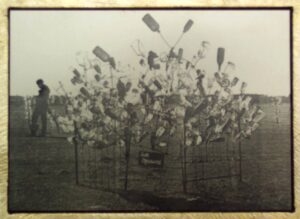
A direct descendent of original settlers in Jackson Township, Winter Zellar (Zero) Swartsel was born in 1876. Throughout his life he was a natural born showman, teacher, eccentric, anarchist, and “possibly the grandfather of American Pop Culture.” At a young age and tired of the routines of Farmersville, he declared that, “He would live by his wits while his brothers lived by the sweat of their brows.” He and a friend bicycled first to New York City and then turned around to head west and eventually the world. Later his home would overflow with items collected while traveling the world. Outside was a similar story. While chiding the American people for their wastefulness and abusing their environment, his 22 acres of farmland became his artist’s canvas filled with the thousands of items he collected from the “wasteful.” [continued on other side]
For more than 10,000 years, Flint Ridge was one of the most important flint quarries in eastern North America. The flint formed at the bottom of a shallow ocean 300 million years ago. The softer rocks surrounding the flint have washed away, leaving the hard flint exposed near the surface. Prehistoric people came here to quarry the flint, which they crafted into a variety of stone tools. Hundreds of quarry pits and workshops are scattered for miles along this ridge. The beautiful rainbow-colored flint was especially prized by the Hopewell culture that built the nearby Newark Earthworks. Artifacts crafted from Flint Ridge flint may be found throughout eastern North America. In more recent times, local industries quarried the flint for use as grindstones.
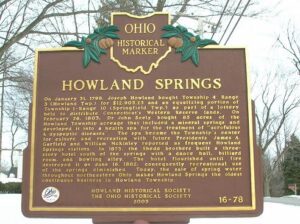
On January 31, 1798, Joseph Howland bought Township 4-Range 3 (Howland Twp.) for $12, 903.23 and an equalizing portion of Township 1-Range 10 (Springfield Twp.) as part of a lottery held to distribute Connecticut’s Western Reserve lands. On February 26, 1803, Dr. John Seely bought 85 acres of the Howland Township acreage that included a mineral springs and developed it into a health spa for the treatment of “scrofulous & dyspeptic diseases”. The spa became the Township’s center for culture and recreation with future Presidents James A. Garfield and William McKinley reported as frequent Howland Springs visitors. In 1873, the Shedd brothers built a three-story hotel south of the springs with a dance hall, billiard room, and bowling alley. The hotel flourished until fire destroyed it on June 16, 1882; consequently recreational use of the springs diminished. Today, the sale of spring water throughout northeastern Ohio makes Howland Springs the oldest continuous business in Howland Township.
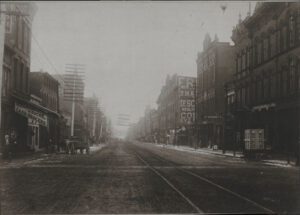
The center of African-American culture in Akron during the mid-20th century, Howard Street was home to many of the city’s black-owned business and entertainment establishments, and provided an atmosphere in which minority-owned businesses could thrive. Attracted to the vitality of the neighborhood, entrepreneur George Mathews (1887-1982) established a barbershop here in 1920 and in 1925 opened the adjoining Mathews Hotel. The hotel quickly became the anchor of the Howard Street district. Mathews’ success allowed him to endow a scholarship fund at the University of Akron in 1964.
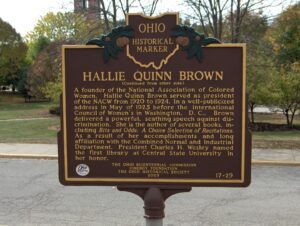
Hallie Quinn Brown (c. 1850) was born in Pittsburgh, Pennsylvania to former slaves. She and her family moved to Wilberforce, Ohio in 1870, where she received a Bachelor of Science degree from Wilberforce University in 1873. Brown taught school in the South until her appointment as professor of elocution at Wilberforce University in 1893. A gifted elocutionist and author, Brown received national and international acclaim not only for her recitals and written works, but also for her passionate belief in civil rights and African American culture. (Continued on other side)