George Bellows (1882-1925) is widely recognized as one of America’s premier artists. His vivid portrayals of modern urban life have become indelible icons of American art. Born and reared in Columbus, he retained close ties here throughout his life. Bellows gained fame while a young artist in New York, becoming a key figure among a group of artists nicknamed the “Ashcan School” because of their preference for commonplace subjects painted in dark colors. Bellows also excelled at printmaking, and it was largely through his efforts that lithography came to be accepted as a fine art in America. Bellow’s career was unexpectedly cut short by his death from complications following an appendectomy at the age of forty-two.
Langston Hughes Branch Library, 10200 Superior Avenue
Cleveland
, OH
One of the most recognized figures of the Harlem Renaissance, Langston Hughes was born in Joplin, Missouri on February 1, 1902 and moved to Cleveland by the time he was in high school. An avid traveler, he credited his years at Central High School for the inspiration to write and dream. The consummate Renaissance man, Hughes incorporated his love of theater, music, poetry, and literature in his writings. As an activist, he wrote about the racial politics and culture of his day. He was awarded the Spingarn Medal by the NAACP. He published over 40 books, for children and adults. Known as the “Poet Laureate of the Negro People,” Hughes most famous poem is “The Negro Speaks of Rivers.” Langston died on May 22, 1967, and his remains were interred beneath the commemoratively designed “I’ve Known Rivers” tile floor in the Schomburg Center for Research in Black Culture in Harlem.
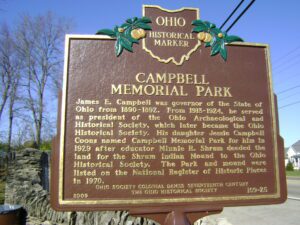
James E. Campbell was governor of the State of Ohio from 1890-1892. From 1913-1924, he served as president of the Ohio Archaeological and Historical Society, which later became the Ohio Historical Society. His daughter Jessie Campbell Coons named Campbell Memorial Park for him in 1929 after educator Minnie R. Shrum deeded the land for the Shrum Indian Mound to the Ohio Historical Society. The park and mound were listed on the National Register of Historic Places in 1970.
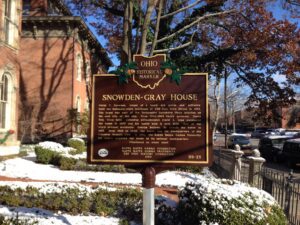
Philip T. Snowden, owner of a fancy dry goods and millinery, built the Italianate-style residence at 530 East Town Street in 1852. The house was part of the fashionable University Place addition on the east side of the city. From 1862-1864 Ohio’s governor, David Tod, lived here. Columbus philanthropist David S. Gray purchased the house in 1870 and his family held it until 1922. One of the city’s premier architects, George Bellows, Sr. rebuilt the house in 1872. From 1923 to 1940, the house was the headquarters of the Columbus Women’s Club. In 1951, the Kappa Kappa Gamma fraternity for women acquired the house as its national headquarters. (Continued on other side)
This block of W. 29th Street was home to Cleveland’s vibrant LGBT community and central to the development of the modern LGBT civil rights movement. In 1988, the Striebinger Building, at 1418 W. 29th, housed Cleveland’s Lesbian-Gay Community Services Center, which addressed the needs of the LGBT community. Cleveland’s first Pride Festival since the mid-1970s was held on the block in 1989, and in 1990 Cleveland’s first Pride Parade culminated here. During the HIV/AIDS crisis, The Living Room and ACT UP were located in the Striebinger Building and gave support to those with HIV/AIDs and provided a platform for political activism. It was on this block where many people could find their voices to “come-out” and advocate for their rights and their humanity. (Continued on other side)
Acquiring the African American Cultural Garden was a struggle for equitable access to public space in Cleveland during the Civil Rights era. Between 1961 and 1977, Black Clevelanders sought space to celebrate Black pride and culture within Cleveland’s Cultural Gardens. Activists lobbied the Cultural Garden Federation, City Council, and engaged the Black community to acquire a garden space. When the African American Cultural Garden was dedicated on October 23, 1977, dignitaries from Ghana, Togo, Kenya, and Tanzania, were joined by national, state, and city officials to celebrate the first garden space assigned to a community of color.