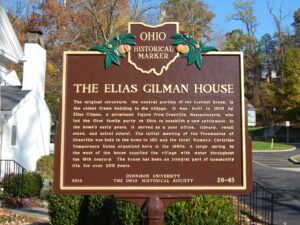
The original structure, the central portion of the current house, is the oldest frame building in the village. It was built in 1808 by Elias Gilman, a prominent figure from Granville Massachusetts, who led the first family party to Ohio to establish a new settlement . In the home’s early years, it served as a post office, library, retail store, and select school. The initial meeting of the Freemasons of Granville was held in the home in 1811 and the local Women’s Christian Temperance Union organized here in the 1880s . A large spring to the west of the house supplied the village with water throughout the 19th century . The house has been an integral part of community life for over 200 years.
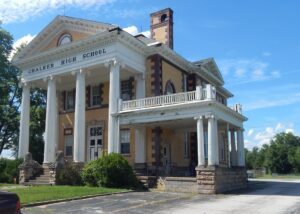
Southington native Newton Chalker built, furnished, and donated Chalker High School to his community in 1907. Chalker was born in 1842 in Southington Township and lived there until adulthood. He later built a prosperous law and real estate practice in Akron. Chalker’s dedication to improve educational opportunities in the township likely originated with his personal struggle to complete high school, which was repeatedly interrupted by financial concerns and family obligations. The Chalker High School building was designed in the Neo-Classical Revival architectural style which was favored for public buildings, churches and schools early in the twentieth century. The building exhibits Classical influences through the use of fluted columns that support a pedimented gable, resembling a Greek temple. Chalker High School and the Civil War Monument were listed in the National Register of Historic Places in 2010. (Continued on other side)
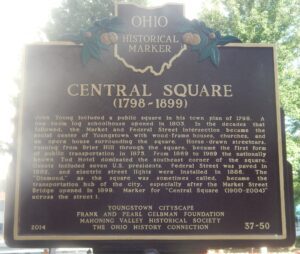
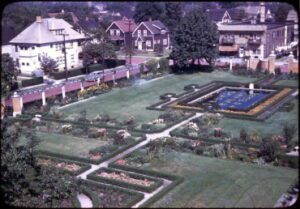
John Young included a public square in his town plan of 1798. A one-room log schoolhouse opened in 1803. In the decades that followed, the Market and Federal Street intersection became the social center of Youngstown with wood-frame houses, churches, and an opera house surrounding the square. Horse-drawn streetcars, running from Brier Hill through the square, became the first form of public transportation in 1875. From 1869 to 1969 the nationally known Tod Hotel dominated the southeast corner of the square. Guests included seven U.S. presidents. Federal Street was paved in 1882, and electric street lights were installed in 1886. The “Diamond,” as the square was sometimes called, became the transportation hub of the city, especially after the Market Street Bridge opened in 1899. Marker for “Central Square (1900-2004)” across the street.
The Village of Collinwood was originally a part of Euclid Township of the Western Reserve and named after the death of railroad chief engineer Charles Collins in 1876. Originally known as “Frogsville,” the population of Collinwood dramatically increased in the 1870s, due partly to repair roundhouses of the Lake Shore & Michigan Southern Railroad. By 1901, the Village has grown to 7,500, and as a result, the schoolhouse, which once housed 200 students and four classrooms, had been enlarged twice to house 350 students in eight classrooms. Constructed in 1901, the Lakeview School was the site of a tragedy that reverberated across the nation and around the world. (Continued on other side)
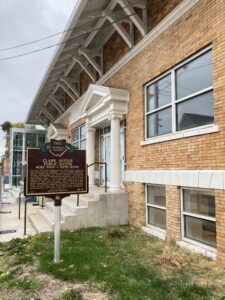
In the early 20th century, the City of Cleveland began opening public bath houses as a way to address the unsanitary living conditions of its overcrowded immigrant neighborhoods. Opened in January 1908, the Clark Avenue Bath House was Cleveland’s third public bath house. It cost $32,000 to build and was designed by prominent Cleveland architect Charles F. Schweinfurth. The semi-Colonial building featured heavy Ionic columns that framed the two entrances marked for “Men” and “Women” overhead. Clark Avenue Bath House had 35 private shower “cabinets,” two group showers, locker rooms, and a gymnasium with a spectator gallery. By 1921, seven such bath houses served the city. Today, five remain and four continue to offer public services to their neighborhoods as Neighborhood Resource and Recreation Centers.